Lecture Four: Receptor Activation
This lecture discusses the initial step of cellular communication: receptor activation. The ligand is the first messenger and it complementary binds with the receptor. Receptors are cellular proteins found on the cell surface and can also be found inside the cell (nucleus and cytoplasm). Factors such as the binding rate, position, and energy produced via sources such as adenosine triphosphate (ATP) and guanosine triphosphate (GTP) are commented on. Several different types of receptors and ligands with respective examples of each form are revealed in the lecture. Amongst the ligands analyzed in the lecture are hydrophilic (water-loving) ligands e.g. proteins and small molecules. Hydrophobic (water-disliking) ligands e.g. fats such as male hormones/androgens (testosterone), female hormones (oestrogen) vitamins (A, D, E, and K), thyroid, cholesterol, and oestrogen. Nitric oxide (NO) gas is another example of a ligand that can diffuse across the plasma membrane and interact with smooth muscle receptors in the blood vessels.
Types Of Receptors
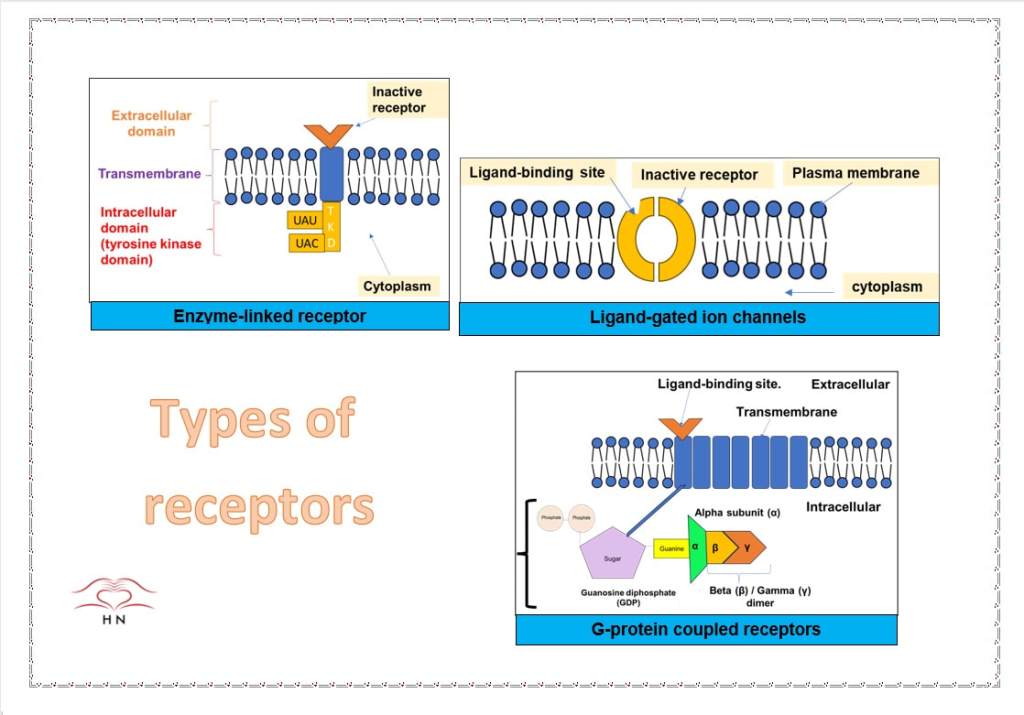
The image presents several types of receptors: Ligand-gated ion channels, enzyme-linked receptors and G-coupled protein receptors. The shape of the receptor proteins varies to allow to bind to its specific ligand which could be a protein or a steroid (fat/lipid). Enzyme-coupled receptors are found commonly in plants and animals. It is divided into three sections: extracellular (orange), intracellular (red), and transmembrane alpha helix (blue-purple) which binds the intracellular and extracellular domains together. A common example is the tyrosine kinase receptor. Ligand-gated ion channels are protein channels that allow the diffusion of ions across cellular membranes. A common example is in the nerve and muscle cells. G-protein coupled receptors are found on the cell surface and are bound with the G-protein. Hydrophilic ligands such as proteins require cell surface receptors. Hydrophobic ligands e.g. steroids, fat-soluble vitamins, and hormones require carrier proteins to travel through the blood and can diffuse through the plasma membrane interacting with receptors inside the cells. A larger size of this image can be found in the resource list.
Resource List For Lecture Four
Youtube Video
Glossary
Quiz
PDF format of the images
 The Farah Saeed Project
Leave a comment