Day Six
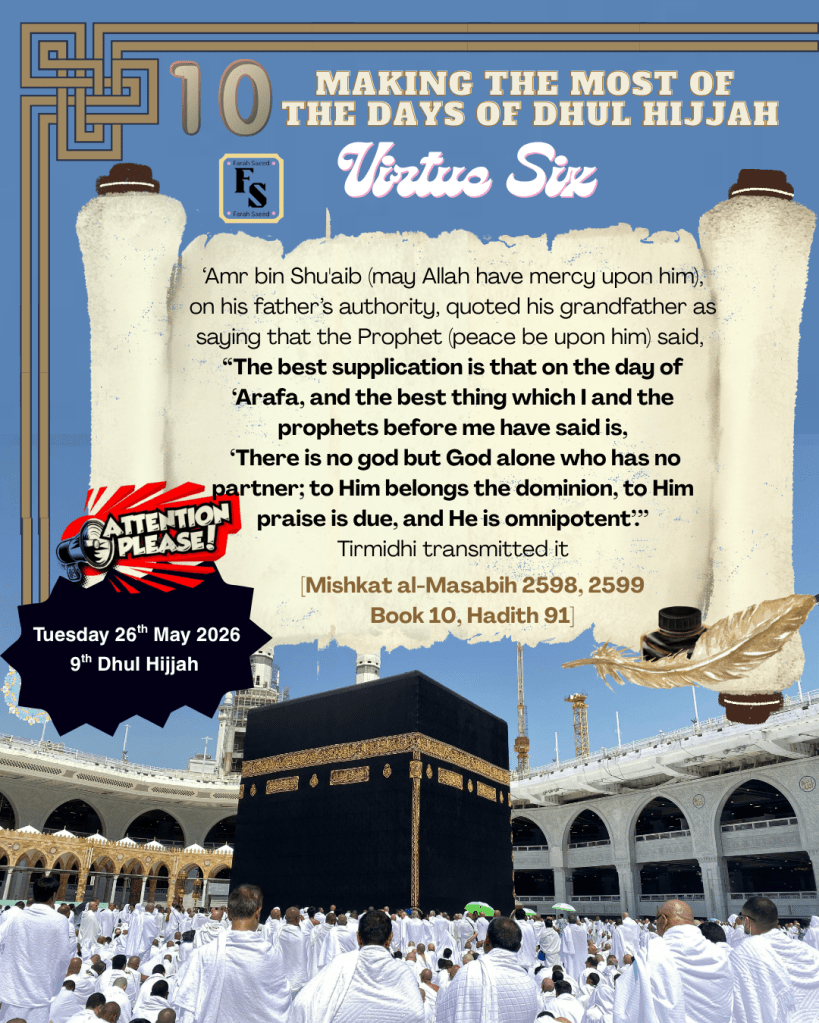
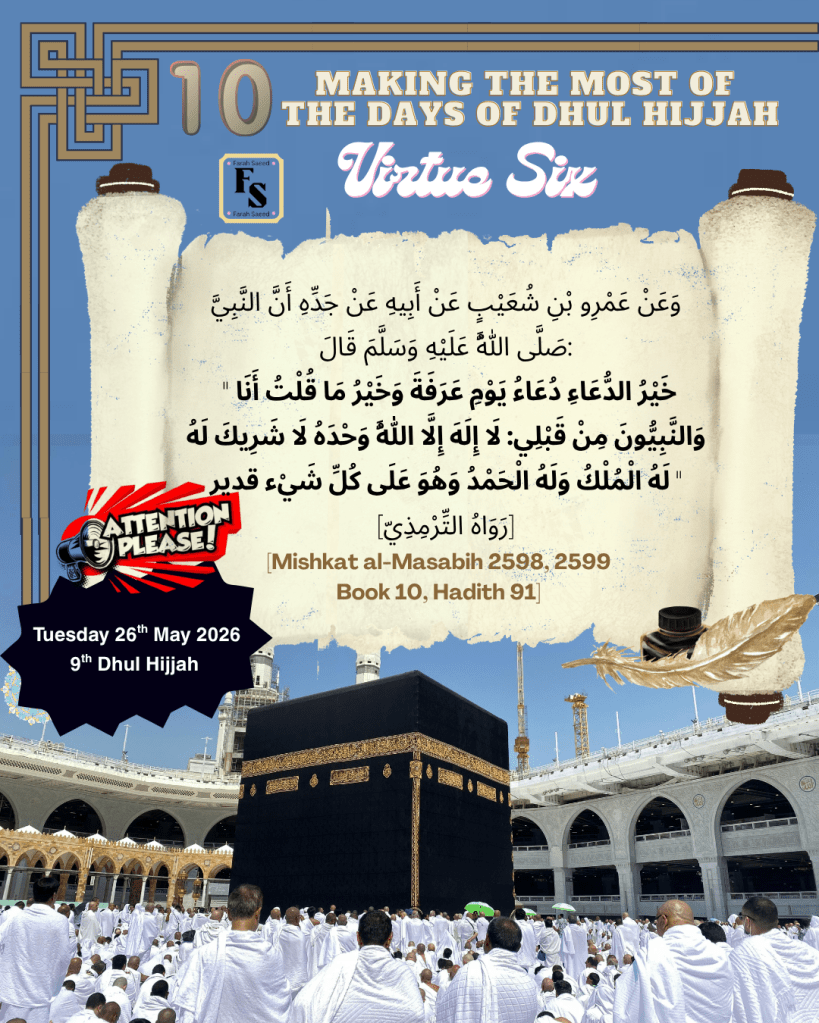
The hadith emphasises that on the Day of Arafah, when many of the Hajj pilgrims stand on the plains of Arafah and recite this dua, it is highly significant.
“Laa ilaaha ill-allaahu, waḥdahu laa shareeka lah, lahul-mulku wa lahul-ḥamdu, wa huwa ‛alaa kulli shay’in qadeer”
There is no God but God alone, who has no partner; to Him belongs the dominion, to Him praise is due, and He is the Omnipotent.
What does this dua highlight for Muslims?
Aqeedah, meaning belief, forms the central foundation for Muslims. The word derives from ‘aqada,’ meaning ‘to tie’ or ‘to bind.’ Aqeedah connects Muslims to their faith and shapes all outward worship, such as prayer, fasting, and dua, guiding thoughts and actions. Without proper Aqeedah, actions lose meaning.
So what is the muslim belief regarding Allah (The Most High)?
Muslims believe that Allah is One who is only worthy of worship, who has no partner, who knows everything, and nothing is hidden from Him; He is the All-Powerful. He has created the entire Universe, and this is his dominion where everything created is by His commands. He provides rizq (blessings and sustenance). He neither sleeps, eats, nor drinks. He has no relative, and all nature depends on Him, but He depends on none. He appointed the angels to supervise and give special tasks, whereas the Prophets were sent to guide humanity to teach good and avoid evil. He is the omniopotent (Alqadeer).
When reflecting on this dua, the human mind can acknowledge His oneness.
When discussing the Aqeedah and understanding one of Allah’s names, Al-Qader (The Omnipotent), one can reflect on the Sifaat al Kamaliyah (Divine Attributes or Attributes of Perfection), which consists of:
Wahdat (Oneness), Qidam/Wujoob ul Wujood (Beginninglessly Eternal), Hayat (life), ‘ilm (Divine Knowledge), Sam’e (Divine Hearing), Kalaam (Divine Speech), Irada (Divine will), Qudrat (Divine Power), Basar (Divine Vision), and Khalq (Creating) and Takweer (Bringing into Existence).
Wahdat is the Unique Oneness of Allah.
Qidam/Wujoob ul Wujood refers to the Beginningless Eternity of Allah, whose non-existence is impossible.
Hayat indicates Allah, who is Ever-Living.
Ilm is that Allah’s Knowledge is Absolute and knows everything before it comes into existence and after it has gone.
Sam’e highlights Allah, who is able to hear everything without any human ears.
Kalaam elaborates that Allah, who does not have a tongue like human nature and is not dependent by any means.
Irada refers to Free Will. He has created everything by His Will, and He can destroy anything by His Will. Everything happens by the Will of Allah, and He has the Supreme Power to do everything. Nothing is difficult or impossible.
Qudrat refers to power. Allah has the power to create and sustain. Destroy and resurrect the universe.
Basar refers to Allah (The Most High), who has the ability to see. He neither has eyes nor is light or darkness affected by this.
Khalq refers to creation. He has created everything within us, around us, and on us.
Takweer. He can bring into existence, and He is the Creator of the entire universe (Mukawwir).
Therefore, when Muslims recite the following, it is with firm belief:
There is no God but God alone, who has no partner; to Him belongs the dominion, to Him praise is due, and He is the omnipotent.
References
NooreSunnat (2026) ‘Aqeedah: What Every Muslim Believes’ Available at: https://www.nooresunnat.com/learn/aqeedah (Accessed: 23rd May 2026)
Day Seven
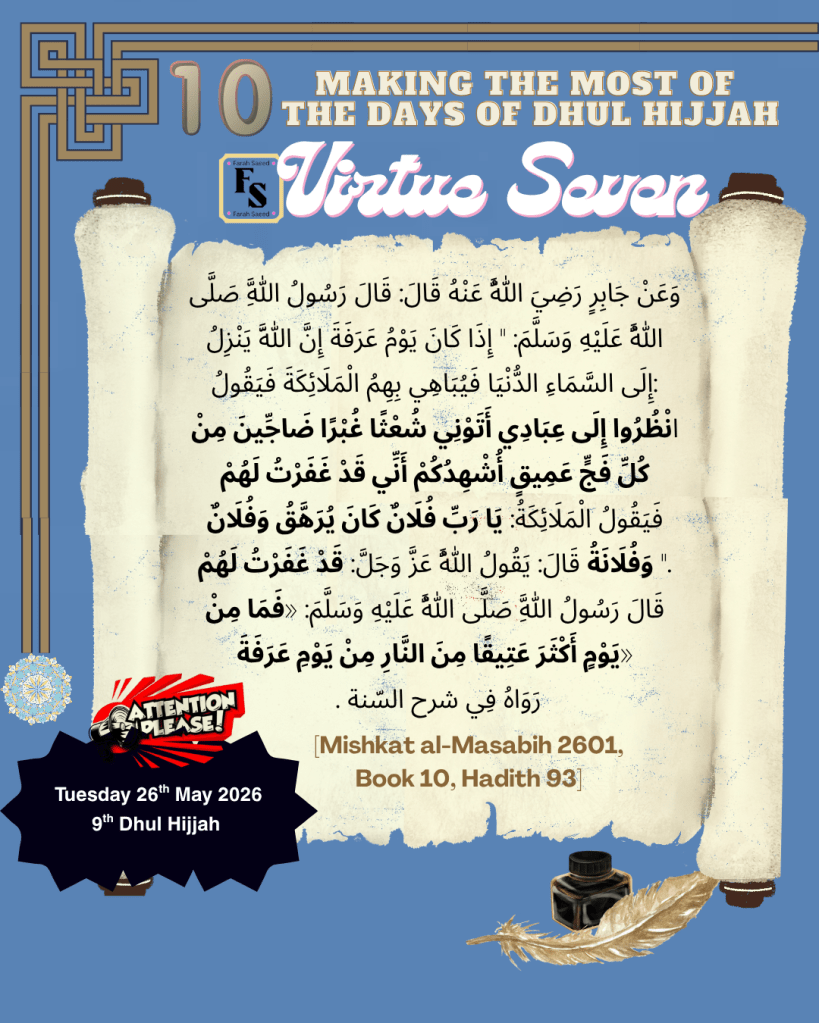
Dear brothers and sisters in faith and humanity,
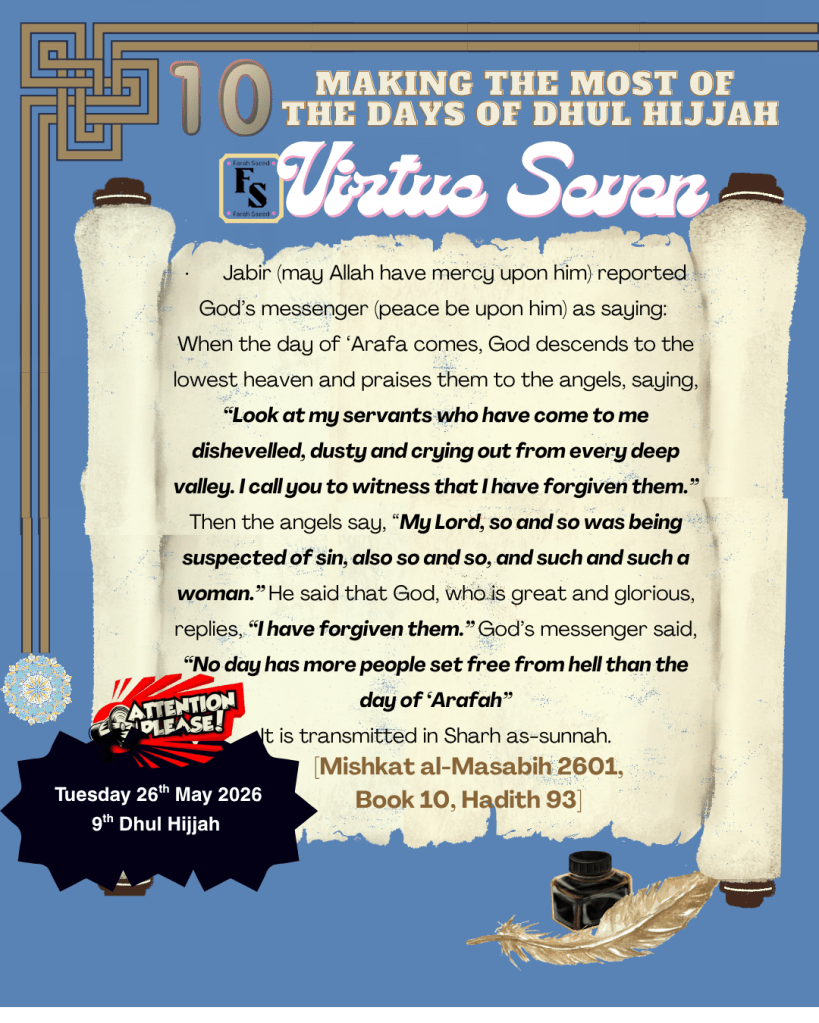
This hadith reflects on Allah’s mercy and compassion for the Hajj pilgrims who are making Dhikr (Remembrance of Allah) and Dua (supplication) towards Allah (The Most High), asking for His forgiveness. To indicate this, Allah (The Most High) presents three adjectives in an alliterative manner: ‘dishevelled, dusty, and deep.’ These words carry significant spiritual meaning. ‘Dishevelled’ describes the pilgrims’ unkempt appearance, showing that they have abandoned concern for worldly beauty in favor of wholehearted devotion. ‘Dusty’ refers to their physical journey and struggle, symbolizing enduring hardship and humility for the sake of worship. ‘Deep’ refers not only to their outward state but also to the intensity and sincerity of their inner humility and devotion as they beseech Allah. These states are honored because they signify a genuine detachment from ego and status, highlighting the sincerity, vulnerability, and longing of those who sincerely seek Allah’s forgiveness. The Muslims came from every mountain pass, hoping for His Mercy, whether through sin or being suspected. They have only heard of descriptions of the Hellfire in the Glorious Quran and its contrast with Heaven; they have not seen His punishment, but they yearn to be saved before it’s too late.
Here, Allah the Most High described their emotive state as crying.
This is the state that we should all be in, whether at Hajj or not. To seek His mercy. To seek repentance from Him. Practically, we can cultivate humility and repentance in our daily lives by consistently engaging in Dhikr (remembrance of Allah), regularly asking for forgiveness in our prayers, and reflecting on our actions each day. Approaching our daily interactions with kindness, being mindful of our shortcomings, and showing gratitude to Allah for His blessings are ways we can nurture humility. Setting aside time to sincerely make dua for forgiveness, seeking pardon before sleep, and admitting our mistakes to those we may have wronged are acts that draw us closer to sincere repentance. By implementing these practices, we can embody the spirit of humility and repentance not only during Hajj but throughout our lives.
Al Waasi’ (the Vast One) is one of the attributes of Allah (The Most High), who encompasses all with His greatness, generosity, and blessings, and grants mercy to everyone. He rejoices so much that He calls His angels to witness this.
In another hadith, the Prophet utilised the same phrases and said:
“Many a person with dishevelled hair and covered with dust is turned away from the doors (whereas) were he to swear by Allah (about something), Allah will fulfil it”.
[Sahih Muslim. Number 2662. Kitaab Al-Bir Was-Silah Wal Aadab]
The respected scholar Imam An-Nawawi (may Allah have mercy upon him said:
This type of person is one whom people drive away from their doors in humiliation, but he is someone who, if he were to swear by Allah about something, Allah would make it happen as an honour for him – by answering his request and safeguarding him from sin regarding his oath. This is due to his great station in the sight of Allah [The Exalted], even though he is someone despised in the sight of the people. It is said that the meaning of [الْقَسَمِ in this hadeeth is (الدُّعَاءُ – supplication) and (إِبْرَارُهُ ) means (إِجَابَتُهُ -the response to the supplication)].
An Excerpt from “Sharh Saheeh Muslim” 15/144’ publisher: Dar Kutub Al-Ilmiyyah’ 1st ed. (1421AH- Year 2000)
Therefore, it highlights that regardless of the piety status of the believer, for he is greater in the sight of Allah, even if they are driven from the doors because Allah is the Most Perfect.
For the Ghafoor (The One who forgives extensively) can cover and forgive sins, who yearn for His mercy to an extent they cannot comprehend.
We ask Allah not to allow us to be deceived by the good opinions people hold about us, as Imam Al-Qahtaanee, may Allah have mercy upon him, said
“And You (Allah) have placed love for me within the hearts….And the affection from You is through mercy and kindness….And you have spread good things about me among the people… And conceal my acts of disobedience from their eyes…And you have made my good mention amongst the people common (or widespread)…until you made them all my brothers….By Allaah, if they knew the repugnance of my secret affairs (or inner self)….The one who meets me would have refused to give me Salaams…And they would have turned away from me and loathed my companionship…And I would have brought disgrace upon myself after being honoured…But you conceal my faults and deficiencies…And you dealt with my sins and transgression with forbearance (i.e., allowed me to repent)…So all praise and commendations- by way of my thoughts, limbs, and tongue- are Yours….”
[Refer to the first lines of Al-Qahtaanee’s Nuniyyah]
Overall:
Allah’s mercy is emphasized for humble, repentant pilgrims.
Humility and repentance are valued states in Islam.
Allah’s attribute Al Waasi’ highlights His vast mercy.
True worth is with Allah, not people.
Allah forgives and conceals faults out of mercy.
Piety may be hidden from public view.
References
Dr Saalim Al-Azhari (2026) Day of Arafah in the Qur’an and Hadith. Available at: https://www.islamic-relief.org.uk/giving/islamic-giving/qurbani/dhul-hijjah/the-day-of-arafah/day-of-arafah-in-the-quran-and-hadith/ (Accessed: 24th May 2026)
Jallow, A. (2025) Dishevelled, Dusty and Turned Away From Doors. Available at: https://salafidawahmanchester.com/2025/12/28/dishevelled-dusty-and-turned-away-from-doors/ (Accessed:: 24th May 2026)
Shaykh Muhammad bin AbdulWahhaab (2018) The Ninety-Nine names of Allaah سبحانه وتعالى. Available at: https://abdurrahman.org/wp-content/uploads/2018/01/the-99-names-of-allaah-dawud-burbank.pdf (Accessed: 24th May 2026)
Day Eight
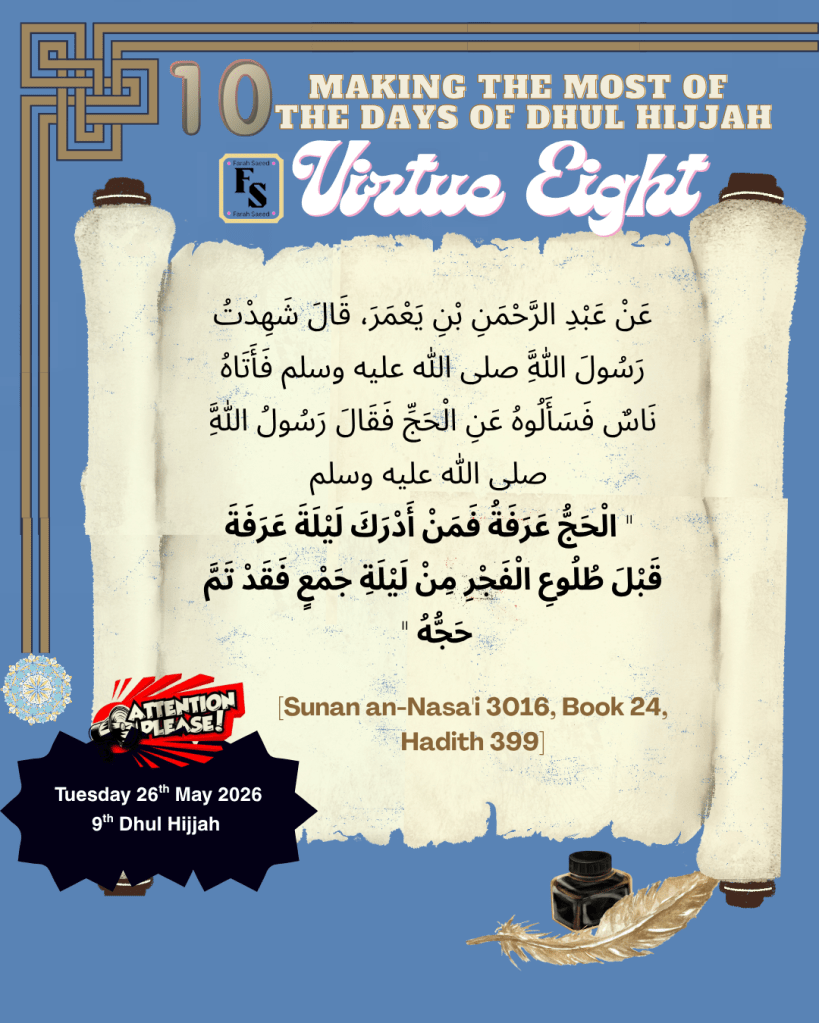
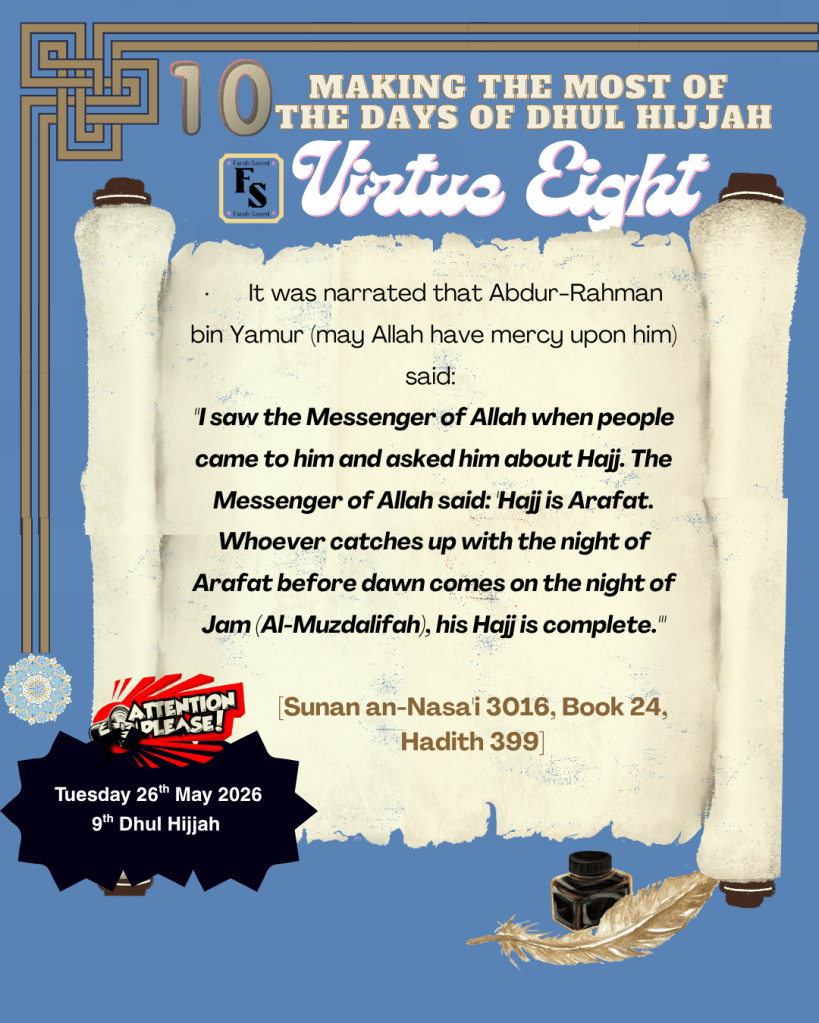
Good afternoon, brothers and sisters in faith and humanity.
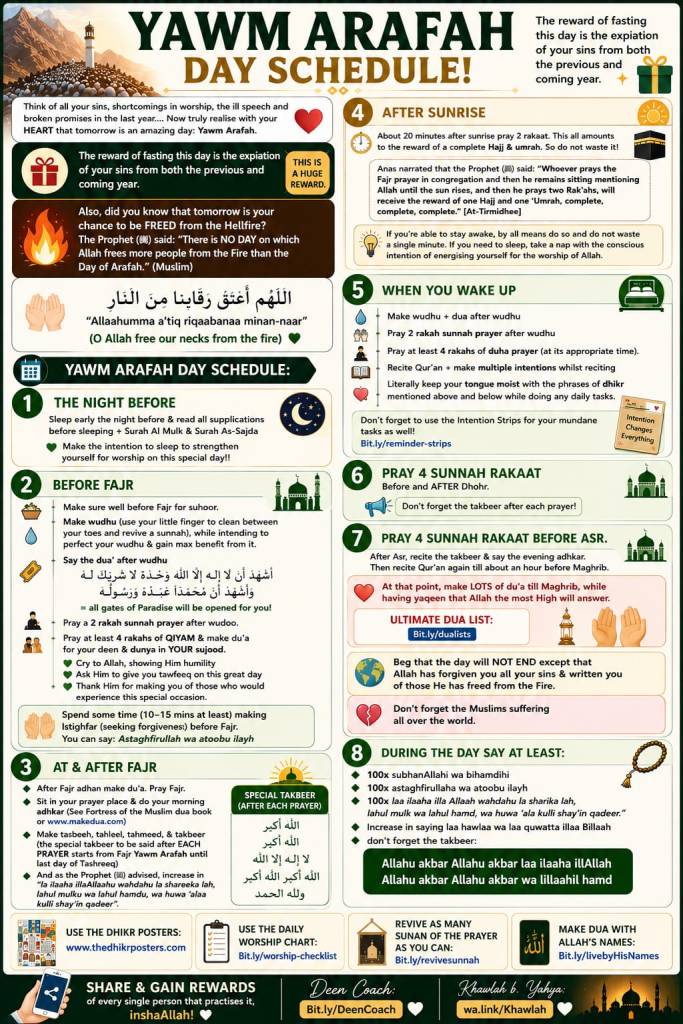
Hajj is Arafat.
This is the most significant part of Hajj (pilgrimage) and a physical and spiritual preparation for the Day of Judgment. Standing at Arafah is an experience that encourages deep self-reflection, humility, and repentance. Pilgrims are reminded of the gathering of all humanity on the Day of Judgment, standing together in need of Allah’s mercy and forgiveness. This time at Arafah allows each person to purify the heart, seek forgiveness for past actions, and strengthen their connection with Allah. By reflecting on their deeds and asking for forgiveness, believers are spiritually renewed and prepared to face the ultimate accountability before their Creator.
It is a moment where every soul of every Hajj pilgrim stands bare before God seeking His mercy.
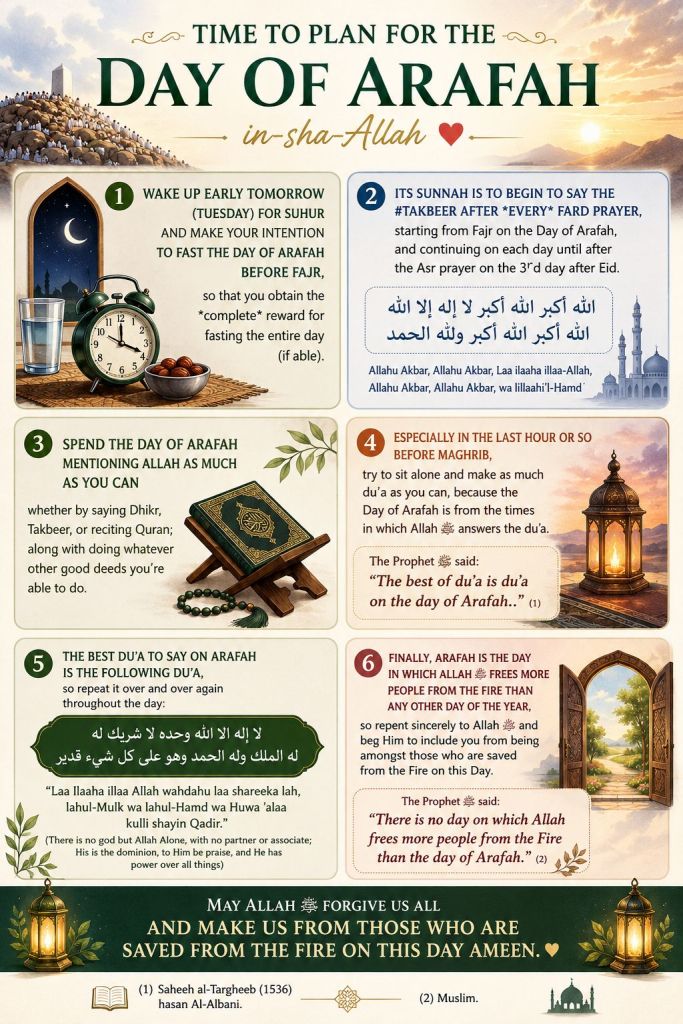
It is a moment where people who are not performing Hajj are also seeking His Mercy by performing other actions of worship. For those who are not at Hajj, several recommended actions on the Day of Arafah are especially virtuous:
– Fasting on the Day of Arafah, which is highly encouraged and expiates the sins of the previous and coming year.
– Engaging in abundant dhikr (remembrance of Allah), such as saying ‘La ilaha illa Allah’ and ‘SubhanAllah.’
– Making sincere and heartfelt dua, especially in the last hour before Maghrib.
– Giving charity to those in need.
– Reciting the Quran, reflecting on its meanings, and seeking forgiveness.
These acts allow non-pilgrims to participate in the blessings of this sacred day and draw closer to Allah.
Missing this action of worship invalidates the entire Hajj. On the other hand, being present before dawn completes it.
Allah states in the Glorious Quran:
“There is no blame upon you for seeking bounty1 from your Lord [during ḥajj]. But when you depart from ʿArafāt, remember Allāh at al-Mashʿar al-Ḥarām.2 And remember Him, as He has guided you, for indeed, you were before that among those astray.“
[The Glorious Quran, Surah Al Baqarah (The Cow), 2:198]
Respected scholars have stated that Allah (the Most High) has specifically advised seeking His Remembrance at Arafah. This distinguishes what pilgrims used to do in their rituals and lineages before.
On this day, our Beloved Prophet (peace be upon him), known for wisdom and uprightness, performed the Farewell pilgrimage. This marked the spiritual peak of the Hajj.
“This day I have perfected for you your religion and completed My favor upon you.”
[The Glorious Quran, Surah Al-Ma’idah (The Table)]
This event follows the month of Dhul Qaidah 10AH when the Prophet (peace be upon him) went on a journey to Makkah to perform Hajj. It was considered the Farewell Hajj, where more than one hundred thousand Muslims performed Hajj under the guidance of the Prophet (peace be upon him).
Many of his companions accompanied him with 100 camels. The caravan arrived in Al Madinah, Makkah, on Sunday, 4th Dhul Hijjah. The cousin and companion of the Prophet (peace be upon him) travelled from Yemen and joined the Prophet (peace be upon him).
On this occasion, he taught his companions how to perform Hajj and delivered an address at Mount Arafat.
At first, the Prophet (peace be upon him) glorified and praised Allah (The Most High):
“ O, people! Behold, I am not sure of meeting you here next year or after that. O people! Your blood and your property are inviolable like the sacredness of this day in this month in this city of yours. Do not do wrong to others lest you be wronged. The Devil has lost hope of being worshipped by those who pray. However, he will be followed in lesser matters. Therefore, you should shun his company.
O people! You have rights on your womenfolk, and they on you. Be good to them. Behold! Whoever holds anything in trust should return it to the person who has entrusted him with it. I leave you two things. One is the Book of Allah and the second is the Sunnah of His Messenger. You will not go astray if I have conveyed the Message of Allah and fulfilled the mission?”
“We testify that you have conveyed the Message of Allah,” the companions replied with one voice.
The Prophet (peace be upon him) said, “O Allah! Be Witness.”
During Hajj, some of the people who were with Ali (may Allah have mercy upon him) complained to the Prophet (peace be upon him) due to misunderstandings.
The Prophet (peace be upon him) said when addressing the Companions at Ghadir Khum, he admired Ali and said:
“The one who is my friend is the friend of Ali, and the one who is an enemy of Ali is my enemy.”
After this, Umar (peace be upon him) congratulated Ali and said:
“From this day, you are a very special friend of mine.” The Prophet (peace be upon him) then returned to Al Madinah.
However, despite these amazing events, as he returned to Al-Madinah, a sad event occurred: his son Ibrahim (may Allah have mercy upon him) passed away.
At Hajj and on the Day of Arafah, people unite, all dressed in white, regardless of status, for one purpose: submission to Allah.
Therefore, we need to make the most of this day by waking up early for Suhoor and making the intention to fast Day of Arafah and performing a range of actions of worship like Dhikr (Remembrance of Allah), praying, reciting the Quran, giving in charity, and making dua, especially in the last hour before Maghrib.
لا اله الا الله وحده لا شريك له
له الملك وله الحمد وهو على كل شيء قدير
“La ilaha illa Allah wahdahu la shareeka lah, lahul-Mulk wa lahul-Hamd wa Huwa ‘alaa kulli shayin Qadir.”
(There is no god but Allah Alone, with no partner or associate; His is the dominion, to Him be praise, and He has power over all things).
Key Points
Arafah is the spiritual heart of Hajj and essential for its validity.
The Prophet’s Farewell Pilgrimage emphasized unity, justice, and remembrance of Allah.
Non-pilgrims can also gain immense reward through fasting, prayer, and dhikr on Arafah.
References
Akbar Shah Najeebabadi (2000). The History of Islam (Volume One). Riyadh: Darussalam International Publishers and Distributors.
Day Nine
Dear brothers and sisters in faith and humanity,
From sunrise, pilgrims journey from the tent city of Mina to the plains of Arafah, climbing Jabal Rahmah (Mountain of Mercy), seeking mercy and blessings.
They may stop prior to this and listen to the Khutbah (sermon) at Masjid Al-Namirah. A masjid is a building where Muslims pray their daily prayers. However, Masjid Al-Namirah is an exception, where it only opens during Hajj (pilgrimage).
At Arafah, pilgrims chant the Takbeer (God is great), make dua facing the Qibla, and seek forgiveness as they stand in prayer (Wuqoof) until sunset. The Qibla is the direction of the House of Allah (Kaabah) present in the Masjid Al-Haram (The Sacred Mosque) in Makkah. While it is recommended for non-pilgrims to fast on the Day of Arafah, the pilgrims themselves do not fast, focusing instead on their acts of worship at Arafah.
Why?
It is a recommended Sunnah to fast on the Day of Arafah for non-pilgrims due to its virtues of expiation of sins of the past year and the previous year. Sunnah is the teachings, actions of Prophet Muhammad (peace be upon him) as a practical guide. On the other hand, Islam teaches mercy due to the strenuous exercise from walking to different sites of Hajj, devotion of worship, and immense effort performed by the Hajj pilgrims. It is not Sunnah for Hajj pilgrims to fast to build their strength.
They pray two of the five daily prayers together: Dhuhr and Asr.
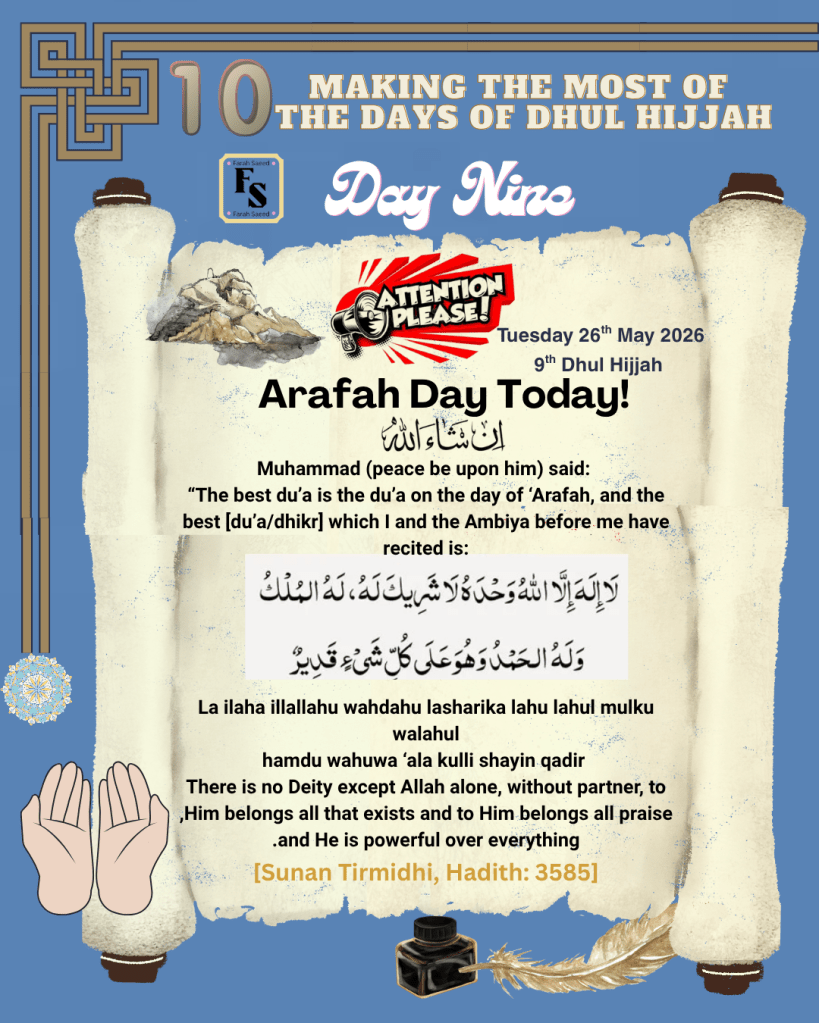
A gentle reminder from our reflection of this dhikr a few days ago, that reciting this remembrance of Allah (Dhikr) is a declaration of Tawheed. Tawheed is a firm belief in the oneness of Allah/God (monotheism). Reciting this dhikr is a reminder that this whole universe belongs to Allah and He alone has the Perfection and the Power, and He alone deserves to be worshipped. I encourage you to make this dhikr a part of your daily routine, so its message remains alive in your heart and mind. By doing so, you will build a strong foundation of faith and allow spiritual growth to blossom with every remembrance.
A gentle reminder on this day that Allah (The Most High) descends to the lowest sky and grants forgiveness, immense reward to all who return to Him, renew their sincere commitment.
In another hadith, reciting this Dhikr on a normal day also has a special significance where a hundred sins are removed from our accounts and is a shield of protection from Allah (The Most High).
It was narrated from Abu Hurairah (may Allah have mercy upon him) that the Prophet (peace be upon him) said:
Whoever says:
“La ilaha illal-lah wahdahu la sharika lahu, lahu-l-mulk wa lahul- hamd wa huwa ‘ala kulli shai’in qadir,” one hundred times will get the same reward as given for manumitting ten slaves; and one hundred good deeds will be written in his accounts, and one hundred sins will be deducted from his accounts, and it (his saying) will be a shield for him from Satan on that day till night, and nobody will be able to do a better deed except the one who does more than he.”
[Hadith, Sahih Al-Bukhari, 6403]
So, imagine the impact of reciting this dua on a special day of Arafah, where it expiates ALL sins, not just one hundred, ALL sins from the previous year and the forthcoming year.
Don’t you see the beauty and mercy of Allah (The Most High)?
For those who are not Muslim but are interested in finding out why Muslims do what they do…let me give you an example.
At school, in preparation for an exam, a teacher guides the students using a curriculum provided by the exam board, with the necessary guidance and tips on how to pass it, using previous exam questions from previous years to create a foundation for them.
Now, the student has the choice to listen to this guidance, revise, and practice in order to pass the exam; otherwise, they will fail. They then have a choice to resit the exam, repeat the year, or find alternative routes to reach the goal.
Now, when we apply this to the concept of the purpose of Arafah and Islam itself.
Allah is the teacher; He provides the necessary guidance in order to pass our test, which is the Day of Judgement. The guidance is the Quran, which He wrote and revealed to the Prophet Muhammad (peace be upon him) via Angel Gabriel (Jibreel), peace be upon him, on how to do good and forbid evil. He also provides examples of the tests and trials faced from Prophet Adam (peace be upon him) till the Last Prophet of Allah, Muhammad (peace be upon him).
The teachings and sayings of the Prophet (peace be upon him) are what He has been taught and advised from the One above. So everything goes hand in hand in terms of guidance. However, learning the language of Arabic or reading the English translation is insufficient to understand the wisdom behind Allah’s commands, so this is where Tafseer comes to be important. The Tafseer (exegesis) is an explanation of what Allah (The Most High) means to avoid getting things out of context.
The exam of the Day of Judgement appears once. There is no going back and repeating.
However, because Allah (The Most High) is Most Merciful and His Mercy overcome His wrath.
He provides us with the opportunity to seek forgiveness from Him throughout the year and more so in special time points that hold immense rewards and forgiveness before its too late.
How?
The month of Ramadan (9th lunar month): The Last Ten Nights of Ramadan, seeking the unknown time period of Night of Power that holds 83 years of worship and forgiveness as if we have done it a lifetime!
The month of Dhul Hijjah (12th lunar month): The first ten days of Dhul Hijjah seeking a known time period of Arafah that expiation of sins of the previous year and forthcoming year.
The month of Muharram (1st lunar month): The tenth day of this month is the month of Ashura, whose fasting on this day expiates the sins of the previous year.
The month of Shaban (8th lunar month): The 15th/middle night, Allah forgives all sins.
If you may have noticed, Night of Power is towards the end of Ramadan, in the last ten days, and the Arafat day are towards the end of the best ten days of the year, as if Allah is trying to explain to us that every end has a new beginning. That after hardship, there is ease. After seeking forgiveness, you’re an improved person.
The space of a few months between Ramadan and Dhul Hijjah is an opportunity for us to self-reflect, have we improved after seeking Allah’s forgiveness and repentance in Ramadan? If not, try again? If yes, continue to remain steadfast.
The number ten then appears again, but this time it is not ten days but one day on the tenth day of Muharram. This is the first month, so if one who lost the opportunity at Arafah in the last month of Dhul Hijjah has the opportunity of seeking forgiveness on the tenth day in the subsequent month of Muharram.
Only Allah (The Most High) knows why the number ten is selected in these golden opportunities.
If we fail to make the most of these golden opportunities, we need to wait another year to resit and try again.
However, how many of us guarantee that we will be present?
None.
This is a reality.
This is an eye-opener.
We have no one to blame but ourselves.
The Prophets who were selected and chosen by the Almighty used to make dua and pray when facing any tests in life, and even when having no tests, to glorify Him.
What about us, laymen?
Therefore, Muslims strive to make the most of the opportunity to seek Allah’s mercy and guidance, to cleanse ourselves outwardly and inwardly.
To understand that Allah alone has the Power.
Key Points
The Day of Arafah is a significant time focused on prayer, seeking forgiveness and spiritual renewal in Islam.
Muslims believe in seeking guidance and mercy from Allah through specific rituals and prayers as opportunities for spiritual growth.
The power and rewards of Dhikr and seeking forgiveness.
Islamic practices are compared to preparing for an exam, emphasizing personal responsibility, purpose, structure and opportunity.
Allah’s mercy and opportunities for renewal throughout the Islamic year.
Day Ten: Youm Al Nahr
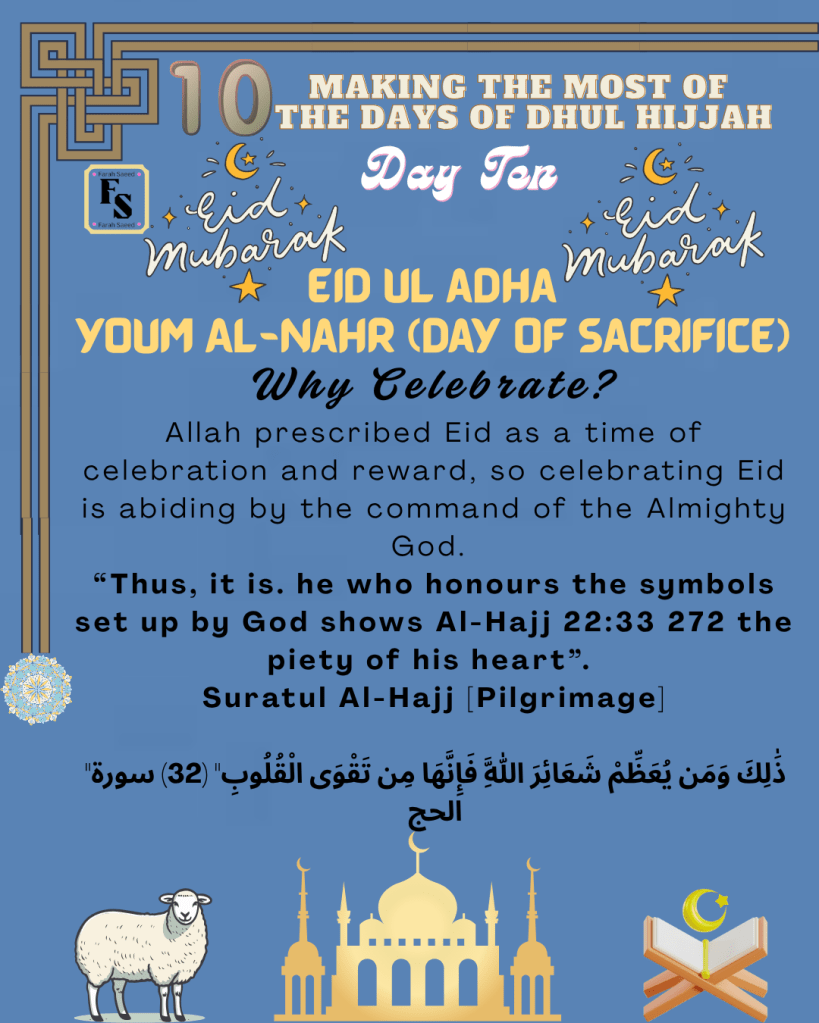
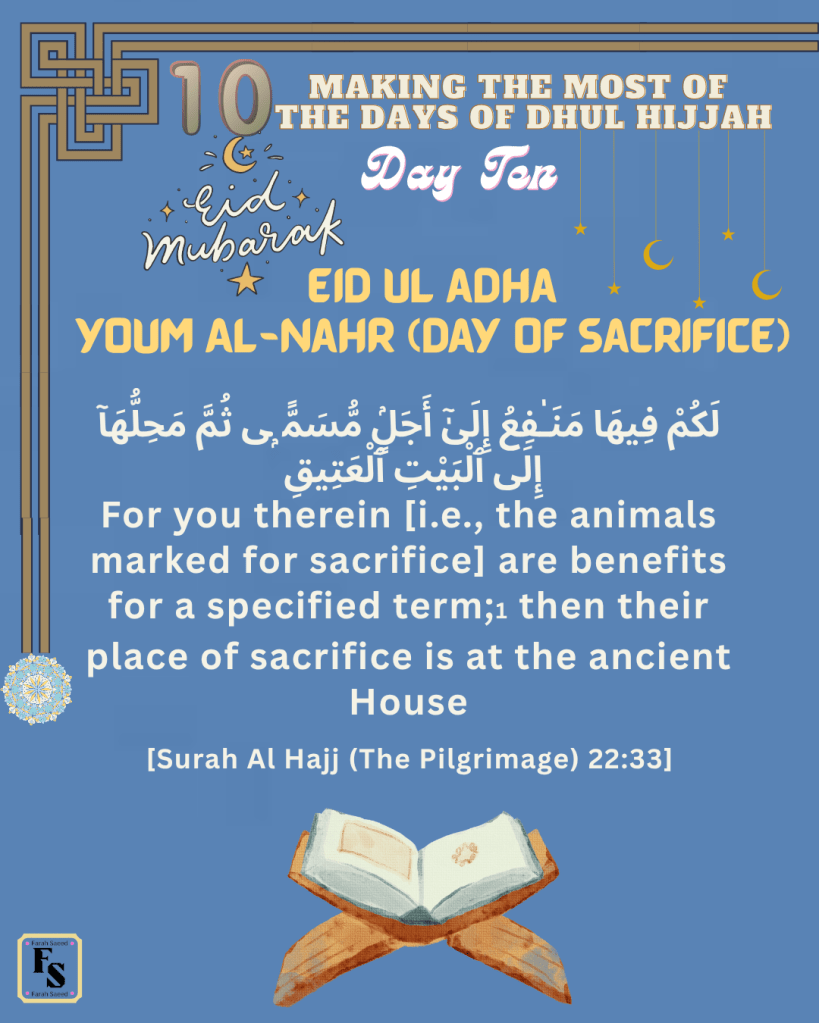
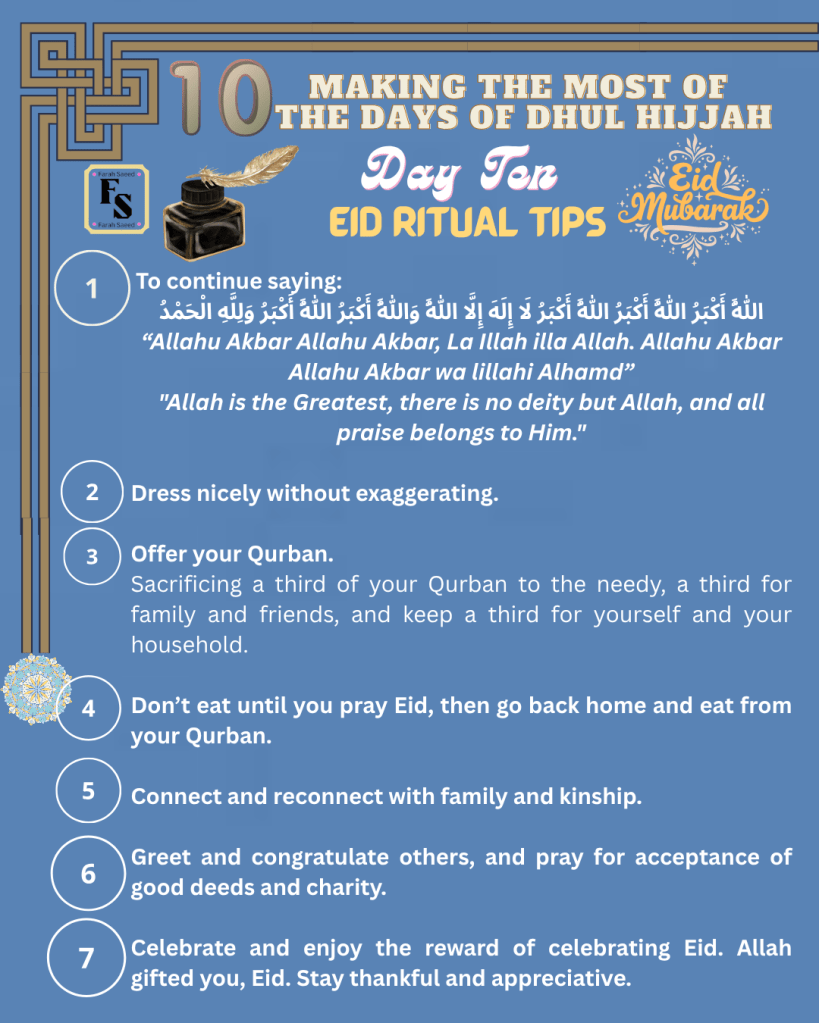
Eid Mubarak, my dear brothers and sisters in faith and humanity,
تَقَبَّلَ اللهُ مِنَّا وَمِنكُم
Taqaballahu minna wa minkum
May Allah accept [good deeds] from you and us too.
Millions of Muslims around the world celebrate Eid al-Adha, a day marked by the attribute of sacrifice. Central to this occasion are the sacrifices of Prophet Ibrahim (peace be upon him), who demonstrated obedience by being willing to sacrifice his son, and of his wife, Hajer (may Allah have mercy upon her), whose perseverance and faith were unwavering. After Prophet Ibrahim left Hajer and her infant son Ismail in the desert, Hajer urgently searched for water, running between the hills of Safa and Marwah. Trusting Allah’s mercy despite exhaustion, her prayers were answered when the angel Jibreel struck the ground, and water sprang forth under Ismail’s feet—the blessed well of ZamZam. Hajer’s determination is commemorated in Hajj and Umrah through the ritual of Saee, where pilgrims walk between Safa and Marwah seven times.
Therefore, due to these sacrifices, Muslims observe several virtues on the tenth day of Dhul-Hijjah, also known as Yaum Al Nahr (The Day of Sacrifice).
Amongst them are the Hajj pilgrims who return to Mina and start throwing pebbles at the stoning pillars at which Prophet Ibrahim (peace be upon him) rejected his temptations to disobey Allah (The Most High).
It is on this day, the tenth of Dhul-Hijjah, that a lamb is sacrificed in celebration that Allah sent a lamb from heaven due to his obedience. Qurbani, otherwise known as Udhiya, is when a livestock animal (lamb, camel, sheep, cow, goat, bull, buffalo, cattle) is sacrificed on the Day of Eid when they have reached the required age and is free from any faults. Qurban is the Arabic word for becoming close, so this is conducted to become closer to Allah (The Most High).
After the sacrifice, the meat from Qurbani is divided into three equal parts: one part is kept for the family, another part is shared with relatives and friends, and the third part is distributed to those in need and the poor. This teaches generosity and ensures that the blessing of this ritual reaches those who are less fortunate.
“Their meat will not reach Allāh, nor will their blood, but what reaches Him is piety from you. Thus have We subjected them to you that you may glorify Allāh for that [to] which He has guided you; and give good tidings to the doers of good.”
[The Glorious Quran, Surah Al-Hajj (The pilgrimage) 22:37]
The sheep can be between 6 months and a year old. A goat is one year. The cow, bull, and buffalo are two years old. Camel is five years old. The sacrifice is normally done straight after the Eid prayer on the 10th Dhul-Hijjah, but some do it on the 11th or 12th until the last of the Days of Tashreeq (13th Dhul-Hijjah) with the intention of offering sacrifice.
Though fasting these nine days is considered a Sunnah. These ten blessed days aim to strengthen our relationship with Allah (The Most High).
Al Nawawi said:
“It is part of the Sunnah to fast the first nine days of the month of Dhul Hijjah.”
[Source: Al-Majmu Sharh Al-Muhadhab 6/386].
It is on this day, the tenth of Dhul-Hijjah, that the Hajj pilgrims shave their heads, remove ihram, make tawaf (circumambulation around the Kaabah), drink ZamZam, pray behind the Station of Ibrahim (Maqam Ibrahim), or anywhere in Masjid Al Haram (Sacred Mosque), and perform Sa’ee (walking between Safa and Marwa) and then return to Mina.
The last ten days are the ability to cleanse our tongues, hearts, minds, and souls from all forms of sins in the open and those that are hidden.
The Prophet (peace be upon him) said:
“All the sons of Adam are sinners, but the best of sinners are those who continue to repent.”
[Hadith, Al-Tirmidhi]
It is not only for ourselves but for our brothers and sisters and the global community.
Abu Darda (may Allah have mercy upon him) reported. The Prophet (peace be upon him) said:
“No Muslim servant supplicated for his brother behind his back, but that the angel says. And for you the same.”
[Hadith, Sahih Muslim]
Moreover, there is also another blessing of one of the Mountains called Mount Safa.
A revelation came that said:
“Therefore, proclaim openly that which you are commanded.”
[The Glorious Quran, Surah Al Hijr (The Rocky Tract), 15:94]
Did you know this event as part of the Seerah of the Prophet Muhammad (peace be upon him), who also climbed Prophet Safae (not during the Hajj period)? He made a proclamation of truth.
He called out to every tribe by name in a raised voice. People gathered in front of him, and he said:
“O Quraish! If I tell you that your enemy is about to attack you, would you believe me?”
They unanimously replied, “Yes, we have always found you truthful and trustworthy.” Having heard this answer. The Prophet Muhammad (peace be upon him) said: “Well, I am a warner to you before a severe chastisement overtakes you.” Hearing this, they burst out laughing.
His paternal uncle, Abu Lahab, exclaimed:
“May you perish. Is it for you that you have brought us here?”
Following this, the people dispersed, and as Abu Lahab left, Surah Al-Masad (The Palm Fiber) was revealed.
A few days later, he was ordered:
“And warn your kith and kin.”
[The Glorious Quran, Surah Al Shur’aa (The Poets), 26:214]
Following this, the Prophet peace be upon him asked Ali bin Abi Talib (may Allah have mercy upon him) to organise a party and invite relatives, where only 40 attended. At the end of the feast, the Prophet, peace be upon him, was about to say something, but this opportunity was taken away from Abu Lahab, where he wanted to advise and warn their evil doings. He then awaited a few days, and another feast was arranged, and the Prophet Muhammad (peace be upon him) then rose again and said, “Look, I have to you something that no one else ever brought for his tribe. Tell me who will lead his support to me in this task?”
Hearing this, nobody made a response other than his other paternal uncle, Abu Talib, who offered support. He then began to openly endeavour to preach the oneness of Allah (Tawheed).
The ten days of Dhul Hijjah may have come to an end, but what have we extracted from these amazing days? Submission and Sincerity when loving, praying, fasting, seeking forgiveness, remembrances, performing good actions, giving charity, and supplicating all for the sake of Allah (The Most High).
Key Points:
Eid al-Adha centers on sacrifice and obedience to Allah.
The virtues and rituals of Dhul-Hijjah are deeply significant.
Sincerity, repentance, and community supplication are highly valued.
References
Akbar Shah Najeebabadi (2000) The History of Islam (Volume One) Riyadh: Darussalam International Publishers and Distributors.


Leave a Reply