Dear brothers and sisters in faith and in humanity.
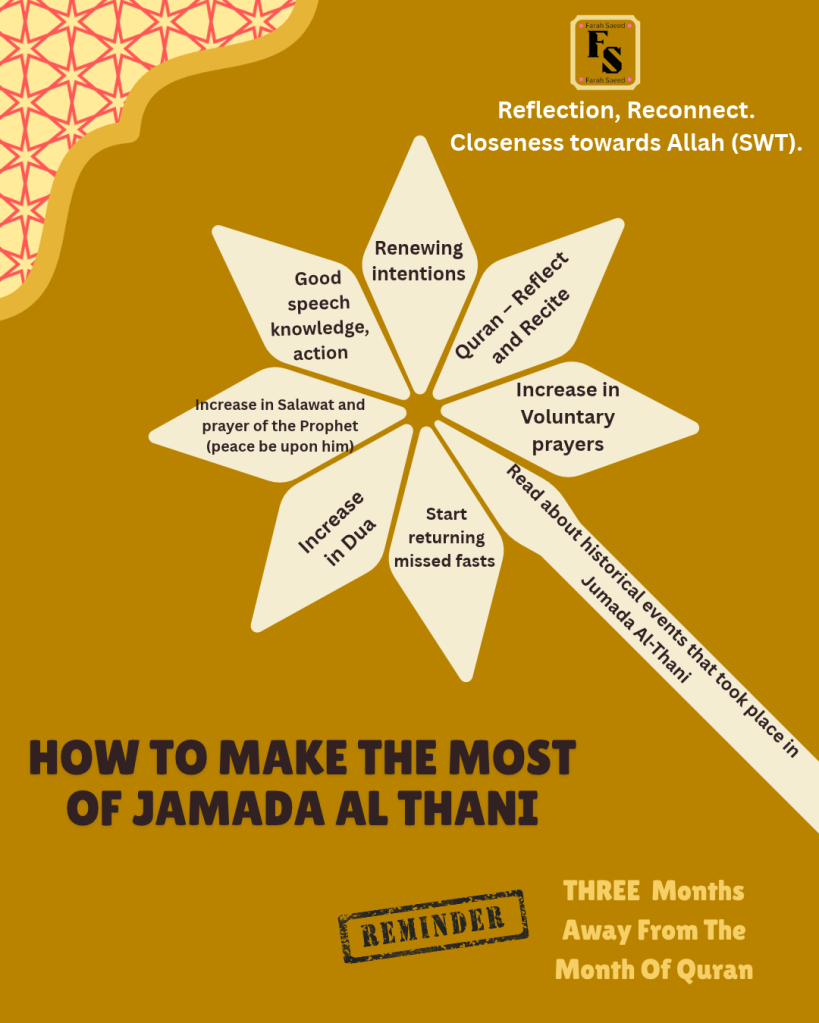
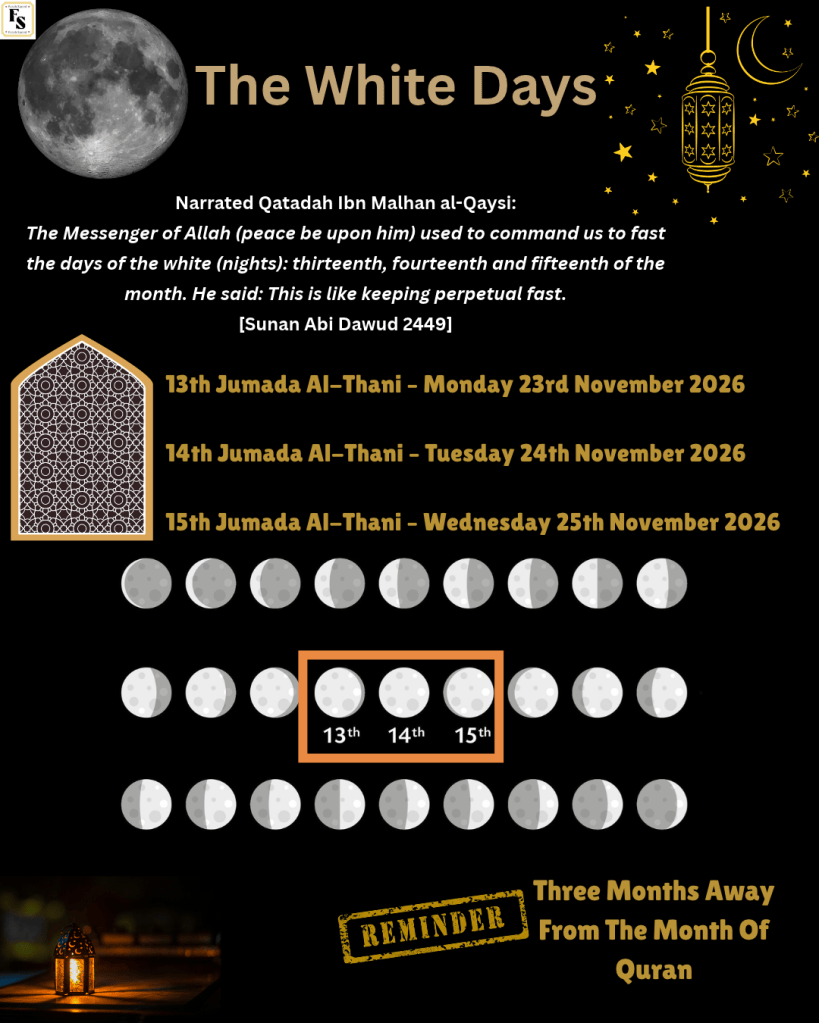
A month has passed, and we have three months left before the blessed month of Ramadan.
How are you feeling?
Are you excited?
Jumada Al-Akhir, also known as Jumada Al-Thani, marks the midpoint of the Islamic lunar calendar. Like Jumada Al-Awel, Jumada Al-Thani comes from the root word “Jamd,” meaning dry and patched land and a lack of rain. During the 5th century CE, this month ended a two-month freeze on the Arabian Peninsula.
Though this month is not amongst the sacred months, its presence before the triad months of Rajab, Shaban and Ramadan serves as an essential preparation for endurance, repentance, forgiveness and evaluation for every brother and sister.
So, why is this month significant?
The love for the Prophet Muhammad (peace be upon him) and how much he was devoted to his family, his companions, the people he worked with, the young, the old, the poor and needy, the orphans, and anyone who interacted with him is something we all should learn from as an exemplary model of bravery, patience, generosity, and belief.
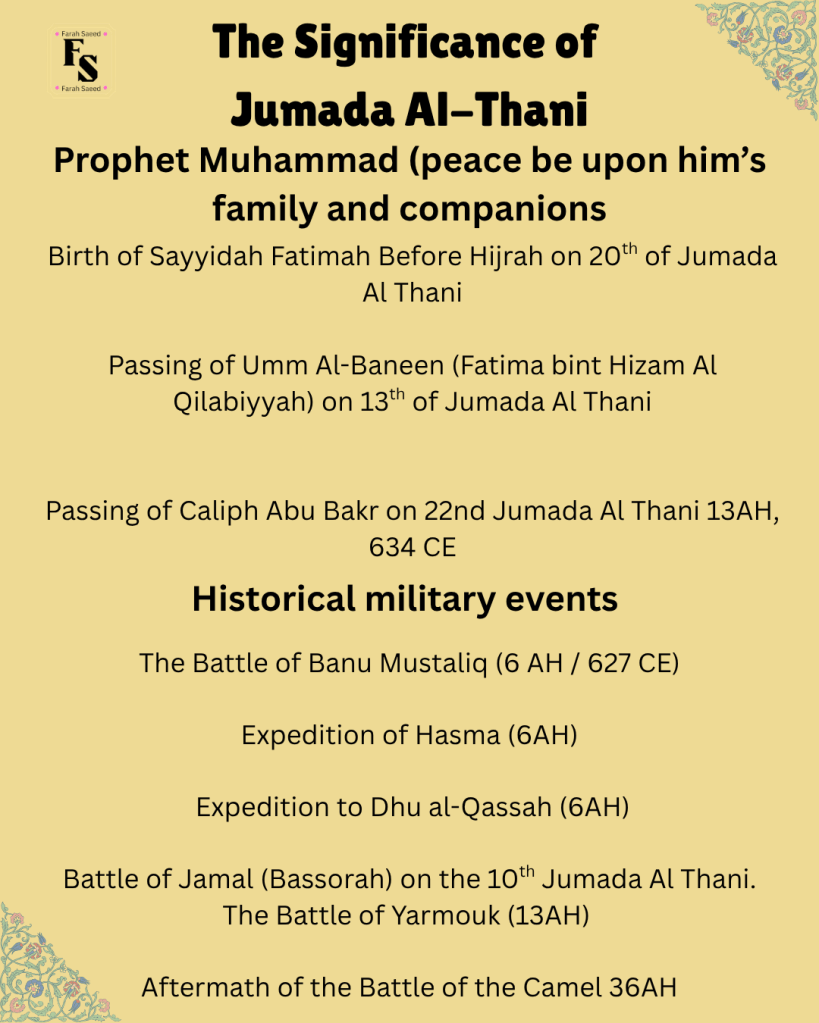
One of his daughters, who is most beloved to him and who stood by him, was born on the 20th of Jumada Al-Thani, Fatimah Al-Zahra (may Allah have mercy upon her). She was called Al-Zahra. In Arabic, Al-Zahra has several definitions: the flower and also the Splendid One. However, the scholars have referred to Al-Zahra as the Splendid One, as her face was radiant like her father’s and resembled her father’s generosity, piety, modesty, courage, and even her speech:
Aisha bint Abi Bakr Al-Siddiq (may Allah have mercy upon her):
“I have not seen anyone of God’s creation resemble the Messenger of God (may the blessings and peace of God be upon him) more in speech, conversation, and manner of sitting than Fatima, may God be pleased with her. When the Prophet (may the blessings and peace of God be upon him) saw her approaching, he would welcome her, stand up and kiss her, take her by the hand, and sit her down in the place where he was sitting.“
(Al-Adab Al-Mufrad)
Fatima Al-Zahra (may Allah have mercy upon her) was close to her father and tried to care for him with her tenderness and protection, even after her mother, Khadijah, passed away; she was called Umm Abiha (the Mother of her Father) and the supreme leader of all women in Paradise.
In a hadith, the Prophet Muhammad (peace be upon him) said:
“Fatimah is a part of me; whoever angers her angers me, and whoever pleases her pleases me”
[Hadith, Sahih al-Bukhari: 3714],
Her husband was also the cousin of Prophet Muhammad (peace be upon him), Ali Ibn Abi Talib (may Allah have mercy upon him). They bore two sons, Al-Hasan and Al-Hussain, who were known for their wisdom, knowledge, and bravery, especially in Karbala against the Umayyads. This lineage was maintained for generations.
Another hadith was reported by Aisha bint Abi Bakr Al-Siddiq (may Allah have mercy upon them.
Narrated `Aisha bint Abi Bakr Al-Siddiq (may Allah have mercy upon her):
Once Fatima came walking, and her gait resembled the gait of the Prophet (peace be upon him). The Prophet (peace be upon him) said, “Welcome, O my daughter!” Then he made her sit on his right or on his left side, and then he told her a secret, and she started weeping. I asked her, “Why are you weeping?”
He again told her a secret, and she started laughing. I said, “I never saw happiness so near to sadness as I saw today.” I asked her what the Prophet (peace be upon him) had told her. She said, “I would never disclose the secret of Allah’s Messenger (peace be upon him).” When the Prophet (peace be upon him) died, I asked her about it.
She replied. “The Prophet (peace be upon him) said: ‘Every year Gabriel used to revise the Qur’an with me once only, but this year he has done so twice. I think this portends my death, and you will be the first of my family to follow me.’ So I started weeping. Then he said. ‘Don’t you like to be the chief of all the ladies of Paradise or the chief of the believing women? So I laughed at that.”
[Hadith, Sahih al-Bukhari 3623, 3624]
After the passing of her father, Muhammad (peace be upon him), she continued his legacy and later passed away six months after him. Her husband, Ali bin Abi Talib (peace be upon him), married another woman with the same name, Fatima bint Hizam Al Qilabiyyah. Fatima was also known as Umm Al-Banin (The Mother of the Sons who belonged to Banu Kilab Kalbasi, Khases Al-Abbasiah tribe (1387 S.H.), which is a branch of the Tribes of Qais Ailan. One of her sons was called Abbas ibn Ali (may Allah have mercy upon him). On the 13th of Jumada Al-Thani, she passed away. Fatima bint Hizam Al Qilabiyyah was devoted to her family; she not only raised her sons she bore with Ali, Jaffar, Uthman, Abdullah, and Abbas, but also her two sons, Hasan and Al-Husain. She was very thoughtful and caring, so she asked Ali not to call her by her first name. Her sons shone like the moon and continued to support all. They even fought on the plains of Karbala as the swords and spears went through, supporting their brother in a good cause. Abbas ibn Ali (may Allah have mercy upon him) was referred to by the title Babul Hawa’ij, the door that fulfils the needs of all those who knock on it. He maintained integrity and had mighty character.
Another important member in the life of the Prophet Muhammad (peace be upon him) was his best and closest companion and Rightly Guided Caliph Abu Bakr Abdullah ibn Abi Quhafah al-Siddiq (may Allah have mercy upon him), who stood by him with loyalty, strength, and protection, and passed away on the 22nd of Jumada Al-Thani after the Hijrah, 634 CE. He was so admired that even Allah (The Most High) honoured him in the Glorious Quran:
“When he said to his companion, Do not grieve, indeed Allah is with us.”
[The Glorious Quran, Surah Al-Tawbah (The Repentance) 9:40]
The above verses were revealed when Abu Bakr (may Allah have mercy upon him) migrated to Madinah.
He had such a strong faith in Allah (The Most High) that can shakes the hearts, he said to people who were crying after the Prophet Muhammad (peace be upon him).
Narrated `Aisha bint Abi Bakr (may Allah have mercy upon him):
Abu Bakr came riding his horse from his dwelling place in As-Sunh. He got down from it, entered the Mosque, and did not speak with anybody till he came to me and went directly to the Prophet, who was covered with a marked blanket. Abu Bakr uncovered his face. He knelt and kissed him and then started weeping and said, “My father and my mother be sacrificed for you, O Allah’s Prophet! Allah will not combine two deaths on you. You have died the death which was written for you.”
Narrated Abu Salama from Ibn `Abbas: Abu Bakr came out and `Umar was addressing the people, and Abu Bakr told him to sit down, but `Umar refused. Abu Bakr again told him to sit down, but `Umar again refused. Then Abu Bakr recited the Tashahhud (i.e., none has the right to be worshipped but Allah, and Muhammad is Allah’s Messenger (ﷺ)), and the people attended to Abu Bakr and left `Umar. Abu Bakr said, “Amma ba’du, whoever amongst you worshipped Muhammad, then Muhammad is dead, but whoever worshipped Allah, Allah is alive and will never die. Allah said: ‘Muhammad is no more than an Apostle, and indeed (many) Apostles have passed away before him…(up to the) grateful.’ ” (3.144)
(The narrator added, “By Allah, it was as if the people never knew that Allah had revealed this verse before till Abu Bakr recited it and then whoever heard it started reciting it.”)
[Hadith, Sahih al-Bukhari 1241, 1242]
After the death of his best friend (peace be upon him), Abu Bakr submitted his oath to become Caliph. During his reign, many people admired his humility, he fought through a perilous storm of the apostasy wars (Hurub Al-Riddah) where he historically opened Levant (Syria and Lebanon and Jordan) and Mesopotamia (Iraq). Not only this, he maintained his love for his Prophet (peace be upon him) and continued his legacy and fought against false prophets and fitnah that arose in Arabia. He even tried to restore unity amongst the Arabian Peninsula and compiled the Quran in a single volume under Zayd ibn Thabit, and undertook many other missions to help prosper the areas and maintain wisdom in various infrastructures. After consultation with Abdur Rahman ibn Awf, Uthman ibn Affan, Ali ibn Abi Talib, and Sa’id ibn Zayd, Umar ibn al-Khattab was nominated as the second Caliph.
Many disliked his strong and strict character. However,
Abu Bakr replied
“His toughness was only because he saw me as gentle; when the responsibility falls upon him, he will soften. What will I say to my Lord when He asks me? I will say: I have appointed over Your servants the best of them.”
Moreover, something this month also holds multiple battles in which many companions demonstrated leadership, bravery, and sacrifice. Ali ibn Abi Talib (may Allah have mercy upon him) won the Battle of Jamal (Bassorah) on the 10th of Jumada al-Thani. The Battle of Banu Mustaliq took place in 6AH and was linked with Jumada al-Thani. The Prophet Muhammad (peace be upon him) treated people who oppose them with respect and humane conduct and freed many of the captives from Banu Mustaliq who many later embraced Islam because of the character. This was the prophetic model of justice during war and illustrates mercy, ethical leadership, and respect for human rights.
Other wars also took place this month, like the Battle of Yarmouk in 13AH. This took place on the plains of the Yarmouk River, south of the Sea of Galilee in Southern Syria. The tactical warrior Khalid ibn Al-Walid and Abu Ubaydah ibn Al-Jarrah led with brilliance a modest army against the Byzantine Roman Empire ruled by Emperor Heraclius, whose army was led by Armenian generals Vahan and Theodore Trithyrius in the Levant, permanently shifting the geopolitical destiny of the Near East. This is found especially in Homs and Damascus. They fought bravely and were able to win the war despite challenging weather. Khalid Ibn Al Waleed received news that Umar ibn Al Khattab had succeeded Caliph Abu Bakr after his death but did not inform his cavalry and army until he had fully recovered; this ended Roman rule in the Levant and liberated Jerusalem in present-day Palestine.
The aim of this article is to discuss the character of each of the members of the Prophets and the impact they had on the Ummah. May we all learn the good and become of the good and continue to improve for the good. Jumada Al-Thani is a time for spiritual preparation before Ramadan. Fatimah Al-Zahra and Abu Bakr are highlighted as exemplary figures. Historical events in Jumada Al-Thani demonstrate leadership, sacrifice, and faith.
References
Ahlul Bayt Digital Islamic Library Project (2026) The Prestigious Status of Lady Umm Al-Banin https://al-islam.org/media/prestigious-status-lady-umm-al-banin (Accessed: 11th November 2026)
Hassan, H. (2025) Jumada Al-Thani (Jumada Al-Akhir): Important Dates and Events. Available at: https://theislamicinformation.com/blogs/jumada-al-thani-jumada-al-akhir-important-dates-events/ (Accessed: 11th November 2026)
Hijri Dates (2026) Jumada al-Thani: Virtues, Historical Events, Meaning & Spiritual Significance. Available at: https://hijri-dates.com/en/jumada-al-thani-guide-history-significance/ (Accessed: 11th November 2026)
Husain, H. (2025) Story of Fatimah – The Favorite Daughter of the Prophet. Available at: https://aboutislam.net/reading-islam/about-muhammad/story-of-fatimah-the-favorite-daughter-of-the-prophet/ (Accessed: 11th November 2026
Islamic Guru (2026) Islamic Month Jumada Al-Thani. Available at: https://www.islamicguru.com/islamic-month-jumada-al-thani/ (Accessed: 11th November 2026)
Mamun, M. (2024) Importance of Jumada al-Thani: History, Events & Spiritual Significance. Available at: https://islamicinfocenter.com/importance-of-jumada-al-thani/ (Accessed: 11th November 2026)
Samaa Al (2015) The Queen of Yathrib: Ummul Baneen. Available at: https://themuslimvibe.com/faith-islam/in-history/the-queen-of-yathrib (Accessed: 11th November 2026)


Leave a Reply