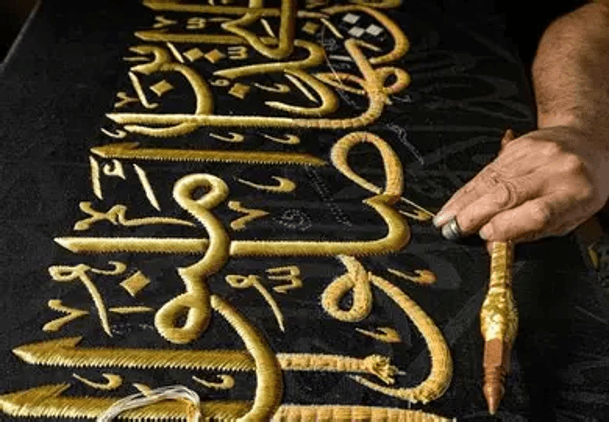
After 11 months of careful and talented craftsmanship, the new Kiswah cloth follows a ceremonial and sacred process on the first day of Muharram of each lunar year calendar. The Kiswah cloth is designed and woven using black silk intricately decorated with silver and gold thread to display Quranic verses at the King Abdulaziz Complex for Holy Kaabah Kiswah in the Umm Al Joud district of Makkah.
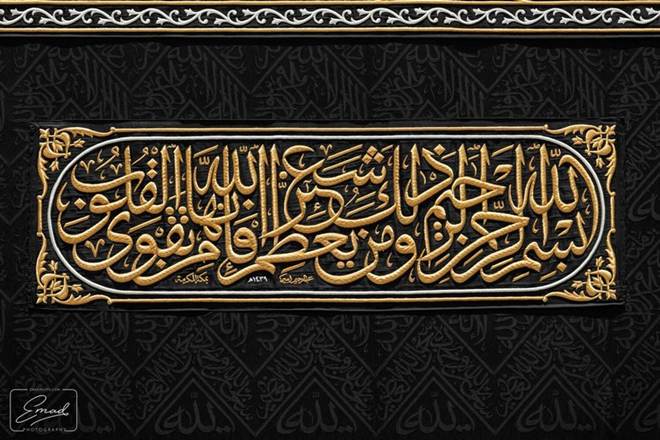
The finished cloth is then transported to Masjid Al-Haram (The Sacred Mosque) in Makkah, accompanied by an official convoy and religious dignitaries. On the designated day, the old Kiswah is carefully removed by the custodians of the Kaabah, members of the Bani Shaybah family. The new Kiswah is then placed over the Kaabah in a precise and respectful manner. The previous covering is cut into pieces and distributed as special gifts to Muslim countries and distinguished guests. The Kiswah cloth is made of 47 finely woven pieces of black silk material, intricated with 68 Quranic passages that are embroidered using silver threads and plated with 24-carat gold, giving an unbelievable weight of 1.415 kg! An example is seen in Figure 1 where it presents Quranic verse 32 from Surah Al Hajj (The Pilgrimage).
“In the name of God, most Gracious, most Compassionate. That is so. And whoever honours the symbols of Allah, it is certainly out of the piety of the heart.”
This is an enjoyable and inspiring event likened by the young and the old. The Prophet Muhammad (peace be upon him) even watched the ceremony at the tender age of six (KSA directory, 2025).
The transformative journey of the Kiswah cloth through time
Scholars have informed that there have been several distinct transitions in how the Kiswah cloth covering was placed on the Kaabah. The first known covering dates back to the time of Prophet Ismail (peace be upon him), who, along with his father Prophet Ibrahim (peace be upon him), constructed the Kaabah and placed a partial covering on it, estimated to be around 2000 BCE.
Several centuries later, during the 5th century CE, the Yemeni King Tubba (Abu Karib) became the first person to cover the entire Kaabah, using red striped Ma’afir cloth specially woven in the Taiz district of Yemen. Following King Tubba’s action, it became a respected religious practice for tribes and individuals to cover the Kaabah, regardless of the type of fabric, colour, or place of origin.
The Quraysh tribe, for instance, contributed by adding coverings of leather, woven palm leaves, and other textiles during their leadership of Makkah. While this tradition allowed various tribes to participate in the sanctification of the Kaabah, it also led to issues, as the accumulation of multiple layers of cloth sometimes resulted in damage to the structure of the Kaabah itself.
The first woman with native Arabian heritage to cover the Kaabah was Natilah bint Jinab (may Allah have mercy upon her). She was the wife of the Prophet Muhammad (peace be upon him)’s grandfather. In other words, it was the Prophet’s grandmother.
However, neither the Prophet Muhammad (peace be upon him) nor His companions (may Allah have mercy upon them) covered the Kaabah because the Makkans did not allow them. This totally changed after the Conquest of Makkah, when they fought for their rights and were then able to do so. There was one turning point where they had to burn the Kiswah cloth as one of the tribals placed perfume on it. The colours of the Kiswah at the time were red with white striped Yemeni cloth. During their caliphate era, Abu Bakr, Umar and Uthman (may Allah be pleased with them) covered the Kaabah with the qibati. Qibati is a thin white cloth sourced in Egypt.
Later, the founder of the great Umayyad dynasty of caliphs, Muawiyah bin Abi Sufiyan who fought against the caliphate, Ali bin Abi Talib, and even resisted Prophet Muhammad’s message, covered the Kaabah twice a year. On the day of Ashurah, brocade was added, whereas Qibati took place at the end of Ramadan. This was also the practice of Abdullah bin Zubair (May Allah be pleased with him), who led a rebellion against the Umayyad dynasty. Besides this, he also led multiple military campaigns to expand Islam and even compiled the official recension of the Quran.
Other Caliphs decorated the Kaabah; for instance, Caliph al-Mamun used three different colours: Red brocade on the 8th Dhul-Hijjah, Qibati on the day the new moon of Rajab was sighted, and on the 27th day of Ramadan. The Abbasid dynasty utilised a green Kiswah to drape the Kaabah and then altered it to black. Thus, the Kiswah cloth has remained black since 1224. Moreover, a wealthy 12th-century medieval merchant, Ramshit from Siraf, covered it with Chinese textiles (Islamic Landmarks n.d).
The manufacturing of the Kiswah Cloth
There are seven main steps:
Purification using water
Washing of silk
Colour dyeing using a black tone
Weaving
Geometric printing of the Quranic verses
Embroidery using gold and silver thread
Final Assembly and inspection
Egypt has been the prominent location of the manufacturing of the Kiswah cloth since the 13th century during the Ayyubid dynasty, Al Salih. The material was thought to be from Sudan, India, and Iraq, and sometimes Yemen, Syria, and Turkey, where it was transported to Makkah on an annual basis.
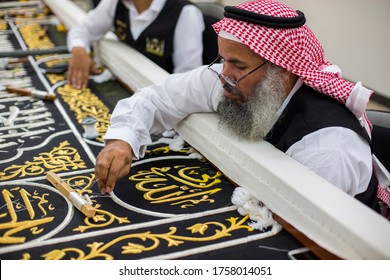
In 1817, the Kiswah cloth factory was constructed in the Kharanfash quarter in Cairo by Muhammad Ali Pasha, where talent was made from producing the Kiswah cloth and designing the inscriptions. At first, the tentmakers (khairman) would design and cut the Kiswah cloth, sitar for the door, door of repentance (Bab Al Tawbah), and the belt around the Kaabah (Hizam), the bag where keys are kept, and the Kiswah for Maqam Ibrahim (Station of Ibrahim). This was then moved to the embroiderers, where talented calligraphers and craftsmen used traditional methods and technology to manufacture Kiswah and other holy textiles. Other key areas designed were the curtaining of the interior of the Kaabah and sacred chamber in Madinah. This continued until it moved to Saudi Arabia in 1927, when King Abdul Aziz established a Kiswah factory in the Ajyad neighbourhood in Makkah. However, in 1961, it moved back to Egypt before being transferred back again to Saudi Arabia in 1972 in the Umm Al-Joud district and continues to do so today; Please see Figure 2. The factory complex is next to the Exhibition of the Two Holy Mosques (Islamic Landmarks n.d).
How was the Kiswah sent to Makkah from Cairo?
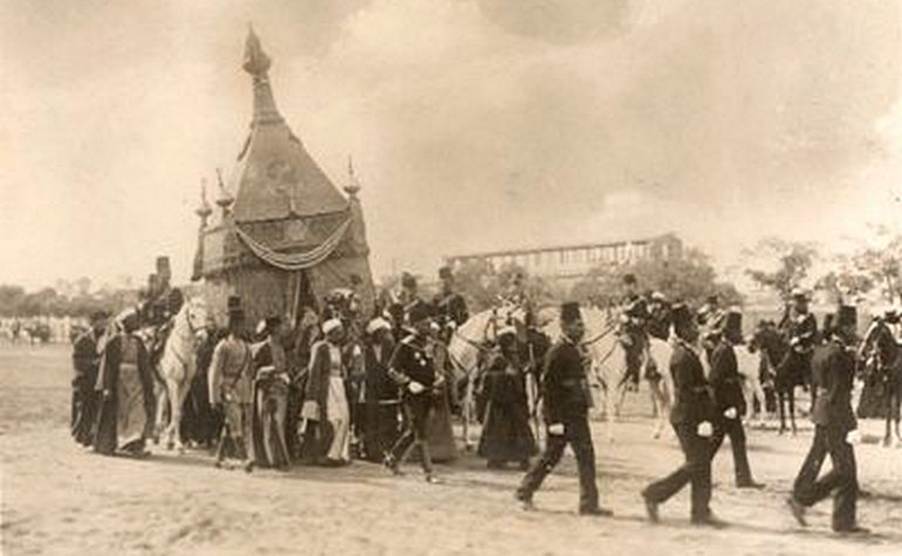
The ceremonial transition was done annually, where it was carried in a large tent-shaped or pyramidically-shaped container called a Mahmal. It was made of a silk cloth embroidered in silver and gold-plated write with an inscription of the Quran. Please see Figure 3. The Mahmal was carried by a strong camel and accompanied a Hajj caravan. A Hajj caravan is a convoy of camels that carried personal belongings and supplies of accompanying pilgrims and was guarded by soldiers until its destination. Each year the Mahmal cover was commissioned, and the name and date were presented at the top. After the pilgrimage was completed, the Mahmal would return to Cairo with the old Kiswah cloth. Today, the Mahmal commissioned by Mamluk Sultan Al-Ghawri is present in the Topkapi Palace in Istanbul, Turkey (Islamic Landmarks n.d).
Overall, the Kiswah’s production and ceremonial replacement is a centuries-old tradition. Various dynasties and regions contributed to the Kiswah’s materials and design. The Mahmal caravan played a significant role in transporting the Kiswah.
References
Islamic Landmarks (n.d.) Kiswah (The cover of the Ka’bah) Available at: https://www.islamiclandmarks.com/makkah-haram-sharief/kiswah-the-cover-of-the-kabah (Accessed: 13th June 2026)
KSA Directory (2025) Kaaba’s Kiswa to be replaced on the first day of Muharram. Available at: https://www.ksa.directory/kaaba-s-kiswa-to-be-replaced-on-the-first-day-of-muharram/2038/n (Accessed: 13th June 2026)


Leave a Reply