Dear brothers and sisters in faith and humanity,
In our third article of the four-part series “Muharram – Another Chance To Seek Allah’s Forgiveness”, we will discuss the grandson of the Prophet Muhammad (peace be upon him) and his ultimate sacrifice.
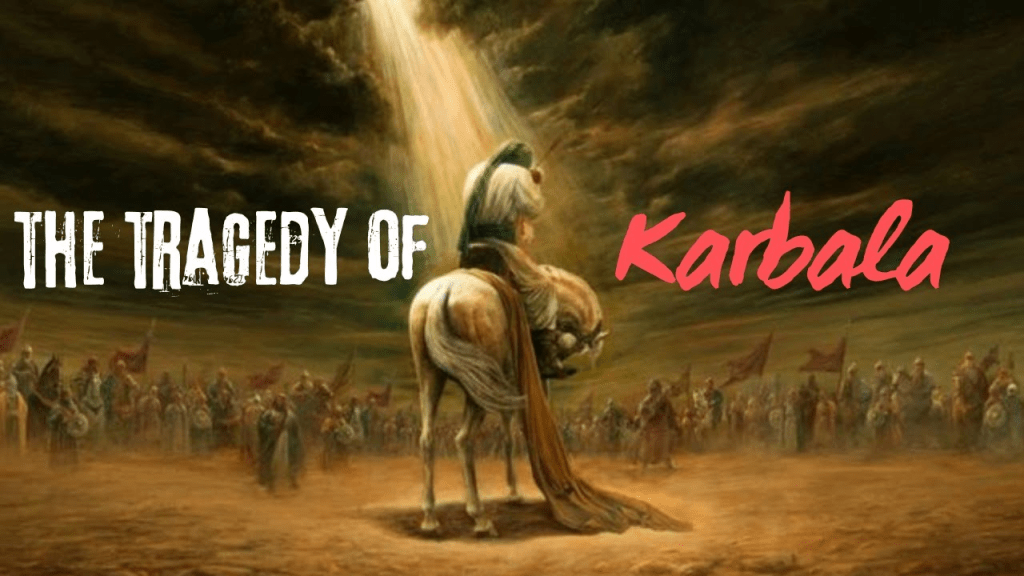
On the morning of the Ashurah (10th) of Muharram, the first lunar month of the Islamic calendar, there was the unforgettable event of when the grandson of the Prophet Muhammad (peace be upon him), Hussain (may Allah have mercy upon him), was martyred alongside 72 people, including male members of the Prophet (peace be upon him)’s family, in Karbala, Iraq. It is one of the most historical and tragic events in Islamic history. It signifies that not only the Prophets (peace be upon them) were tested but also the Companions and relatives of the Prophet (peace be upon him) faced trials and tribulations where they were inflicted pain and bore with patience.
The aim of this article is to narrate this saddened event and contemplate the bravery, patience, and sacrifice shown by Imam Hussain (may Allah have mercy upon him), which is solemn for every Muslim, uniting everyone and connecting people together.
As we reflect on the story of Karbala, let us ask ourselves: How can the courage, faith, and endurance of Imam Hussain inspire us in our own trials? What lessons can we apply to our daily lives to stand against injustice, show compassion, and strengthen our faith? Taking the time to personally reflect on these questions can deepen our connection to the legacy of Karbala and draw us closer together as an Ummah.
The Character of Hussain (may Allah have mercy upon him)
Before discussing the tragic event, it is important to reflect on the close relationship the Prophet Muhammad (peace be upon him) had with his children and sons-in-law. This is evident in how he cherished spending time with his grandsons, Hassan and Hussain (may Allah have mercy upon them), the sons of his daughter, Fatima Al-Zahra (may Allah have mercy upon her), and his son-in-law, Ali bin Abi Talib (may Allah have mercy upon him), who was also his cousin, Companion, and one of the chosen Caliphs after him.
Several hadiths provide evidence of how the Prophet (peace be upon him) loved both of his grandsons very much, as he referred to them as “sweet basils”.
Narrated Ibn Abi Nu’m (May Allah have mercy upon him):
`Abdullah bin `Umar (May Allah have mercy upon him) was asked about a muhrim (a person in the state of pilgrimage). Shu’bah (a subnarrator) said, “I think killing flies.”
I heard him saying (in reply). “The people of Iraq are asking about flies while they themselves murdered the son of the daughter of Allah’s Messenger (peace be upon him). The Prophet (peace be upon him) said, ‘They (i.e. Hasan and Husain) are my two sweet basils in this world.‘ “
[Hadith, Sahih Al-Bukhari, 3753]
This highlights the presence of the Prophet’s grandsons, whose innocence and character brought a pleasant and sweet presence, likened to the gentle aroma of sweet basil, which is an herb used to add fragrance and flavor in cooking.
In another hadith,
Abu Sa‘īd al-Khudri (may Allah be pleased with him) reported: The Messenger of Allah (may Allah’s peace and blessings be upon him) said:
“Al-Hasan and Al-Husayn are the masters of the youth of Paradise.”
[Hadith, Al-Tirmidhi, 3768]
This emphasises, according to the respected scholars, that the grandsons of the Prophet (peace be upon him) were masters of those who passed away young and will enter Paradise in terms of virtue. They are also masters of the youth of Paradise, except for the Prophets and the rightly-guided caliphs.
Furthermore, there is other evidence that implies how close the Prophet (peace be upon him) was with his children and grandchildren.
Narrated ‘Ali bin Husain (may Allah have mercy upon him) said:
from his father, from his grandfather, ‘Ali bin Abi Talib (may Allah have mercy upon them all):
“The Prophet (peace be upon him) took Hasan and Husain by the hand and said: ‘Whoever loves me and loves these two, and their father and mother, he shall be with me in my level on the Day of Judgement.”
[Hadith, Al-Tirmidhi, 3733]
This presents how affectionate the Prophet (peace be upon him) was with his grandchildren and the deep relationship. They gave him joy in his life, and they will be levelled on the Day of Reckoning. It also indicates how much love he had for them, as they were his daughter Fatimah’s sons. Al-Hussein was born on the 4th Hijri (4 years after the Prophet migrated from Makkah to Madinah).
In another hadith,
Narrated Buraidah (may Allah have mercy upon him):
“The Messenger of Allah (peace be upon him) was delivering a Khutbah to us when Al-Hassan and Al-Hussain [peace be upon them] came, wearing red shirts, walking and falling down. So the Messenger of Allah (peace be upon him) descended from the Minbar and carried them, and placed them in front of him. Then he said:
‘Allah spoke the Truth: Indeed, your wealth and your children are a trial (64:15).
I looked at these two children walking and falling down, and I could not bear it anymore until I interrupted my talk and picked them up.”
[Hadith, Al-Tirmidhi, 3774]
In another hadith
Ya’la ibn Murra (may Allah have mercy upon him) said, “We went out with the Prophet, may Allah bless him and grant him peace, and we were invited to eat. Hussain was playing in the road and the Prophet, may Allah bless him and grant him peace, raced the people and then spread out his arms. The boy began to run this way and that, and the Prophet made him laugh until he caught hold of him. He put one of his hands under his chin and the other on his head and then embraced him. Then the Prophet, may Allah bless him and grant him peace, said, ‘Husayn is from me, and I am from Husayn. Allah loves anyone who loves al-Hasan and al-Husayn. They are two of my distinguished descendants.’”
[Al-AdabAl-Mufrad, 364]
This highlights how playful Hassan and Hussain (may Allah have mercy upon them) were with the Prophet (peace be upon him), as he would climb on his back freely during prayer.
Moreover, the Prophet (peace be upon him) and his grandsons (may Allah have mercy upon them) were similar in character, as they had a calming attitude towards life. This was because of being blessed to be close to him and taught by him.
Once Imam Hassan (peace be upon him) was riding with his caravan when a Syrian man saw him and started insulting Hassan (may Allah have mercy upon him).
Hassan Ibn Ali bin Abi Talib (may Allah have mercy upon him) listened to the man calmly and did not respond to the insults. When he got closer to the man, he cheerfully said,
“Old man, maybe you have mistaken me for someone else. If you seek forgiveness, it will be given to you. If you are looking for transportation, it will be provided. If you are hungry, you will be provided with food. If you need clothes, we will give them to you. If you are deprived of anything, you will be provided with it. If you are running from someone, you will be given refuge. Whatever you need, we will give it to you. If you wish to go on with your caravan or stay as a guest, you are free to do so. We have a great position and numerous belongings.”
The Syrian man began to cry, and he then said that he considered Imam Hassan and his father, Imam Ali (may Allah have mercy upon them), as one of the most respected creatures. This act of kindness altered his perspective and made them Allah’s most beloved creations. The Syrian man then stayed with his caravan as a guest.
This story indicates how Imam Hassan (may Allah have mercy upon him) did not wish others ill, even though the Syrian man insulted him. Imam Hassan opened his arms, offered him help, and welcomed him as a guest.
Another story that demonstrates the kindness and generosity of Imam Hassan and Hussain (peace be upon him) was when they saw an elderly man performing Wudhu (ablution) and Salah (prayer) incorrectly. The brothers decided to alert and inform the man respectfully. So they asked the old man to make a judgement on which of the brothers (Hassan and Hussain) performed ablution correctly and guide them if they erred. The elderly man observed the moves made by the brothers and realised his mistake and was also grateful that the Prophet’s grandsons tried to guide them with gentleness, wisdom, and humility.
He exclaimed, “By Allah! The Wudhu done by you is correct. I am grateful to you for teaching me the correct method in such a gentle manner.”
This proclaims how the Prophet’s grandsons were respectful and cared for the young and old with morality.
Another example of their courage was during the siege of Uthman bin Affan (may Allah have mercy upon him). Their father, Ali bin Abi Talib, asked both of his sons, Hassan and Hussain, to guard his home and protect him from people.
The other Caliphs, Abu Bakr and Umar bin Khattab, also respected Hussain (may Allah have mercy upon them all). During the time of the third Caliphate, Hussain waged war in Tabaristan (or Tapuria) (Ibn Kathir, vol.3, p.45). This was an Abbasid military campaign against Tabaristan (141–144 AH / 758–761 CE) during the reign of Caliph Abu Ja’far al-Mansur. This illustrates the true brotherhood that existed between the Companions of the Prophet (peace be upon him) and his grandsons.
Rising to the Caliphate
After the death of the Prophet Muhammad (peace be upon him) in 11 AH, his companions became the Caliphate Al Rashidoon (The Rightly Guided Caliphs/Deputies) to guide the Muslim Ummah and the growing empire. At first, it was Abu Bakr Al-Siddiq, Umar bin Khattab, Uthman bin Affan, and Ali bin Abi Talib (may Allah have mercy upon them all).
As the Islamic Caliphate expanded, more ignorance inevitably came in.
After their father, Ali (may Allah have mercy upon him), passed away, a group of people called the Khazarij.
Hussain’s older brother, Hassan (may Allah have mercy upon him), became the Caliph. However, despite knowing that he was the grandson of the Prophet (peace be upon him), Muslims tried to stir up trouble and wanted to lead and gain power after six or seven months of Hassan being Caliphate. Amongst them was Amir Muawiyah of the Umayyad dynasty, the governor of Syria and Egypt, who did not even acknowledge nor spare the life of the grandson of the Seal of the Prophets and wanted to become the sole ruler.
Muawiyah previously rose against Ali ibn Ali Talib in two battles and now wanted to face his son Hassan. Hassan was abdicated after signing a treaty with Muawiyah. This implied that the Caliphate would go to Hassan after Muawiyah’s death.
On the contrary, Hassan tried to focus on his leadership, where he shared knowledge, presented bravery, and was kind to the poor. He spent most of his life in Madinah until he passed away at the tender age of 45. He was buried in Jannatul Al-Baqi in Madina. It was said that his wife, Ja’ada bint Al-Ashat, had poisoned him.
Muawiyah wanted his son Yazid to be the next ruler and asked people not to oppose him. Muawiyah passed away in 60 After Hijrah (AH).
Unfolding Of The Events That Led To The Martyrdom of Hussain (may Allah have mercy upon him)
From the 7th to the 10th of Muharram, Imam Hussain (may Allah have mercy on him) and his family, who were 72 male members of the Prophet (peace be upon him), fought heroically unarmed against the tyrant ruler, Yazid, and his ruthless army of 4000 soldiers at the Battle of Karbala. They fought to stand up against oppression and to preserve Islam in its best nature. Both Yazid and Hussain had opposing natures and concepts in life, where Hussain had pure faith and was generous, whereas Yazid’s level of faith was low and he had poor character. Hussain (may Allah mercy upon him) had no desire to rule but only to protect Islam and stand firmly with justice.
They brutally decapitated him.
Can you imagine how the grandson of our Beloved Prophet Muhammad (peace be upon him) was treated in this manner to gain power?
So how did it lead to this?
Yazid ordered that he wanted to take the pledge of allegiance at his hand. A pledge is defined as a substance given in security for the fulfilment of a contract or debt. Some were willing to take the pledge, whereas others disagreed and reluctantly took the pledge out of fear of Muawiyah.
However, Hussain, Abdullah ibn Zubair, and others felt that Yazid should not possess the right to the caliphate.
Furthermore, miles away in Kufah in Iraq, there were about 18,000 people who were ready to take the pledge of allegiance for Hussain bin Ali (May Allah have mercy upon him) and for him to come to Kufah to take up the throne.
This information was confirmed by Muslim ibn Aqeel (may Allah have mercy upon him). There were also lots of letters sent in support of Hussain. Hussain bin Ali (may Allah have mercy upon him) had a sense of comfort and wanted to visit Kufah.
On the other hand, Abdullah ibn Abbas and the other elders opposed this action and warned him against doing so. This is because Imam Hussain moved with his family to Makkah after sensing trouble in Madina.
Somehow, Yazid bin Muawiyah found out about the support of Muslim ibn Aqeel and the people of Kufah. Nauman ibn Bashir, the government, and their spies were thought to have informed Yazid. They advised him to appoint a governor in Kufa; otherwise, he would lose Iraq and Kufa. Yazid, without thought, sacked Nauman and appointed Abdullah ibn Ziyaad, who was already the governor of Basra, to be the new governor in Kufah.
Yazid ordered Ibn Ziyaad to kill Muslim ibn Aqeel in Kufah. This emphasises the lack of freedom in selecting a competent leader who is pious and of good character, leading to feudalism, nepotism, and tyranny.
Upon hearing the news of his murder, Hussain (may Allah have mercy upon him) was sad, and Aqeel’s brother went to Kufah to seek revenge. Hussain (may Allah have mercy upon him) was also on his way to Kufah and gave everyone a choice: continue to go with him to Kufah or return.
Many were indecisive, and there were only a few companions of the Prophet (peace be upon him) who remained, along with the family of the Prophet (Ahlul Bait), giving a grand total of 72 people in Hussain’s camp. They knew the possible outcomes but were willing to support Hussain (may Allah have mercy upon him).
Unknowingly, Yazid thought of a tactic to detain Hussain (peace be upon him) and 72 supporters. On the 3rd day of the month of Muharram, Ibn Sa’ad arrived with an army of 4000 men. The governor of Basra, Ibn Ziyaad, said out loud:
“Hussain should come to Kufah and pledge allegiance to Yazid”.
(Ibn Kathir)
Conversely, Hussein (may Allah mercy upon him) rejected the offer and chose death rather than to agree with injustice. Yazid and his followers threatened the Prophet’s grandson and his supporters, and they turned off the water source on 7th Muharram and performed other acts of cruelty whilst Hussain and his supporters patiently adhered to the effects of the desert of Karbala. The main water source was the Euphrates. The emergence of starvation and distress occurred.
One of Yazid’s camp members felt these actions were atrocious and transferred to Imam Hussein’s group. The flag of the Hussain camp was in the hands of Abbas, the uncle of the Prophet (peace be upon him). Hussain’s sister Zainab felt sad, and Hussain’s heart trembled with sadness upon seeing his sister in this manner and cried. He told her to be patient and said:
One day we all have to return to our Lord. Promise by God that after my death you will not act contrary to the example of the Holy Prophet. Do not defame anyone, saying anything untoward.
(Tarikh Ibn Kathir, p.514)
However, the Prophet’s grandson showed courage, and neither he nor his family deterred or gave in to the tyrannical ruler. There was no alternative apart from war. Hussain tried to liaise with ibn Ziyaad. He was willing to accept either to return to Madina or go to the borders of Islamic lands, or to meet Yazid in Damascus, Syria. Ibn Ziyaad refused to make peace and warned that it would launch an attack.
On the 10th of Muharram 61 AH and 680 AD, Hussain and his supporters prepared to fight against the injustice. They made weapons and performed different acts of worship seeking relief from Allah (The Most High).
On the morning of Ashurah, they battled against the Yazid Army. The flag of the Hussain camp was in the hands of Abbas, the uncle of the Prophet (peace be upon him).
Hussain wanted to make peace and move away from the enemy, but they demanded he pledge allegiance to Yazid first.
Imam Hussain and his supporters fought back when Ibn Ziyaad launched an attack. At first, Imam Hussain held them back, but the number of people surrounding the camp increased and even cut off the water supply.
His female relatives could not take the torture Hussain was facing. Zainab observed her brother; Sakina took a last look at her father; Hussain’s wife, Sharbanu, daughter of the King of Persia, Yazdjard, looked at her husband for the last time before he left the tent and stood by him.
Hussain was thirsty and went to a nearby river. Suddenly, an arrow was fired at his face by Ibn Ram. Blood gushed from his mouth. The Companions of Hussain came forward in defense but were martyred. This followed the family of the Prophet (peace be upon him) too.
Hussain was now alone and went to the river to drink. An arrow hit him on his face, and he fought heroically until his last breath. Ibn Shareek cut off Hussain’s hand. He bled so much, he had no strength in his right hand, and his legs became weak, and he fell.
Umar bin Sa’d instructed horse riders to trample on the body of the martyr, and it was completely disfigured in the aftermath. Additional brutality was applied: Hussain was hit 45 times by arrows, 33 times by spears, and 40 times by sword blows. His head was severed and put on a spear and was displayed by the governor for public view. Other sources indicate it was sent to Yazid in Damascus.
They did not even spare the baby son of Hussain; a six-month-old baby, Ali Asghar, was held in his army out of sadness at the baby’s thirst. They used an arrow to pierce the tiny throat.
All men were martyred except for women and Ali bin Hussain, who was ill. His sister Zainab witnessed the horrors of war and spent her remaining days in Cairo and passed away there.
The atrocities and crimes committed by Yazid did not let him be at peace. People in Madina and other places were unwilling to accept him after what he did to Imam Hussain (may Allah have mercy upon him). This was not only the response by the commoners but also rulers of Bann Ummiyah, Umar Ibn Abdul Aziz, who would give 20 lashes for anyone who mentioned Yazid. Yazid’s son Muawiya once abdicated and said,
“I smell the blood of Hussain, and it disturbs me”
This happened to the grandson of the Prophet Muhammad (peace be upon him).
The opposing themes of truth and falsehood, justice and oppression, ignorance and kindness can be extracted from the story of Prophet Hussain (peace be upon him).
For power in a world that is meaningless and we will all leave behind.
So when you see the sacrifice of the grandson, the Prophet Muhammad (peace be upon him), His Companions and the Prophets before Muhammad (peace be upon him), ask yourself: was all the pain, sweat and tears bringing the Ummah together and to spread kindness to all? Do we still have this level of love for each other when facing any form of injustice?
Islam provides guidance not only to oneself and the community but to the whole global society that one day Allah (The Most High) will ask about it and what we have done.
“The believers are but brothers, so make settlement between your brothers. And fear Allāh that you may receive mercy.”
[The Glorious Quran, Surah Al Hujarat (The Inner Apartments), 49:10]
Overall, Hussain’s sacrifice symbolizes standing against injustice and upholding faith. Kindness, patience, and unity are central moral lessons from Karbala. The Prophet Muhammad (peace be upon him )’s love for his grandson was deeply emphasised.
References
Cambridge University Press & Assessment (2026) sweet basil. Available at: https://dictionary.cambridge.org/dictionary/english/sweet-basil (Accessed: 22nd June 2026)
Dr Musharraf Hussain al-Azhari (2008) The Tragedy of Karbala: The Prophet’s Grandson’s Struggle against an Oppressive Tyrant, Available at: https://www.musharrafhussain.com/wp-content/uploads/2013/11/Tragedy-of-Karbala.pdf (Accessed: 22nd June 2026)
HadeethEnc (2026) Hadith: Al-Hasan and Al-Husayn are the masters of the youth of Paradise. Available at: https://hadeethenc.com/en/browse/hadith/11169 (Accessed: 22Nd June 2026)
Hassan, H. (2024) Hadiths About Imam Hasan And Imam Hussain. Available at: https://theislamicinformation.com/blogs/hadiths-about-imam-hasan-and-imam-hussain/ (Accessed: 13th June 2026)
Shokatfard, R. (2024) What Really Happened in Karbala? Available at: https://aboutislam.net/reading-islam/research-studies/what-really-happened-in-karbala/ (Accessed: 13th June 2026)
Zahra, (2022) 4 Beautiful Stories of Imam Hassan & Hussain to Remember in Muharram. Available at: https://blog.muslimandquran.com/4-beautiful-stories-of-imam-hassan-hussain-to-remember-in-muharram/(Accessed: 13th June 2026)


Leave a Reply