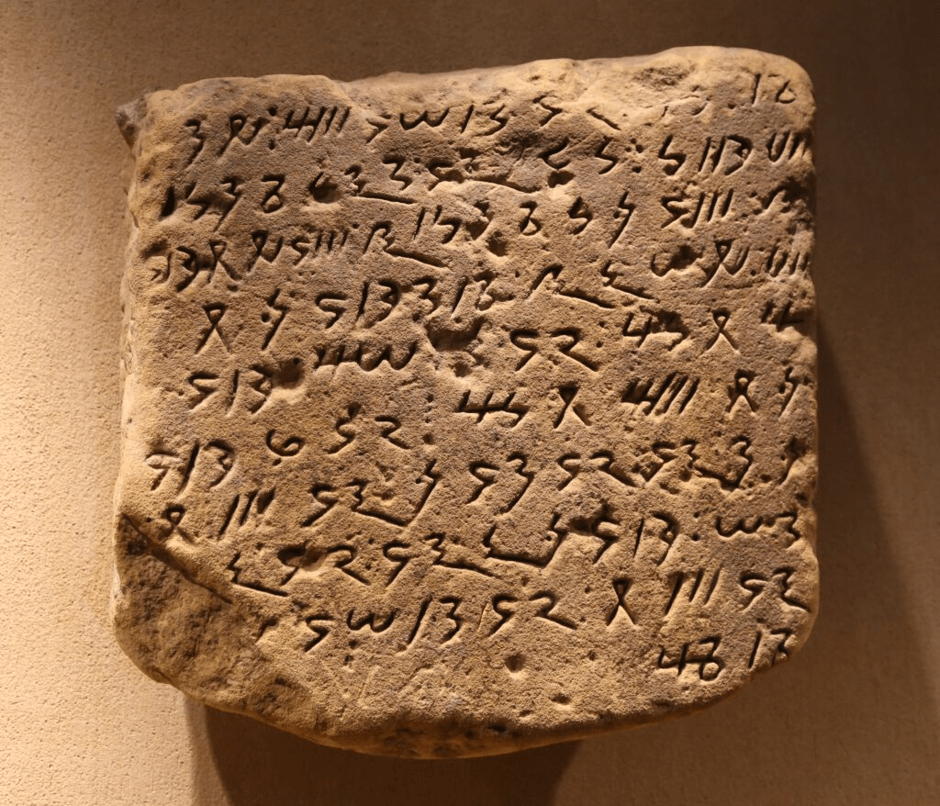
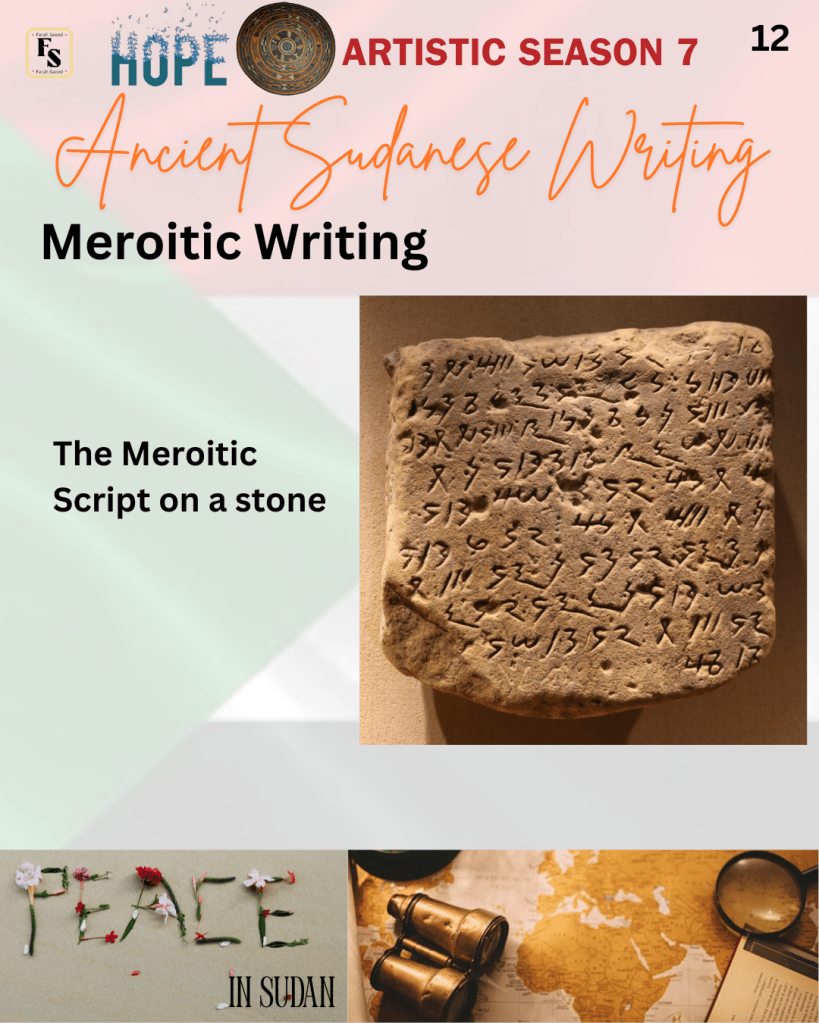
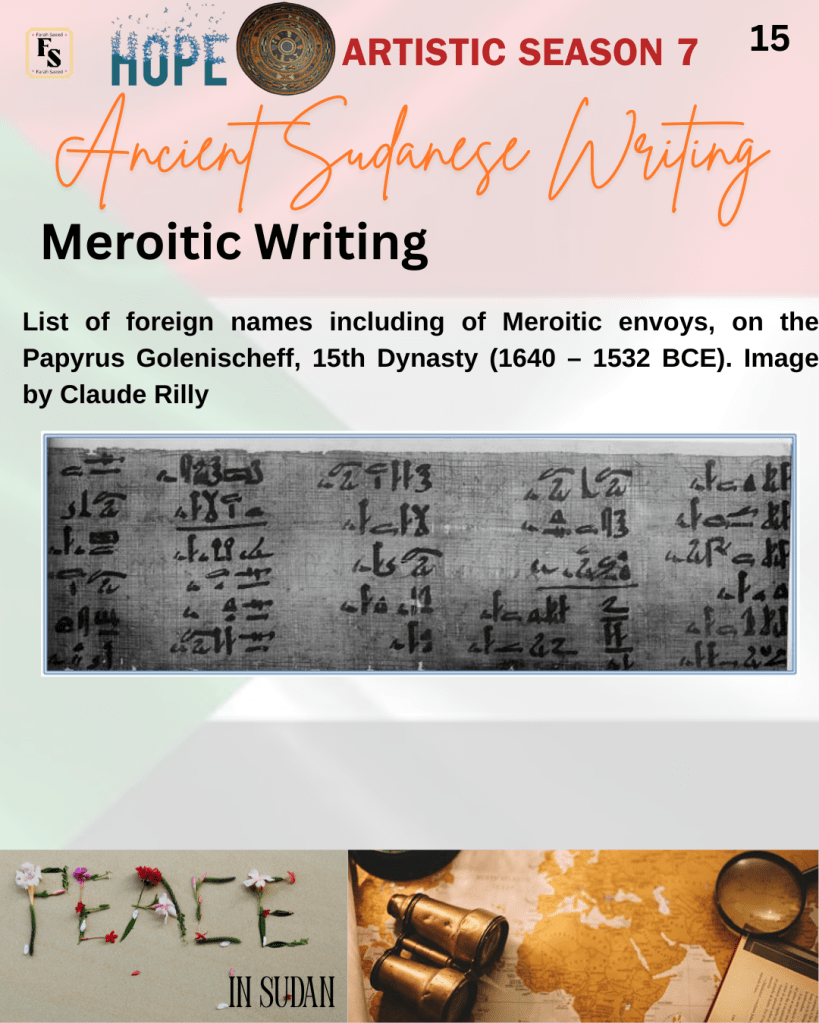
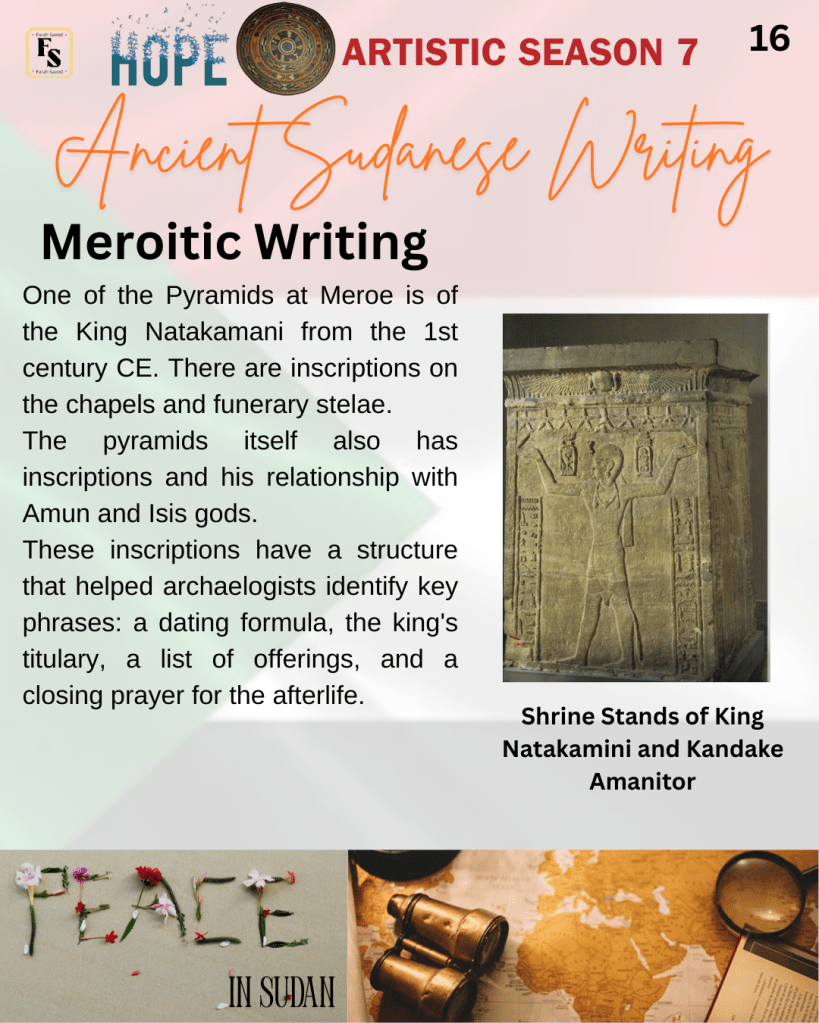
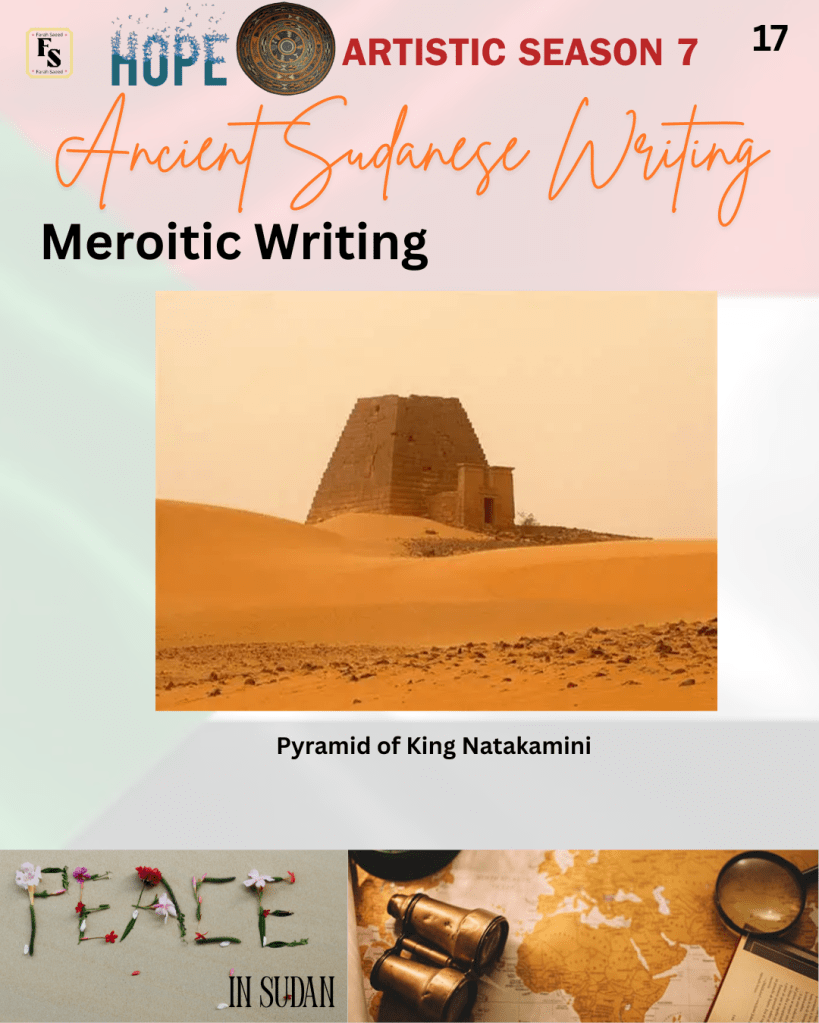
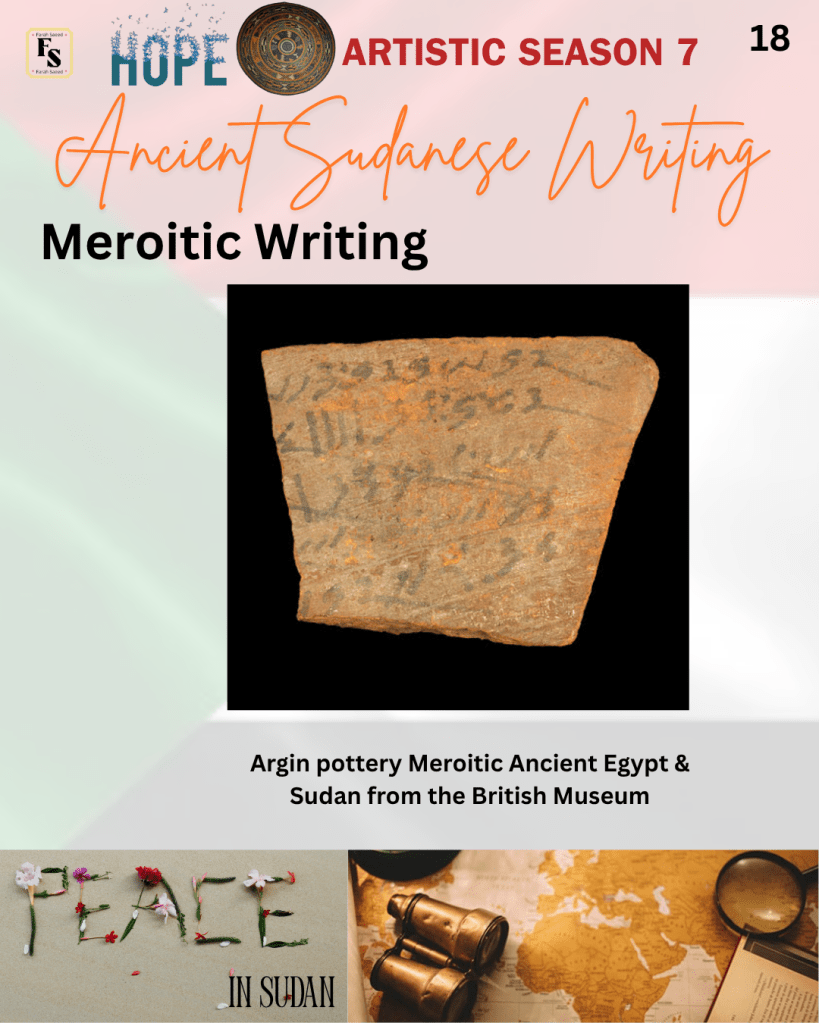
The Meroitic writing system, named after a capital of the Kushite Kingdom (present-day North Sudan), Meroë, is the most innovative ancient writing system created and was mainly used during the 25th dynasty (747-656 BCE). However, many of the scribes, elite, and pharaohs were educated in Ancient Egyptian hieroglyphics before the 25th dynasty, mainly in Middle Kingdom Hieroglyphics, with evidence of royal inscriptions. Today, archaeologists and Nubiologists continue to try to decipher the language to uncover its mysterical wonder of their way of life and how they evolved over time. The Meroitic inscriptions have been largely found in monumental structures, tombs, papyrus, funerary stelae, statues, pottery, wall paintings, and other artifacts at the necropolises. A necropolis is a large cemetery containing monuments.
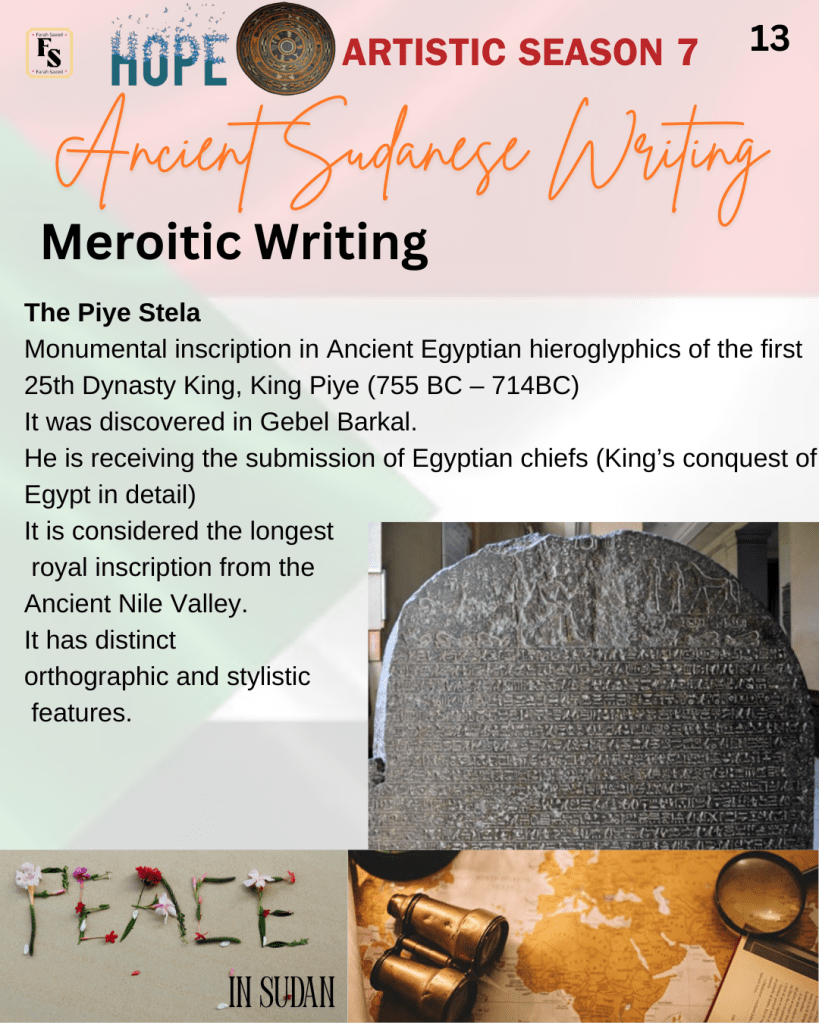
The capital of the 25th dynasty was Napata, and then it moved to Meroë. Examples of pharaohs at the time were Piye, Shabaka, Shebitku, Taharqa, and Tantamani. The most studied excavation sites, particularly at the royal stelae and pyramids from the necropolises in Sudan discovered by George Reisner at Nuri, el-Kurru, Jabal Barkal, and Meroe, hold prominence of the Napatan Dynasty and a crossroads between Ancient Egyptians and the Kushite Kingdom, where there is pharaonic in the foundation but Nubian in culture. A stela is a stone or wooden slab that has text or ornamentation as part of a monument.
There are also extensive archaeological remains like Meroitic funerary complexes at the Island of Sai that were incorporated as part of the Napatan Kingdom (9th to 3rd century BCE) and the Meroe Kingdom (3rd century BCE- mid 4th century CE) and then later to Boutana. The transition in capital took place after the Assyrian invasion in the 7th century BCE, which resulted in a significant loss for Pharaoh Taharqa. Taharqa aimed to revive and shape the history of Egypt and Nubia by merging both Theban and Egyptian imperial ideology through architecture, art, religion, and writing. This can be seen in his efforts in monumental building.
The functional existence of the Meroitic writing system shares similarities with the Ancient Egyptian civilization, where they have been mainly used for recording religious beliefs, legal codes, royal achievements, military campaigns, and social purposes. Other influences such as Hellenistic, Roman, and indigenous sub-Saharan African traditions are particularly noted in their art, religion, and language contexts. This indicates the significance of the Royal City of Meroe, that were the centre of metalworking, pottery, glassmaking, and a prolific writing system of the Kushite civilization.
One archaeological evidence that has been found at the pyramid site of Al Nuri and El-Kurru was the funerary texts that had inscriptions from the Book of the Dead and Pyramid texts. This indicates their commitment towards Ancient Egyptian religious traditions and maintaining their own cultural prestige. Though not a book, the Book of the Dead is a compilation or collection of texts which the Ancient Egyptians believed to help the dead and guide them through the underworld known as Tuat. It consisted of prayers, hymns, formulas, and incantations. They studied discovered by Karl Richard Lepius, who translated the manuscript in 1846 by establishing number system that helped to distinguish chapters. Édouard Naville was encouraged by Karl Lepius to combine all 186 spells in three-volume collections.
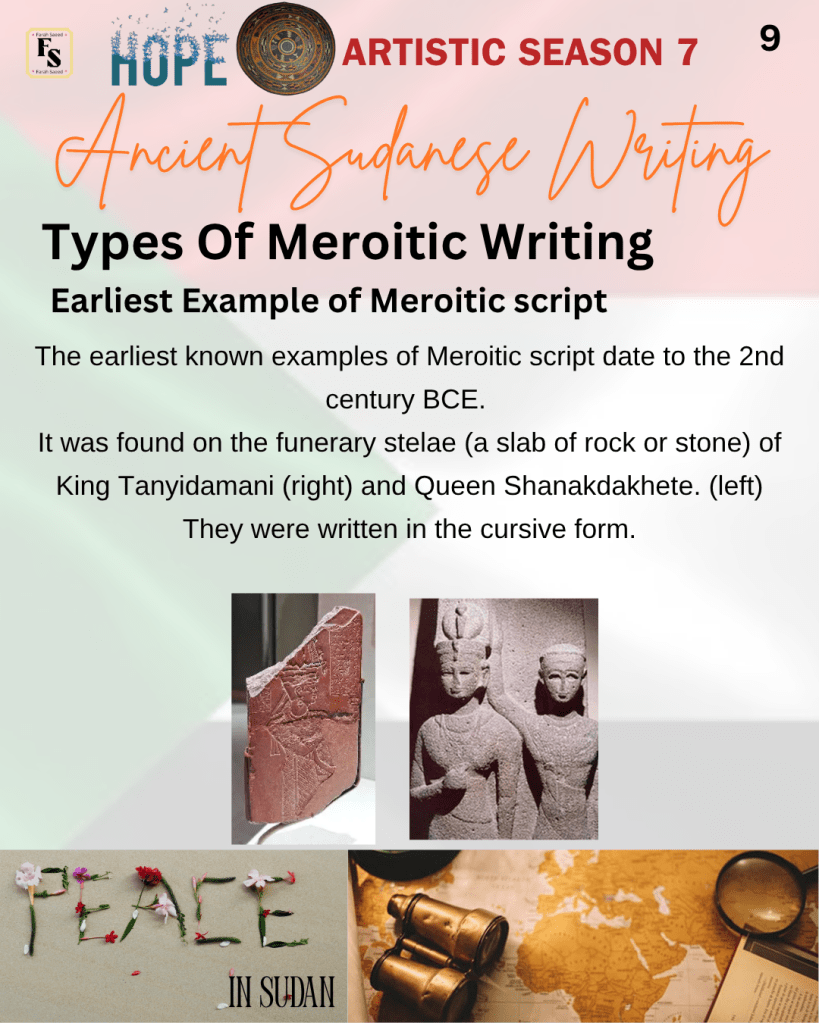
The transition of the Ancient Egyptian hieroglyphics to the formation of the Meroitic writing system developed around the 3rd century BC illustrates the growing sense of having a distinctive cultural identity known to the Kushite civilization while still maintaining close contact with the Egyptian culture to develop a unique writing system. The two main forms of the Meroitic language are hieroglyphics and cursive. In comparison to the Ancient Egyptian timeline of the transition from hieroglyphics, Hieratic, demotic, and then the Coptic language. The Meroitic cursive was established first, before the Meroitic hieroglyphics, and was mainly used for art, papyrus writing, and daily use for its simplified and practical purpose.
The Kushites were also familiar with Hieratic, the cursive form of hieroglyphics by the Ancient Egyptians, and were used for administration, records, contracts, and religious texts in Kush. They were found on papyrus fragments, ostraca, potsherds, wooden tablets, and stones because of their durability in comparison to papyrus documents. Ostraca are small fragments of pottery or stone that were used as a writing surface. It comes from the Greek word for ‘shell’ that refers to fragments used those resembled shells. Potsherds are broken pieces of ceramic material. The distinction between the materials used was that papyrus was fragile to survive Sudan’s climate, and only a few have been recovered from Qsar Ibrim in Lower Nubia.
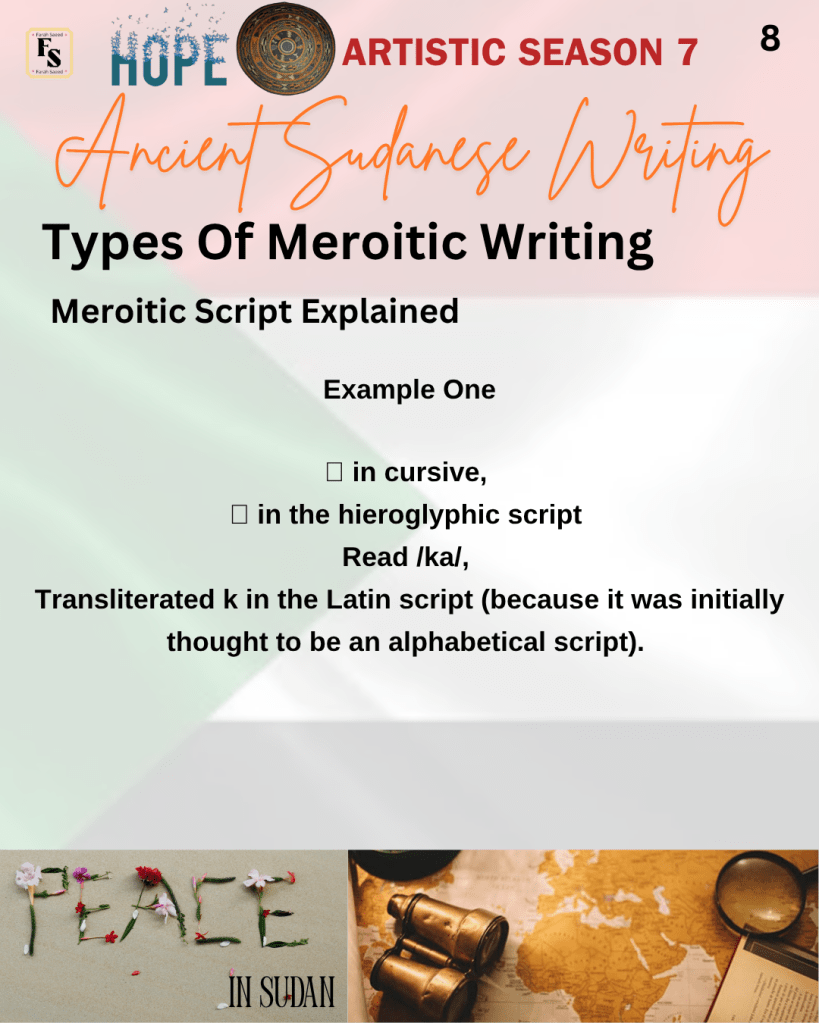
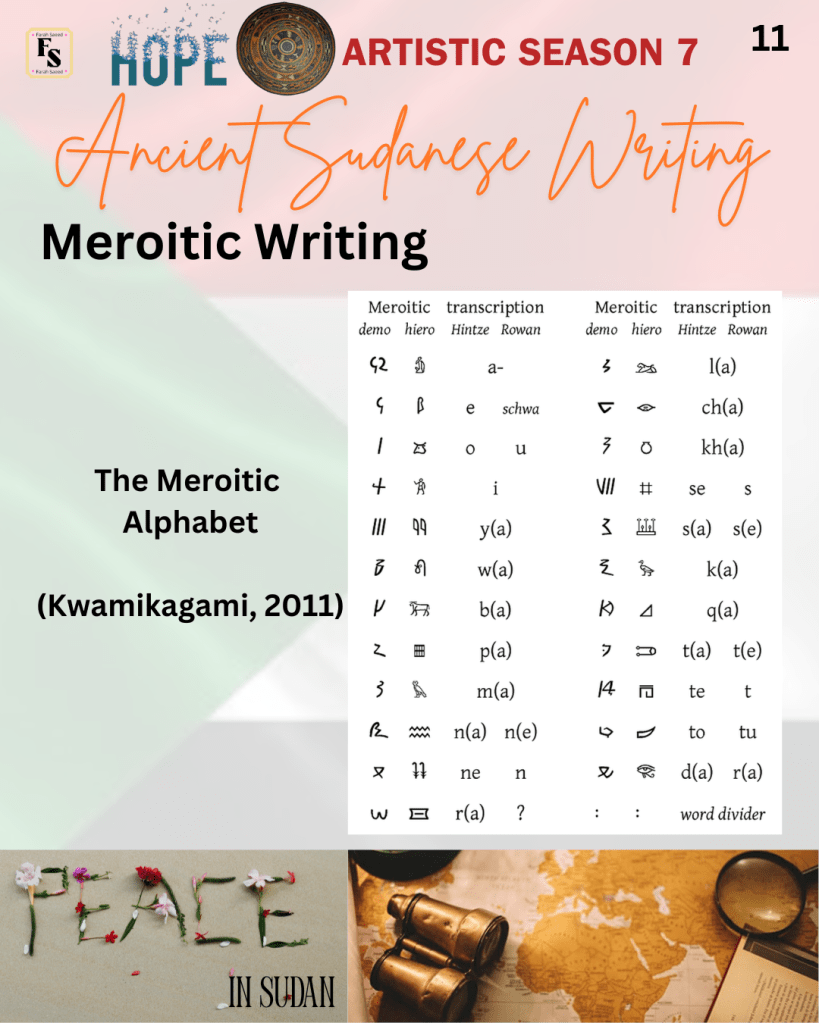
This may have been inspired by the Meroitic cursive script, where they share curves and long tails like the Ancient Egyptians (eg Hha 𐦮, Sa 𐦯, and Ka 𐦲). The Meroitic writing is an alphasyllabary, which is a type of writing system that combines alphabets and syllabaries. This is where consonant with inherent vowels and modifications to vowels. Inherent vowels e.g. abugida script, are vowel sound which is used with each unmarked or basic consonant symbol. Thus, it shares similarities with the Indian scripts, for instance Brahmi and Devanagari. Other inspirations are the Ge’ze script of Ethiopia and Eritrea, to examine the political and social history of the northern Horn of Africa.
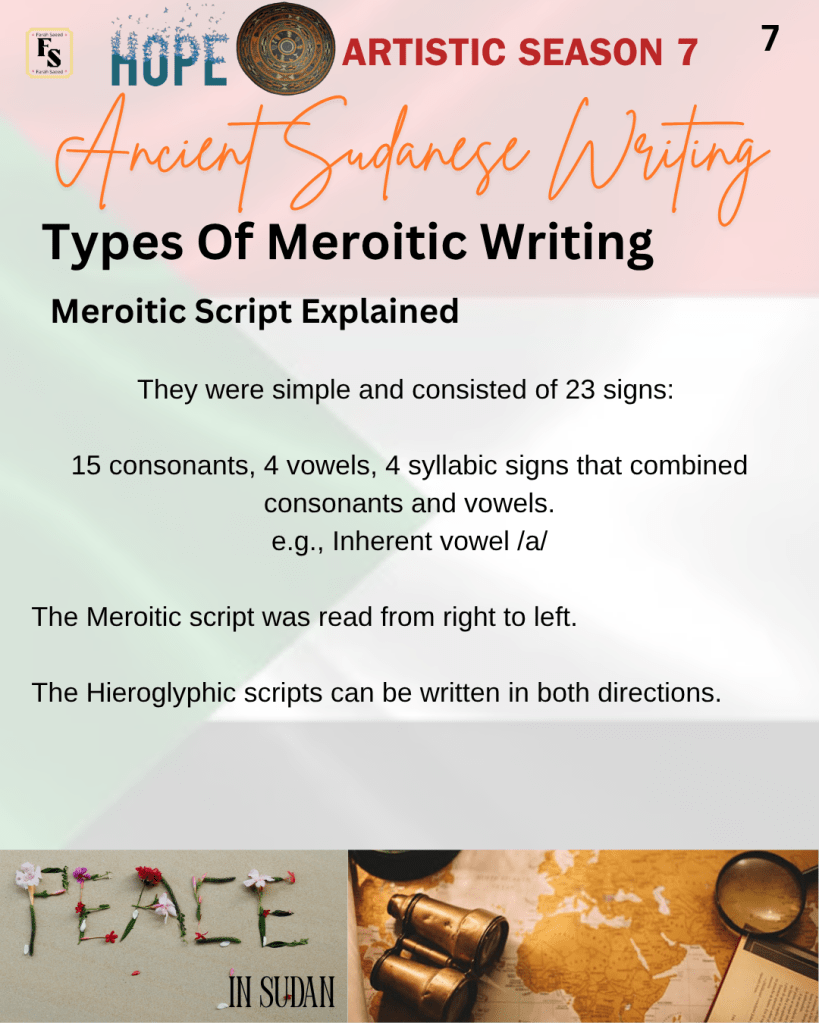
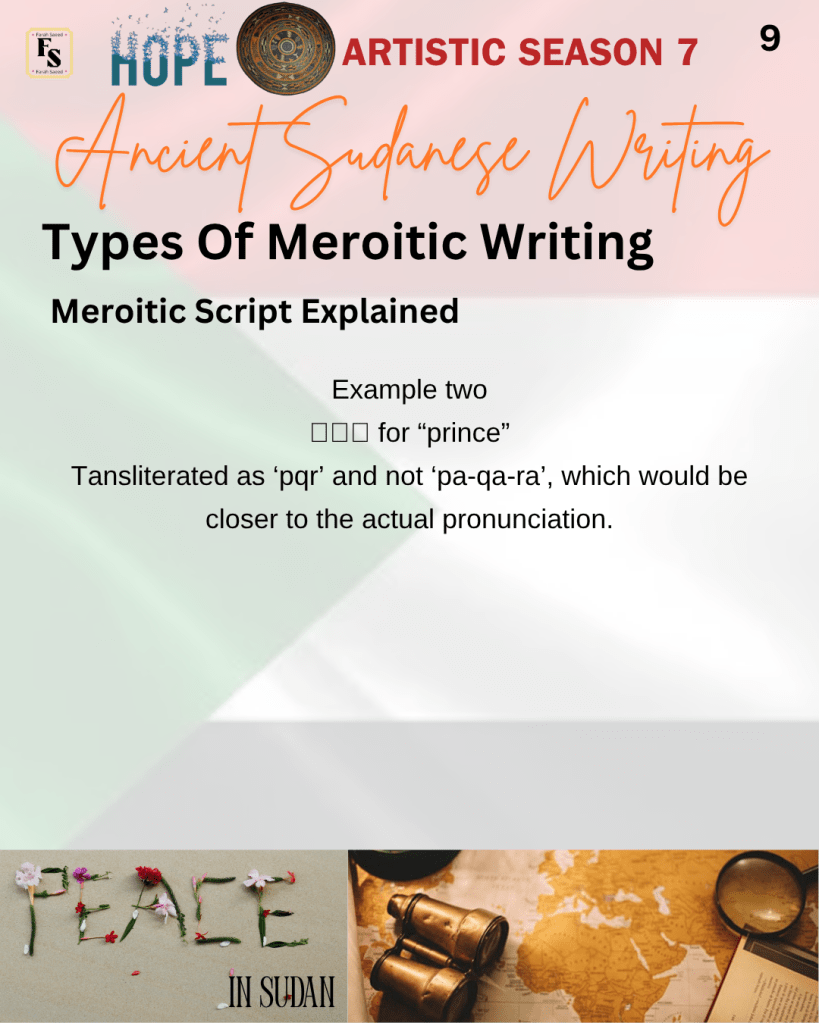
Some scholars have claimed that the Meroitic alphabetical system contains 23 signs: 15 were consonants, 4 vowels, and 4 syllabic signs that conjugate the consonants and vowels. On the other hand, other researchers, like Claude Reilly, have indicated that there are 16 basic signs for syllables; there is a default vowel “a” and three vocalic modifiers to write syllables with “e”, “ə” and “I” and “u”. There were four frequent syllables: “ne”, “se”, “te” and “to”. There was also a word-divider that consisted of two or three dots between groups of sentences.
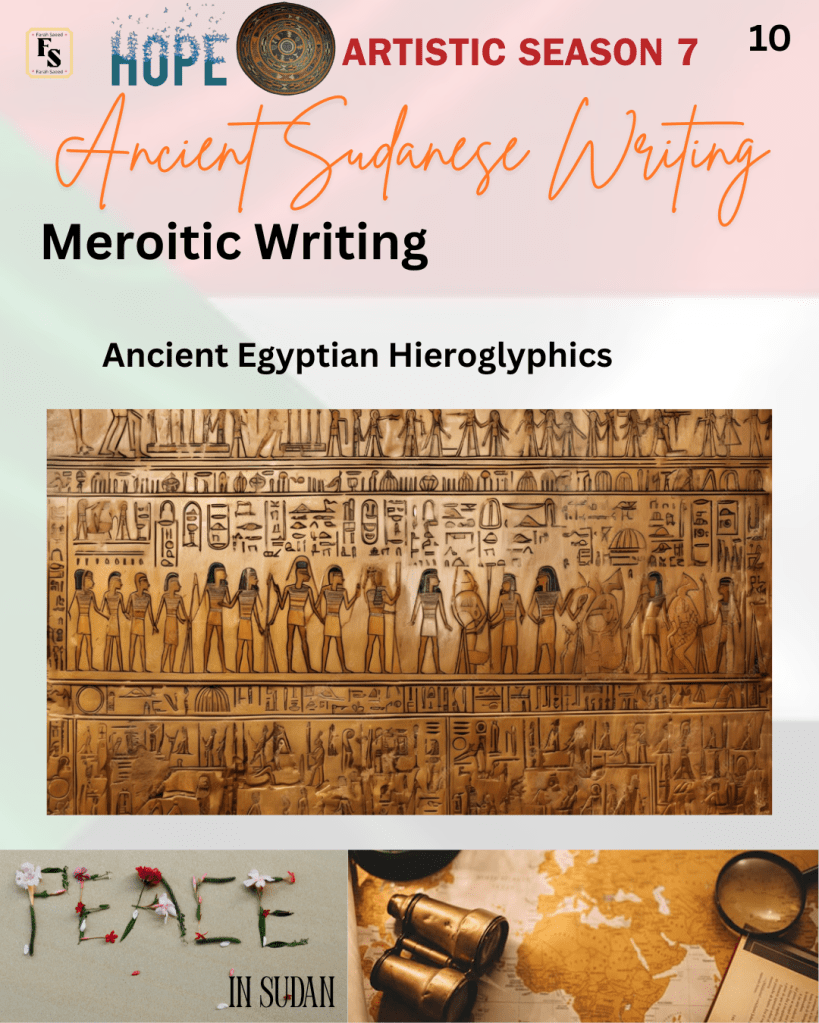
This distinguishes Ancient Egyptian writing from Ancient Meroitic script, where Meroitic is read from right to left and has a purely alphabetical script with signs presenting consonants and vowels, whereas Egyptian hieroglyphics had a logographic alphabetical system. However, Ancient Egyptian hieratic was written right to left in horizontal lines using black ink on papyrus. On the other hand, though Egyptian hieroglyphs are usually read from right to left, they can be written horizontally (rows) or vertically (columns) depending on the orientation of the glyph’s faces. For instance, if written in rows, it can be read from left to right or right to left. On the other hand, if in columns, it is read top to bottom.
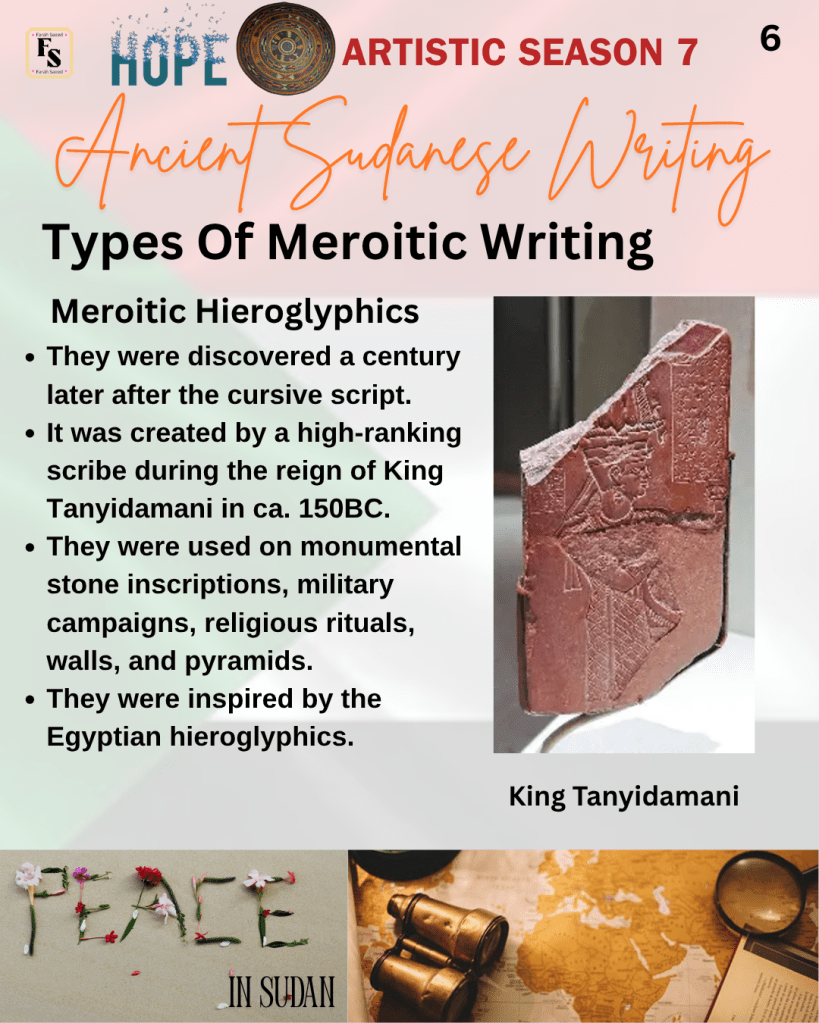
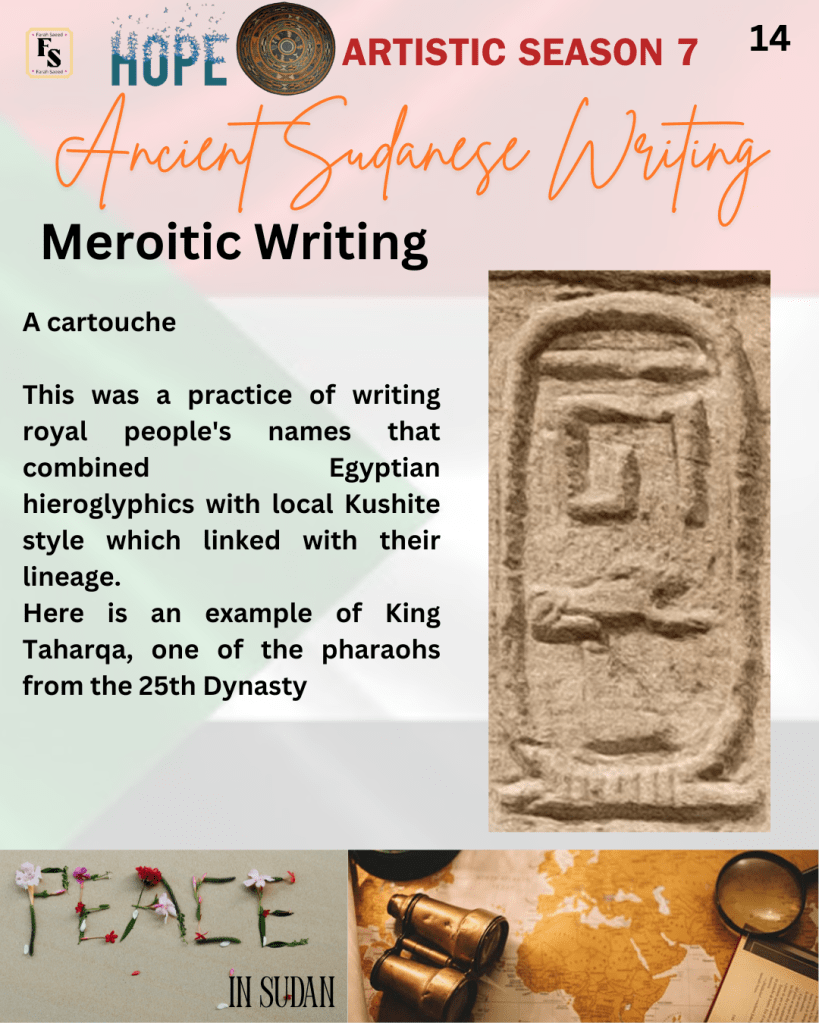
Following the Meroitic cursive script, the Meroitic hieroglyphics were established and replaced the Ancient Egyptian monumental inscriptions. It consisted of Meroitic cursive characters and one-to-one correspondence between signs. The signs were selected from the Ancient Egyptian hieroglyphics. One innovation was the specific use of determinatives. These are signs that indicate a category of a word. For example, Kushite or Nubian had a sign and sometimes had a feather or bow motif to distinguish the identity of the kingdom. The Kushite scribes also shared Egyptians words phonetically, using groups of signs to establish a local pronunciation. This indicates how Egyptians spoke in the southern Nile valley. Moreover, the ancient Egyptians wrote royal names in a cartouche. This is a type of royal enclosure that combined Egyptian hieroglyphics and local style. Of their lineages and favour.
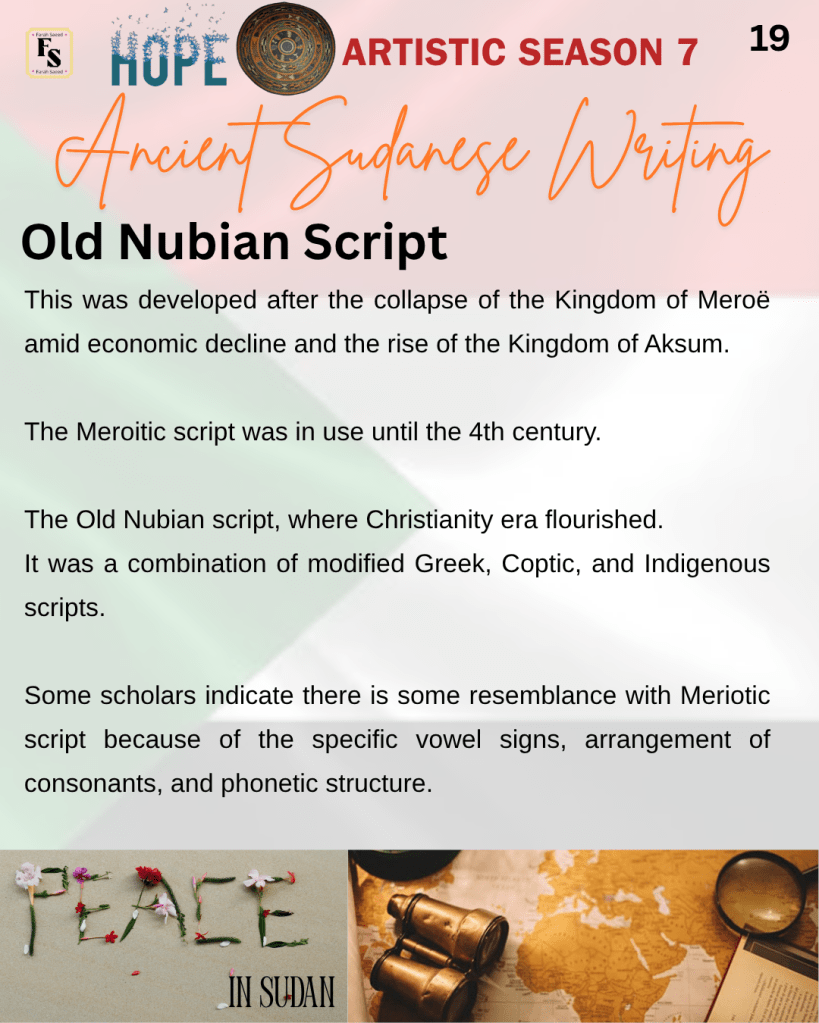
On the contrary, the Meroitic script was continuously used until the 4th century and disappeared in the 5th century CE when the Kushite Kingdom collapsed due to economy and rise of the Kingdom of Aksum (100-940 CE). The Kingdom of Aksum was situated in modern Ethiopia and Eritrea, known for its powerful civilization of trade, religion, and culture.
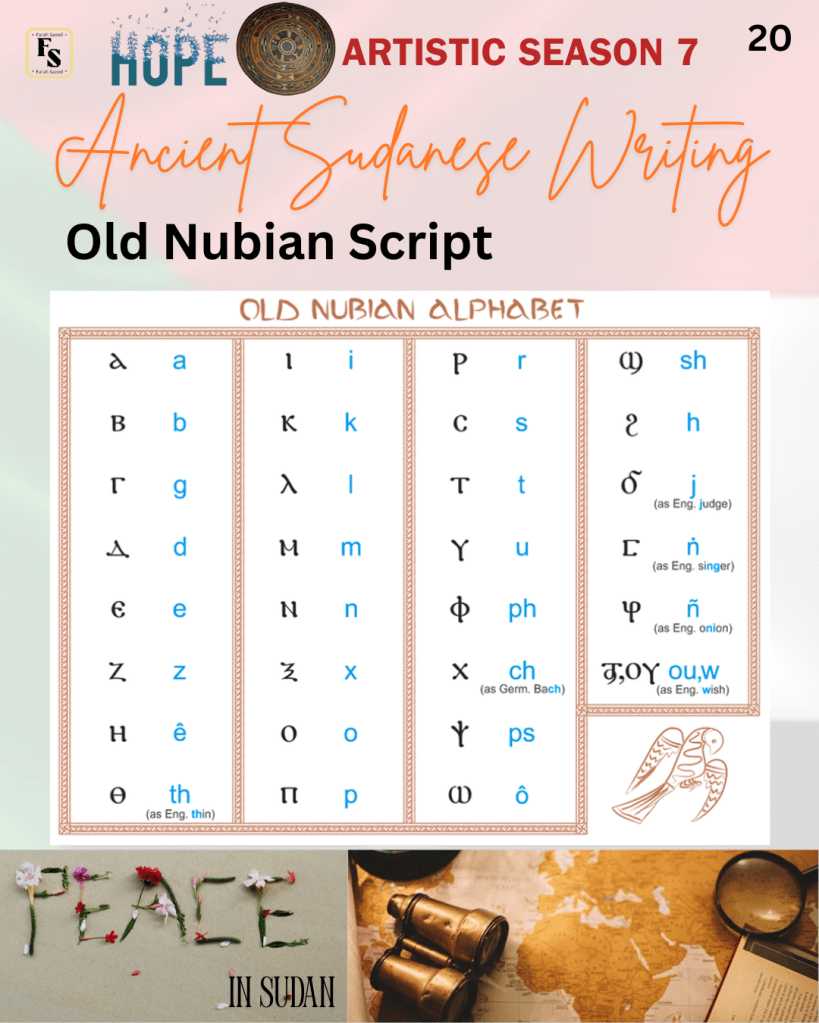
However, a new script emerged known as the Old Nubian script during the 6th to 14th century Christian Nubian period. It distinguished itself from Meroitic as it was a combination of modified Greek, Coptic, Latin, and indigenous characters but maintained cultural memory of previous written influence, where there is some parallel in terms of phonetics and vowel signs and how they were arranged. For instance, it integrated three signs from the Meroitic script, which remained until the Islamic era of the Ottoman Empire. This suggests the mirror effect of the Meroitic kingdoms of Nubia in the pre-Christian period and the Old Nubian script.
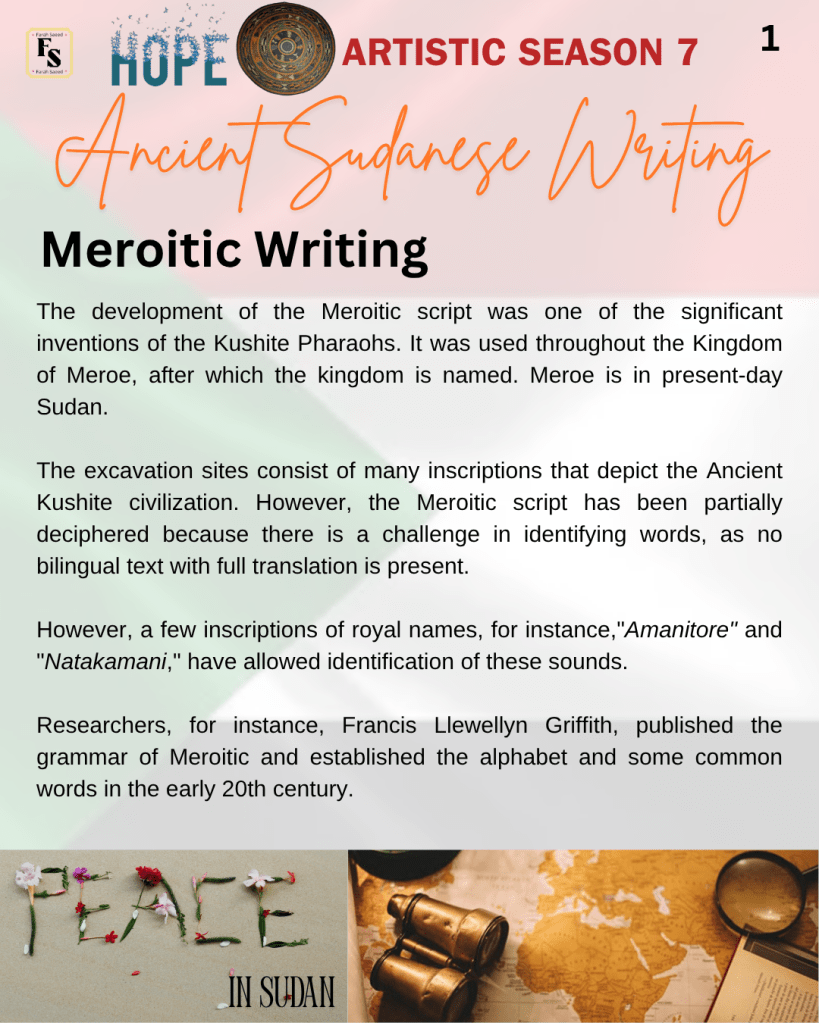
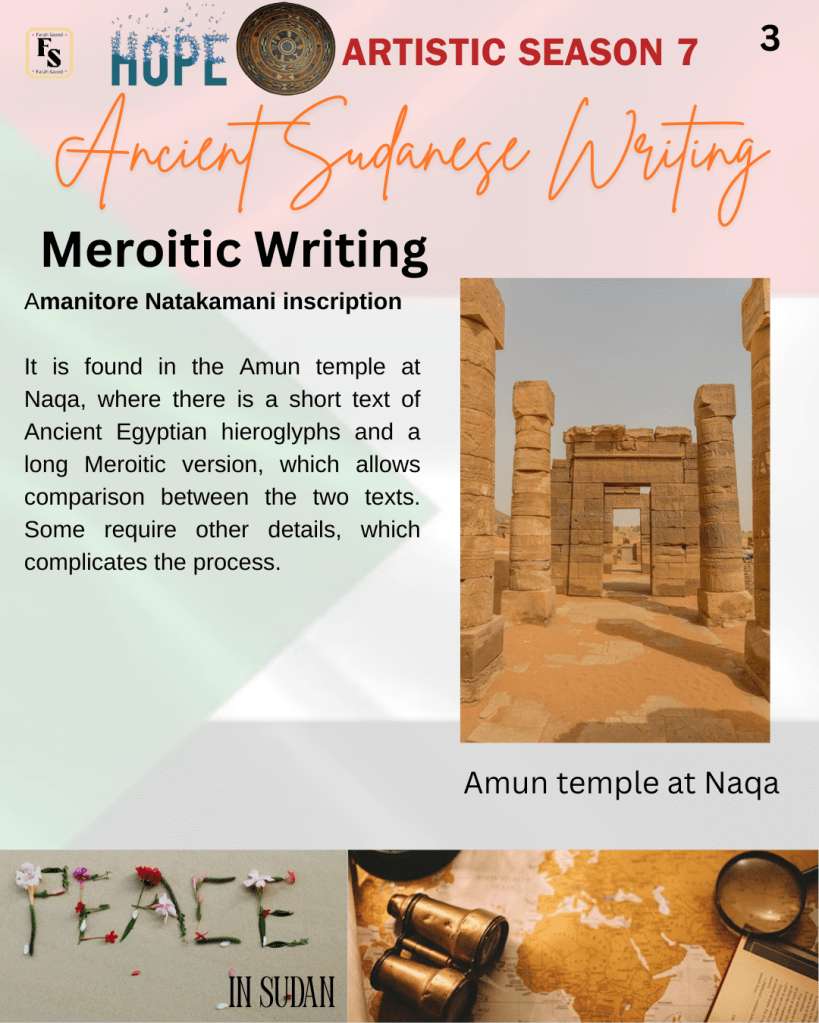
There is ongoing decipherment because there is no bilingual text with an appropriate translation has been found. The initiation of decipherment began when identifying the sound values of royal names like “Amanitore” and “Natakamani”. Efforts have been made by archaeologists, for instance, Francis Llewellyn Griffith in the early 20th century, when he was able to identify common phrases and the alphabet and simple information. The advent of the Meroitic Script Digital Corpus and the International Meroitic Congress has allowed researchers to make steady progress, where imaging, computational linguistics, and new scripts found at places like Meroe pyramids, Qasr Ibrim, and Kalabsha have offered new insights.
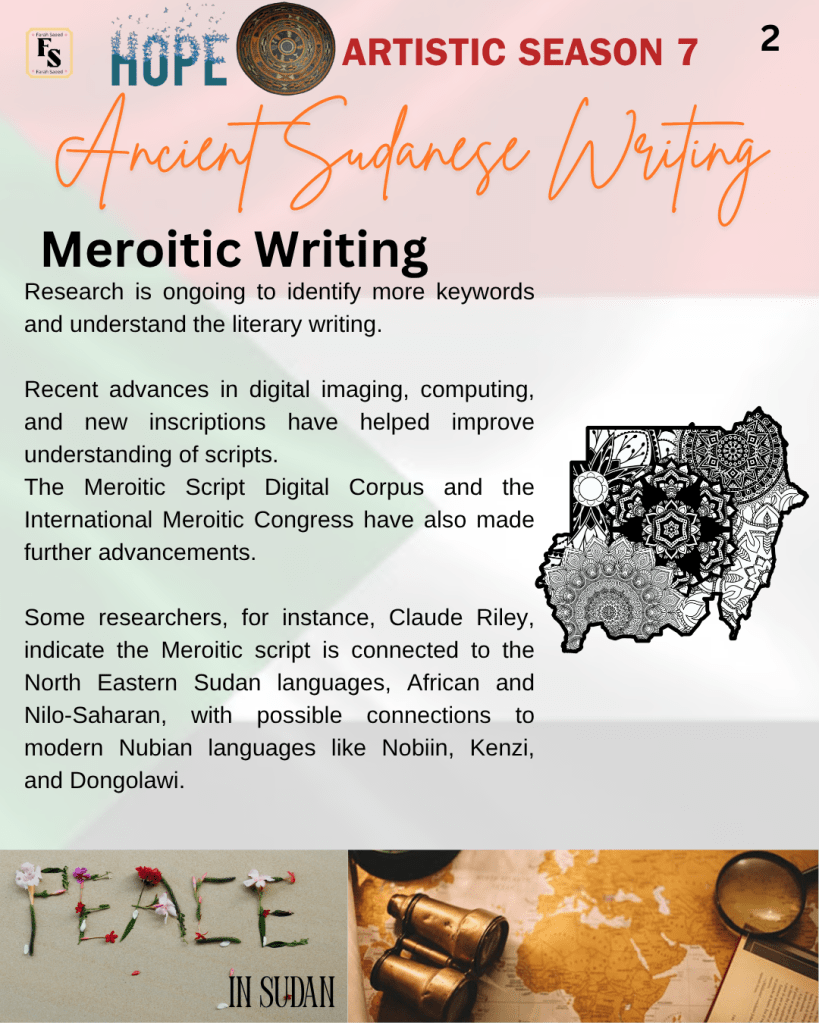
For instance, scholars like Claude Rilly discovered that Meroitic is not close to any known language and has possible connections with the Nilo-Saharan as a common ancestor of Northern Eastern Sudanic languages like the Maasai of Kenya and Toubou of Chad. There is also an essence of Nubian language of Sudan, Nara of Eritrea, Taman of Chad/Sudan, and Nyuma of Sudan’s Nuba Mountains. Other modern Nubian languages include Nobiin and Kenzi-Dogolawi. It facilitates translation; for instance, the Meroitic word for “water” (ato) is similar to the Nobiin word “ati,” where there is a linguistic resemblance.
Other hypothetical discoveries Claude Rilly indicated are demotic, and hieroglyphics were used to make the Meroitic cursive script that appeared in the 3rd century BCE, but evidence is lacking.
Furthermore, the language of Sudan today is a fusion between Arabic in the North and South, mainly with tribal indigenous languages, where the aim is to convert the culture to Arabic, which is one of the causes for the ongoing civil war. There are more than 100 Sudanese tribes, and 35% have the Nubian language of Faditcha, and 20% are of Kenuz with Meroitic origins. Examples of languages with Meroitic origins are Fur of Darfur, Kordofan in western Sudan, Chad, and Ethiopia. This presents a connection between the Nubian language and Africa South of the Sahara.
Overall, the Meroitic inscription developed by the Kushite Kingdom is symbolic of the rich and diverse Sudan’s cultural and historical tapestry and the influence of Ancient Egyptians. They served for monumental, religious, and administrative purposes. Today, the Meroitic script is taught in some universities in Sudan as an encouraging movement to revive interest in the history of Sudan and the Nubian diaspora. Researchers in the fields of linguistics, archaeology, and Nubiology continue their quest to decipher the Meroitic script with curiosity about understanding the Ancient Kushite civilization.
References
Ancient Egyptian Online (n.d) The Book of the dead. Available at: https://www.ancient-egypt-online.com/book-of-the-dead.html (Accessed: 21st June 2026)
Dr. Abdelrahman Ali Mohamed (2017) Sudanese Cultural Heritage Sites Available at: https://sudan.un.org/sites/default/files/2019-10/180520_WH%20sites%20Final%20en_0.pdf (Accessed: 21st June 2026)
Encyclopaedia Africana (2026) SUDAN: MEROITIC. Available at: https://encyclopaediaafricana.com/sudan-meroitic/ (Accessed: 21st June 2026)
Everything Explained Today (2026) Inherent vowel explained. Available at: https://everything.explained.today/Inherent_vowel/ (Accessed: 21st June 2026)
History Rise (2025) Kushite Pharaohs’ Contributions to the Development of Nubian Writing Systems. Available at: https://historyrise.com/article/kushite-pharaohs-contributions-to-the-development-of-nubian-writing-systems/ (Accessed: 21st June 2026)
International Kurru Archaeological Project (2026) History of Excavations. Available at: https://ikap.us/excavations/history-of-excavations/ (Accessed: 21st June 2026)
Kwamikagami (2011) Meroitic Script. Available at: https://www.worldhistory.org/image/536/meroitic-script/ (Accessd: 21st June 2026)
Ministere de la Culture (2026) Saï: an island at the heart of Nubia. Available at: https://archeologie.culture.gouv.fr/en/sai-island-heart-nubia (Accessed: 21st June 2026)
Radar Africa (2023) Sudan’s ancient “Meroitic” writing system. Available at: https://radarafrica.com/discover/sudans-ancient-meroitic-writing-system/ (Accessed: 21st June 2026)
Rilly, C. (2022). Meroitic Writing. UCLA Encyclopedia of Egyptology, 1(1). Retrieved from https://escholarship.org/uc/item/2ts0n9p0 (Accessed: 21st June 2026)
Samuel, I. (2024) The Meroitic script and the documents of ancient Kush (ca. 300BC-450CE). Available at: https://www.africanhistoryextra.com/p/the-meroitic-script-and-the-documents (Accessed: 21st June 2026)
Sharm Club (2026) Nubian people: culture, traditions, way of life | Nubian heritage in Egypt Available at: https://www.sharm-club.com/egypt/traditions/nubians (Accessed: 21st June 2026)
The Archaeologist (2026) The Kingdom of Aksum: The Forgotten Empire That Rivaled Rome. Available at: https://www.thearchaeologist.org/blog/the-kingdom-of-aksum-the-forgotten-empire-that-rivaled-rome (Accessed: 21st June 2026)
World History Edu (2026) Pharaoh Taharqa: The Kushite King who ruled Ancient Egypt. Available at: https://worldhistoryedu.com/pharaoh-taharqa/ (Accessed: 21st June 2026)


Leave a Reply