
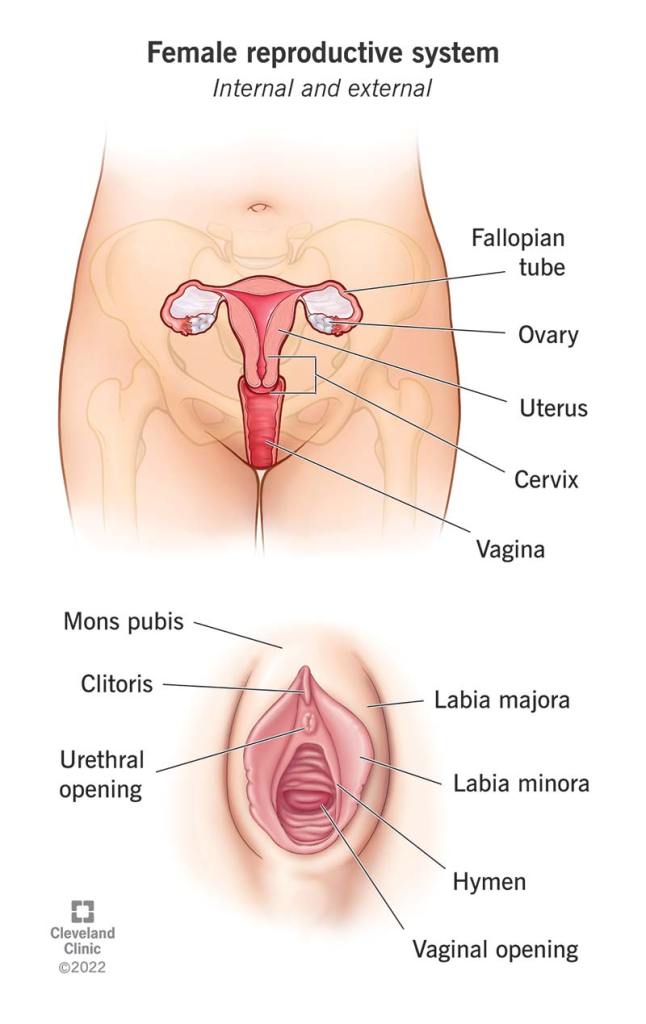
A “taboo” is when a substance is neither discussed nor acknowledged because of social or cultural norms. There is a pressing number of gynaecological cancers worldwide, and this is caused by an imbalance in healthcare approaches in patient-centred care between high-income countries (HICs) like the United Kingdom and low-income countries (LICs) and low- and middle-income countries (LMICs). Gynaecological cancers are cancers that affect the female reproductive system (womb, ovaries, fallopian tubes, vulva and vagina).
Gynaecological cancers are cancers that affect the female reproductive system (womb, ovaries, fallopian tubes, vulva and vagina). A sixth type of gynaecologic cancer is the very rare fallopian tube cancer. Cancer is where cells grow uncontrollably. All types of gynaecological cancers vary in the number of cases, death, prognosis and the risk factors. Prognosis is how the patient is responding over the course of the disease. However, there are several overlapping risk factors. For instance, though they are rare cancers, the vagina, vulva and cervix are strongly associated with the human papilloma virus (HPV) infection. Other risk factors are poorly understood. The most common gynaecological cancer is the endometrium, that appears on the lining of the womb. It is often diagnosed during the early stages because the signs and symptoms are well-defined. On the other hand, ovarian cancer is the most common gynaecological cancer associated with high death rates. This is caused because of the vague signs and symptoms, lack of effective screening tests which leads to detecting cancer during late stage. There is also minimal progress in ovarian cancer treatment.
Specialists in the field of women’s health have many years of experience and have highlighted that, to close the gynaecological gap, a continuum of raising awareness is needed to overcome the stigma, shyness, shame, cultural and social attitudes, and myths associated with women’s reproductive system, menstruation and sexual bonding, and, on a universal level, sexuality. Symptoms, for instance, abnormal vaginal bleeding and other signs, are also often overlooked. As a female doctor and cancer researcher, it is vital to raise awareness of all types of cancers regardless of gender.
In many cultures, there are several misconceptions and misunderstandings about reproductive health. This is especially pronounced in many countries worldwide, namely in Africa and Asia, where there are limited resources, economic disparities, inadequate access to healthcare facilities in rural and remote areas, and marginalised societies. This leads to missed routine check-ups, vulnerability, psychological distress, lack of preventive screening, delayed treatment, or compromised care. Some religious norms also restrict discussion on reproductive health.
The only gynaecological cancer that has an approved screening programme is cervical Cancer, where, in combination with the human papillomavirus (HPV) vaccine improve the control of cervical cancer. However, it is a significant public health concern in developing countries. Amongst the global strategies of the World Health Organisation is to ensure 90% of girls worldwide have had the HPV vaccine by age 14. It is estimated that 70% of women will be screened with a high-quality test by age 35 and 45, and 90% of women with cervical disease will receive treatment. On the other hand, only 9% of females in LLMICs had undergone cervical cancer screening.
Another area of limitation is the variation in cancer research. In HICs, cancer research is a strong driving force to improve the quality of patient care and learn new ways to detect and treat cancer. On the other hand, in LMIC countries, strategies normally applied are developed from research conducted in HICs and transferred to LLMICs with the aim of successful implementation in care practice.
Therefore, the main avenues for high incidence rates are: High out-of-pocket expenses for gynaecological treatments, which can be a barrier for many women, leading to limited or no access to essential services; constraints on resources; sociocultural barriers; lack of training; low workforce; and poor public awareness.
Why is raising female cancer awareness important?
The more public awareness, the lower the incidence rates, the fewer infections go undetected, the higher the survival rates, the lower the death rates (mortality), and the more women access care where necessary.
Around the world, significant efforts have been made in communities and at the societal level to address limitations and improve care practices that are inclusive, culturally sensitive, respectful, and accessible. Adequate training, well-equipped clinics, and outreach programmes are needed to reach marginalised communities and to empower women to improve their gynaecological health, attend screening, and develop a competent workforce will further remove disparities, help overcome delays in diagnosis and treatment in female cancer care, and support universal health coverage.
The aim of FST, via its humble nature, is to provide FREE, detailed, accurate, and high-quality information on the types of cancers that arise in the female reproductive system, the risk factors, signs and symptoms, tests, and ways of treatment and prevention, and improve the quality of life holistically in diverse cultural contexts and quality references.
References
Illah, O., Morhason‐Bello, I., and Olaitan, A. (2024). A review of the global inequalities in the management of gynaecological cancers. The Obstetrician & Gynaecologist. doi:10.1111/tog.12957.
Millhone, C. (2026) What Cancer Is Considered Taboo In Women? Available at: https://www.fertilehope.org/what-cancer-is-considered-taboo-in-women/#google_vignette (Accessed: 22nd August 2026)
Pal, A. (2023) Cultural and Social Factors Affecting Women’s Gynaecological Health. Available at: https://privategynaecology.co.uk/cultural-and-social-factors-affecting-womens-gynaecological-health/ (Accessed: 21st August 2026)
Recommended Article To Read
Further Reading and Supporting Resources
https://www.macmillan.org.uk/cancer-information-and-support
Ovarian Cancer
https://www.cancerresearchuk.org/about-cancer/ovarian-cancer/living-with/resources-organisations
Endometrial Cancer/Womb Cancer
https://www.cancerresearchuk.org/about-cancer/womb-cancer/living-with/resources-organisations
Vaginal Cancer
https://www.cancerresearchuk.org/about-cancer/vaginal-cancer/living-with/resources-books
Vulval Cancer
https://www.cancerresearchuk.org/about-cancer/vulval-cancer/living-with/resources-organisations


Leave a Reply