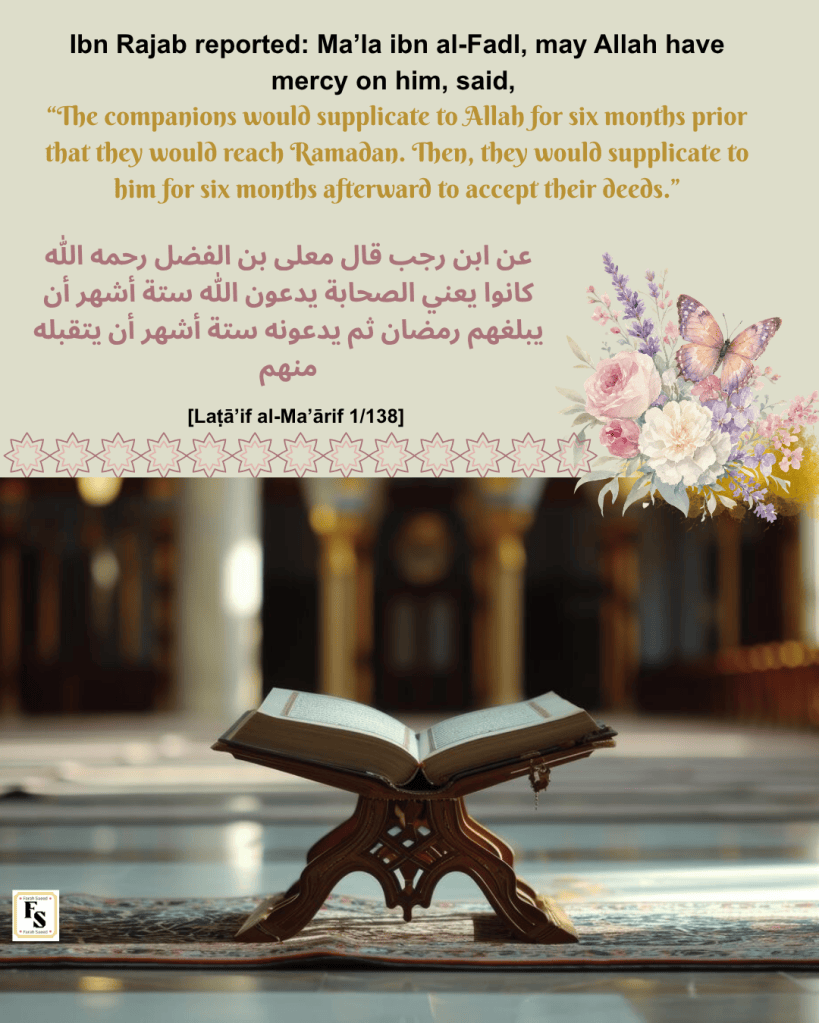
We are a few months away from the blessed month of Ramadan, one of Islam’s five pillars. A time to draw closer to Allah (The Most High) and excel in good deeds. The consciousness and duty of fasting this month not only allow us to comprehend how many people across the world are tested by poverty but also give us the ability to suppress any negativity, as our tongues, ears, eyes, and all our senses are also in the state of fasting. Discipline and rigour help us to face the reality of our purpose in life and become truly subservient to His Will. To seek His Mercy, to seek His Protection from His Wrath and the Hellfire, and to continue to guide us onto the right path and what pleases Him. Ramadan is the ninth lunar month that appears once a year, and it is important to prepare ourselves and all in general. We need to ask Allah (The Most High) to help and allow us to witness one of the most important months in the year once again with gratitude, enthusiasm, and eagerness. This was how the Sahabah (Companions) of the Prophet used to do for six months before Ramadan and then the other six months, asking Allah (The Most High to accept their fasts and efforts during the blessed month of Ramadan.
One of the companions of the Prophet Muhammad (peace be upon him), Umar Ibn Khattab (may Allah have mercy upon him), developed the Islamic calendar in 638 AD. Every lunar month has a particular meaning, and scholars like Al-Haafiz Ibn Katheer (may Allah have mercy on him) said regarding Jumada Al-Awwal (The 5th month of the lunar calendar), also written as Jamada Al-Ula, that it refers to the freezing of the water because of the cold weather at the time.
“In their calculations, the months did not rotate through the seasons, although there is some doubt concerning that, because their months were connected to the lunar cycle, so they would inevitably rotate through the seasons. Perhaps they called Jumaada by this name the first time, when water froze because of the cold. The plural form of Jumaada is Jumaadiyyaat, like the word hubaara (pl. hubaariyyaat). The word may be either masculine or feminine, so one may say Jumaada al-Oola or al-Awwal, and Jumaada al-Aakhir or al-Aakhirah.”
“Ramadan, on the other hand, is derived from the word ramda ’, meaning intense heat. Another word from the same root is used to refer to the thirst of camels when they become thirsty. The plural form is Ramadaanaat or Ramaadeen or Armidah.”
Tafseer Ibn Katheer (4/128-129)
Other scholars referred to it as being associated with the Ariid, dry or rainless months. The meaning may be “to take charge with, commend, commit, or care during this month”
Yahya ibn Abi Kathir, may Allah have mercy on him, would supplicate when the month of Ramadan arrived,
“O Allah, secure me for Ramadan, secure Ramadan for me, and receive my deeds with acceptance.”
[Ḥilyat al-Awliyā’ 3/69].
Jumada Al-Awwal marks the midpoint of the Islamic Hijri Calendar.
What Is The Significance of the events that took place in Jumada Al-Awwal?
There was a range of happy and sad moments that occurred in the life of the Prophet Muhammad (peace be upon him) during the month of Jumada Al-Awwal. Though it is not one of the sacred months, it holds strong significance in Islamic history. The four sacred months are: Muharram, Rajab, Dhul-Qidah, and Dhul-Hijjah. The events of Jamada Al-Awwal form part of the Seerah (biography) of the Prophet Muhammad (peace be upon him). It can be subdivided into new additions to his family, the passing away of relatives and friends, and the battles.
Historically, there was a battle between the Romans of the Byzantine Empire and Arabs (200000) against the Muslims (3000) during this month in the 8th year of Hijrah (8 AH). It took place in what is now near modern-day Jordan, and was led by one of the companions of the Prophet Muhammad (peace be upon him), Zaid ibn Al-Harith (may Allah have mercy upon him). This was rooted in the frequent attacks and torture by the Romans and their Arab allies that attacked the goods of Muslims from Ash-Sham (Levant) and caravans on their roads. They also killed Harith ibn Umayr Al-Azdi (may Allah have mercy upon him), who tried to call the king of Busraa to Islam, Shurahbeel ibn Am Al-Ghassani. The Prophet Muhammad (peace be upon him) was not present and advised them to defend themselves from their horrific attacks. He also had a concern for their welfare, though he was far away in Madinah.
If Zayd ibn Haarithah is wounded, let Ja‘far ibn Abi Taalib succeed him. If Ja‘far is wounded, let ‘Abdullaah ibn Rawaahah succeed him.”
[Hadith, Al-Bukhari and Muslim]
Khalid (may Allah have mercy upon him) then took leadership to save the Muslim army and used a tactic by altering the organisation of his army. He replaced the right wing with the left and the vanguard with the rearguard. His cavalry created dust and noise, and the Romans assumed that the Muslims had reinforcements; the Muslims then launched an attack, which helped to defend and protect the Muslims. However, there were some who fled away. They wanted to travel away by sea and leave Al-Madinah, a city in Saudi Arabia, but wanted to consult the Prophet (peace be upon him) as they feared his anger and Allah’s wrath.
They went to the Prophet Muhammad (peace be upon him) before the dawn prayer. When he saw them, he asked: “Who are you?” They replied: “We are those who fled.” The Prophet (peace be upon him) said: “No! Rather, you are those who will return to the fighting. You are not to be blamed; you joined me, and I am the recourse of all Muslims.” They therefore drew near him and kissed his noble hands.
The most important lesson that can be established here is Tawakkul (Reliance) on Allah (The Most High), for they fought for the sake of Allah and faced the armed forces that caused them harm. Allah gave them success for their courage, willful loyalty, and the struggle faced to help preserve their faith.
However, this victory led to the martyrdom of several of the companions of the Prophet Muhammad (peace be upon him): Zayd ibn Harith, followed by Jaffar ibn Abi Talib and then Abdullah bin Rawahah (may Allah have mercy upon them all). It was said that all of them fought bravely, and the scholars have said that Jafar ibn Abi Talib fought heroically, though there are several reports. Some of them said that he fought until he had 90 wounds on his body; another said he saw his right hand cut off; another reported his left hand was cut off. Another reported that both of his arms were cut off and said the following:
“How wonderful is paradise as it draws near! How pleasant and cool is its drink! Punishment for the Byzantines is not far away!”
There is a hadith narrated by Abu Hurayrah (may Allah be pleased with him) that the Messenger of Allah (may Allah’s peace and blessings be upon him) said:
“I saw Ja‘far flying in Paradise with the angels.”
[Hadith, Sahih Al-Tirmidhi]
The scholars have explained that the Prophet (peace be upon him) dreamt of his cousin Jafar ibn Abi Talib flying in Paradise with the angels and hence was called Jafar Al-Tayyar “The Flying Jafar” and was also referred to as Dhu Al-Janahayn, meaning “The one with the two wings”. Thus, because his arms were cut off, they were replaced in Paradise with two wings.
Moreover, not only have his companions and cousin passed away, but also the Prophet’s grandfather, Abdullah Muttalib (may Allah have mercy upon him), passed away from natural causes.
On the other hand, shortly after the passing of Prophet Muhammad (peace be upon him), and in sadness and agony for her father, Fatimah, daughter of the Prophet (peace be upon him), passed away due to illness on the 13th of Jamada Al-Awwal and was buried by her husband and the Prophet’s companion, Ali bin Abi Talib (may Allah have mercy upon him).
However, there were also happy moments that happened in Jamada Al-Awwal.
Prophet Muhammad (peace be upon him) married his first supporter and one who believed in him, Khadijah bin Khawaylid (may Allah have mercy upon her), when she was 40 years old, and he was 25 years of age. One of their daughters, Fatima, who was married to Ali, gave birth to Zainab on the 5th of Jamada Al Awwal after Hassan and Hussain (may Allah have mercy upon them). This took place five years after Hijrah.
Some have also indicated she was born on the first day of Shaban, the 8th lunar month.
The respected scholars have said that:
In “serenity and thoughtfulness,” she was like Umm ul-Muminin Khadija, her grandmother (may Allah have mercy upon her). In “innocence and bashfulness,” she was like her mother, Fatima Zahra (may Allah have mercy upon her). In “fluency and expressiveness,” she was like her father Ali (may Allah have mercy upon him). In “leniency and fortitude,” she was like her brother, Hassan (may Allah have mercy upon him). And in “courage and repose of the heart,” she was like Hussain (may Allah have mercy upon him).
She also reflected her father’s admiration and grandfather’s esteem.
Zainab bint Ali bin Abi Talib (may Allah have mercy upon her. She had a good sibling in her brother Hussain, with whom she would smile when she was held up by him. This was admired by her family, including her mother and the Prophet Muhammad (peace be upon him). She was married to Abdullah ibn Jafar (may Allah have mercy upon him) and bore four sons (Awn, Ali, Muhammad and Abbas) and one daughter named Umm Kulthum (may Allah have mercy upon them all). The scholars have also admired her knowledge, advocacy for women, memorisation of the Quran, and tried to embed the mannerisms and ethics that Islam holds. She used to give lots of inspirational talks, including the Tafsir of the Quran (exegesis), and also taught Islamic law and gave in charity. She was a moving example of Islam, as everything was reflected in her actions, values, and manners, and she had a modest life of deep love for Allah and spent her day and night in solitude praying and fasting. She is laid to rest in Egypt to this day.
Another inspirational figure to ponder upon is the birth of the great-grandson of the Prophet Muhammad (peace be upon him), who was also born in this month – 15th of Jamada Al-Awwal. Other scholars reported he was born on the 5th of Shaban 38AH in Madinah. He was also the nephew of Zainab bint Ali bin Abi Talib (may Allah have mercy upon her).
He was the son of Imam Hussain ibn Ali and Sharbanu (may Allah have mercy upon them). He had two other brothers, Ali al-Asghar ibn Hussain and Ali al-Akbar ibn Hussain (may Allah have mercy upon them all). He was inspired by the leadership of his father Hussain bin Ali and his uncle Hasan bin Ali (may Allah have mercy upon them), through whom he observed their generosity, kindness, piety, and martyrdom, especially his father and many of his relatives, at the Battle of Karbala in 60 AH, where he survived the massacre outrageously performed by the Umayyad ruler, Yazid. He was brought to Kufa and then Damascus in chains. He courageously, at the time of prayer, screamed in the minaret, “ I bear witness that Muhammad is the messenger of Allah”. This was how Islam was saved and further protected by his aunt, Zainab bint Ali bin Abi Talib (may Allah have mercy upon her), who intervened. He was then imprisoned, but Yazid later released him and the remaining members of Hussain bin Ali bin Abi Talib (may Allah have mercy upon him).
Later, his aunt Zainab bint Ali bin Abi Talib (may Allah have mercy upon her) gave a gathering on the sad events of Karbala. The remaining life of Zain Al-Abdeen was in Al-Madinah, where he anonymously helped alleviate poverty by giving food, covering his face so he would not be recognised, and giving charity at night, and none knew his identity until later generations. He was also known for his respect and dedication in prayer during the month of Ramadan. He also taught many about Islam and led a calm and peaceful life.
Overall, Jumada Al-Awwal holds significant historical and spiritual events in Islamic history. It is about spiritual growth and mindful preparation for the blessed month of Ramadan. These important events that took place in this month help us boost our connection with Allah (The Most High) and improve ourselves with the qualities, dedication, and patience presented by the early Muslims (The Salaf). It helps to prepare for Ramadan, rooted in the practices of the Prophet’s companions.
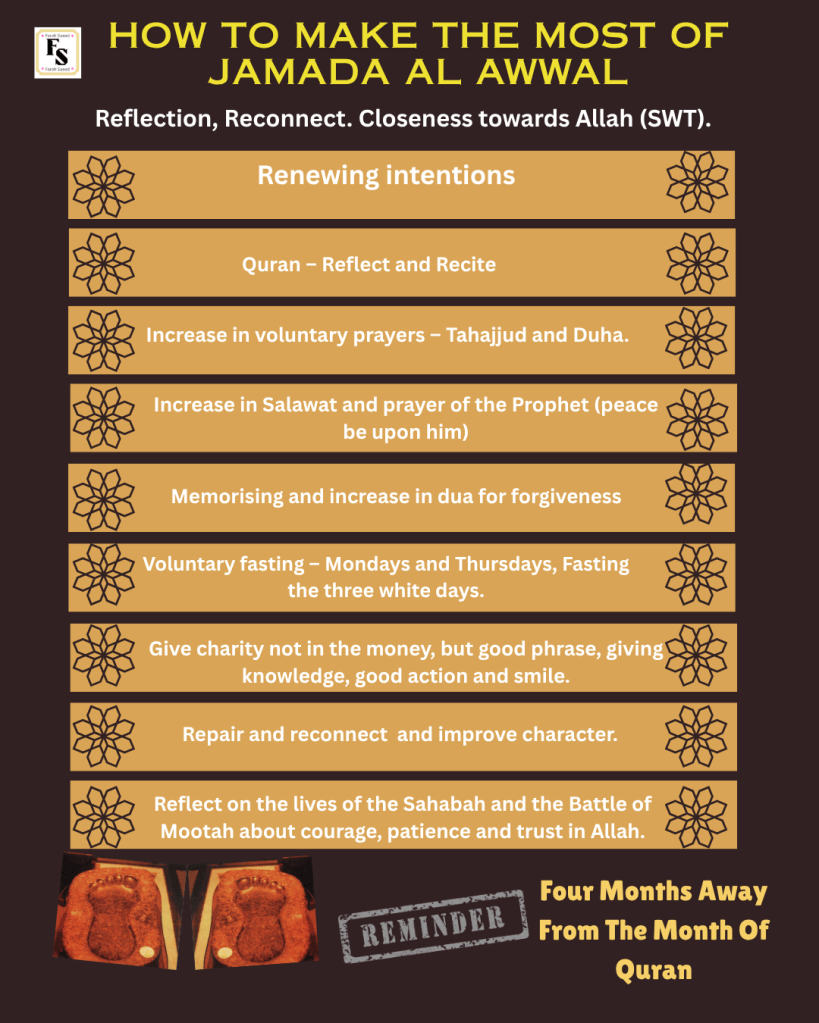
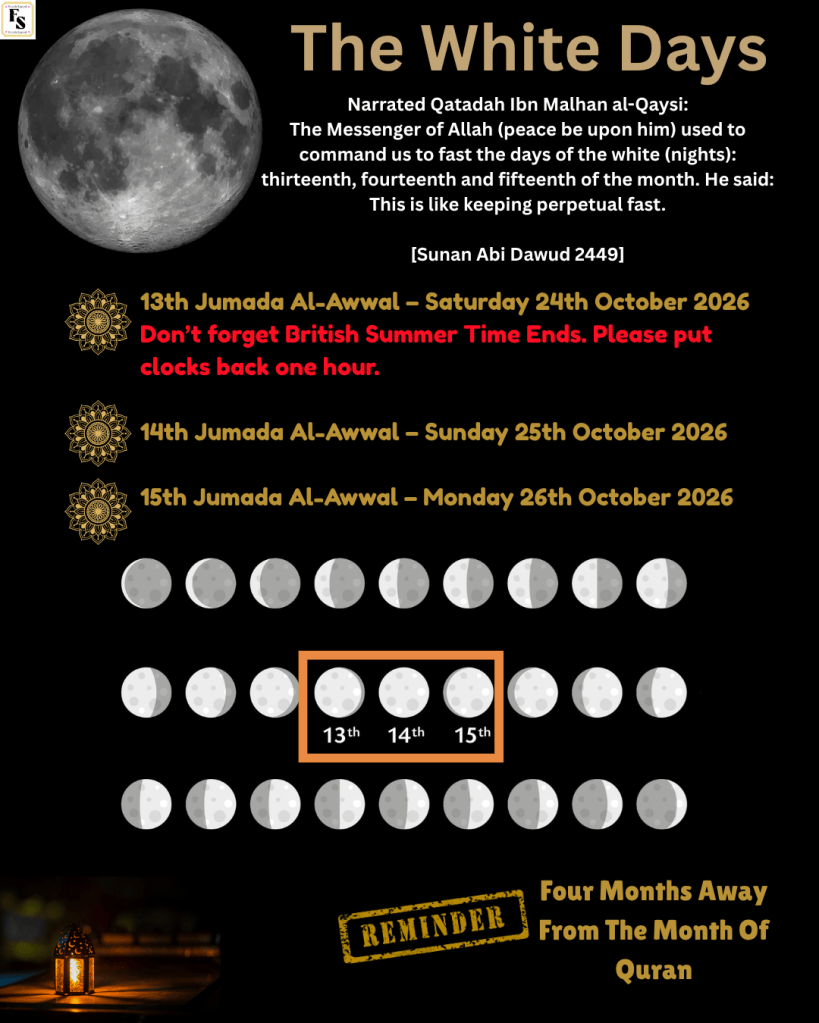
Below are some tips on how to make the most of the remaining months before the month of Quran arrives.
References
Abbas, W. (2026) Inspiration from Life of Zainab bint Ali. Available at: https://aboutislam.net/family-life/special-coverage-family-society/inspiration-from-the-life-of-zainab-bint-ali/ (Accessed: 13th October 2026)
Abbas, W. (2026) The Forgotten Tabi’at (Series) Inspiration from Life of Zainab Bint Ali. Available at: https://aboutislam.net/family-life/special-coverage-family-society/inspiration-from-the-life-of-zainab-bint-ali/ (Accessed: 13th October 2026)
AlMerja (2019) A short biography of Imam Zain Al-Abideen. Available at: https://www.almerja.com/en/more.php?pid=1057 (Accessed: 13th October 2026)
Bukhari, M. (2024) Ramadan for the Sahabas (RAA). Available at: https://humanappeal.org.uk/news/2024/03/ramadan-for-the-sahabas-raa (Accessed: 13th October 2026)
Deen Up (n.d) Jumada al-Awwal. Available at: Jumada Al-Awwal. Available at: https://www.deenup.app/glossary/jumada-al-awwal (Accessed: 13th October 2026).
HadeethEnc.com (2026) Hadith: I saw Ja‘far flying in Paradise with the angels. Available at: https://hadeethenc.com/en/browse/hadith/11187 (Accessed: 13th October 2026)
Iqra TV (2026) Jumada Al-Awwal, It’s Importance in the Light of History Events. Available at: https://iqra.tv/jumada-al-awwal-its-importance-in-the-light-of-history-events/ (Accessed: 13th October 2026)
Islam Q and A (2016) The reason why the Hijri months are called by their well-known names. Available at: https://islamqa.info/en/answers/211395/the-reason-why-the-hijri-months-are-called-by-their-well-known-names (Accessed: 13th October 2026)
Islamweb.net (2015) The Battle of Mu’tah. Available at: https://islamweb.net/en/article/157807/the-battle-of-mutah (Accessed: 13th October 2026)
Ramadan Tent Project (2026) Welcoming Jumada al-Awwal: A Month of Reflection, Growth, and Preparation. Available at: https://www.ramadantentproject.com/welcoming-jumada-al-awwal-a-month-of-reflection-growth-and-preparation/ (Accessed: 13th October 2026).


Leave a Reply