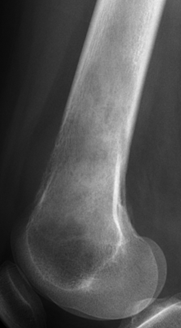
Overview of Fibrosarcoma
Malignancy: Rare and aggressive soft tissue malignancy.
Type of bone tumour: Primary
Grade: Varies
Paediatric –> Slow-growing –> infantile or congenital fibrosarcoma.
Adults and teenagers –> Adult form fibrosarcoma.
Location:
It originates from spindle-shaped fibroblasts found in tissue around tendons, ligaments and muscles (fascia).
This type of sarcoma can either start in the soft tissue or bone.
It affects the deep soft tissues in the trunk, head, and neck.
Onset:
Middle-aged and older people are most commonly affected (third to sixth decades of life).
Risk Factors Of Fibrosarcoma
Cause unknown.
A) Genetics:
No known Genetic conditions or defining genetic alterations, as it varies in each case.
Some found are loss of chromosomes, e.g., 13q, causing mutation in the retinoblastoma gene.
Another chromosomal loss is 10q.
Some have chromosome gain, e.g., 17p, linked to tumour suppressor gene TP53.
Other risk factors of fibrosarcoma of the bone
B) Gender
Males are mainly affected.
C) Ethnicity:
No racial preference.
D) Exposures
Exposure to radiation
Exposure to chemicals
Chronic surgical implants or foreign bodies; chronic irritation or scar tissue.
Appearance Under Microscope
Cell Morphology:
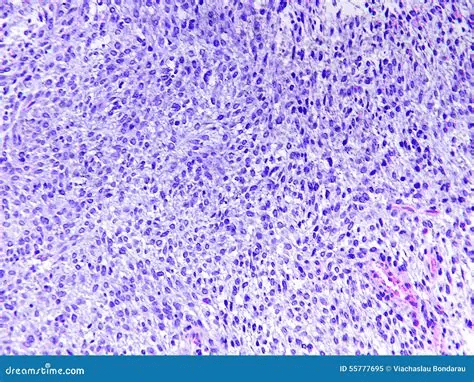
Relatively uniform spindle-shaped fibroblasts.
It is arranged in fascicular, herringbone (chevron-like) patterns
Radiological features
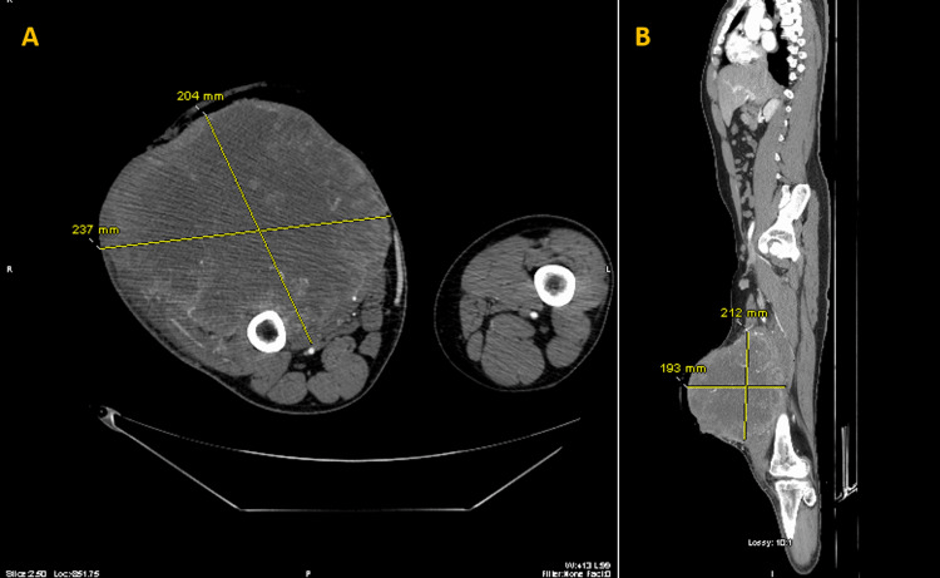
22cm necrotic mass. No erosion on the femur nor cortical erosions. No neurovascular involvement, as it extended to the skin. Right inguinal adenopathy (Raza et al. 2023)
References
Bădilă, A.E., Rădulescu, D.M., Niculescu, A.-G., Grumezescu, A.M., Rădulescu, M. and Rădulescu, A.R. (2021). Recent Advances in the Treatment of Bone Metastases and Primary Bone Tumors: An Up-to-Date Review. Cancers, [online] 13(16), p.4229. Doi: https://doi.org/10.3390/cancers13164229.
Biermann, J.S., Hirbe, A., Ahlawat, S., Bernthal, N.M., Binitie, O., Boles, S., Brigman, B., Callan, A.K., Cipriano, C., Cranmer, L.D., Davis, J., Donnelly, E., Ferguson, M., Graham, A., Groundland, J., Hess, M., Hiniker, S.M., Hoover-Regan, M.L., Hornick, J.L. and Jonard, B. (2025). Bone Cancer, Version 2.2025, NCCN Clinical Practice Guidelines in Oncology. Journal of the National Comprehensive Cancer Network, [online] 23(4). does: https://doi.org/10.6004/jnccn.2025.0017.
Cancer Research UK (2025a) Types of bone cancer. Available at: https://www.cancerresearchuk.org/about-cancer/bone-cancer/types (Accessed 3rd April 2026)
Cowan, P., Launico, M. and Kahai, P. (2024) Anatomy, Bones. Available at: https://www.ncbi.nlm.nih.gov/books/NBK537199/ (Accessed: 9th April 2026)
Gerrand, C., Amary, F., Anwar, H.A., Brennan, B., Dileo, P., Kalkat, M.S., McCabe, M.G., McCullough, A.L., Parry, M.C., Patel, A., Seddon, B.M., Sherriff, J.M., Tirabosco, R. and Strauss, S.J. (2024). UK guidelines for the management of bone sarcomas. British Journal of Cancer. doi:https://doi.org/10.1038/s41416-024-02868-4.
Hosseini, H., Heydari, S., Kiavash Hushmandi, Salman Daneshi and Rasoul Raesi (2025). Bone tumors: a systematic review of prevalence, risk determinants, and survival patterns. BMC Cancer, 25(1). doi:https://doi.org/10.1186/s12885-025-13720-0.
Raza, A., Siraj, I., Malik, S., Mohammed, R. and Shariff, M.A. (2023). A Case of Locally Advanced Fibrosarcoma in a Young Male. Cureus. doi:10.7759/cureus.44095.
Pullan, J.E., and Lotfollahzadeh, S. (2024) Primary Bone Cancer Available at: https://www.ncbi.nlm.nih.gov/books/NBK560830/ (Accessed: 9th April 2026)
Sarcoma UK (n.d.) Fibrosarcoma. Available at: https://sarcoma.org.uk/about-sarcoma/what-is-sarcoma/types-of-sarcoma/fibrosarcoma/ (Accessed: 3rd April 2026)
WHO Editorial Board. WHO classification of bone tumours. In WHO Classification of Tumours Editorial Board. Soft tissue and bone tumours. Bovee J, Flanagan AM, Lazar AJ, Nielsen GP and Yoshida A (eds) pp 338. International Agency for Research on Cancer (2020)
Updated July 2026 Next Review July 2028


Leave a comment