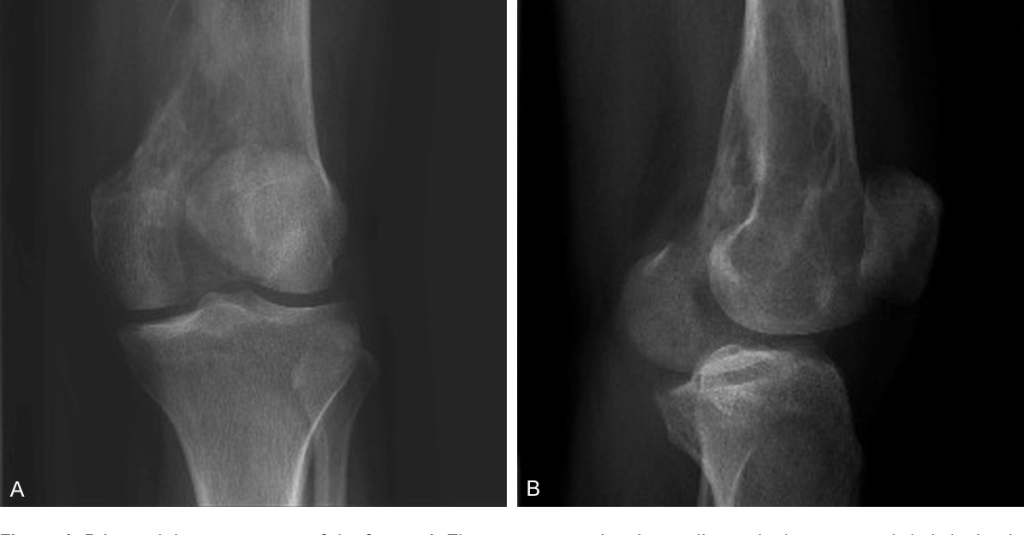
Overview of Leiomyosarcoma
Malignancy: Malignant mesenchymal tumours
Aggressive and fast-growing
Type of bone tumour: primary
Grade: Varies
Location:
This type of sarcoma can either start in the soft tissue (smooth muscle) or bone, for instance, the femur as presented in the X-ray above.
10% to 20% of soft tissue sarcoma cases.
0.17% of all cancers.
Smooth Muscle
- Smooth muscle is involuntary muscle without our control and is found in hollow organs, e.g., intestines, stomach, bladder, and blood vessels in either gender/sex, but the uterus in females.
- To help circulate blood, nutrients, and other substances.
- Large blood vessels, most commonly the inferior vena cava,
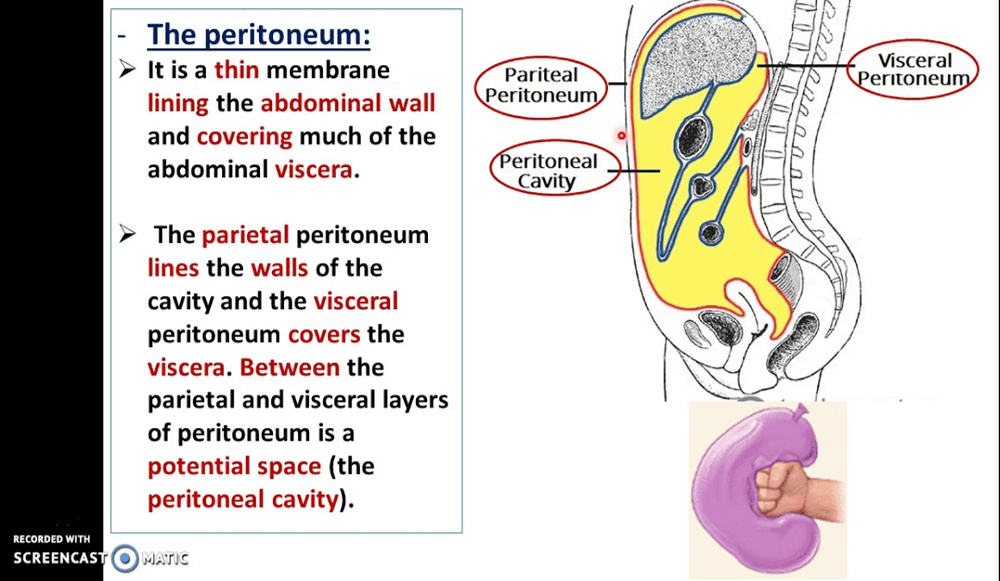
- The retroperitoneum is within the abdomen and pelvis, behind the abdominal lining.
- The most common area is the abdomen and uterus.
- Peritoneum is a sheet that supports or links together abdominal organs.
Onset:
More common in adults than children.
Very rare under 20 years old.
Median age at diagnosis: 64 years old
Risk Factors of Leiomyosarcoma
A) Genetics:
- Loss in chromosomes 10q(PTEN) and 13q (RB1) and chromosomal gain at 17p (TP53).
- Li Fraumeni syndrome – mutation in p53 tumour suppressor.
- Gardner syndrome – a form of polyps found in the colon (part of the large intestine) and also osteomas in the skull and jaws (mandible).
- Werner syndrome – premature ageing characterised by thin skin, leg ulcers and diabetes.
- Neurofibromatosis type 1 – Autosomal dominant – mutation in the gene that encodes for the supportive network of nerves. Damage to coverings of the nerves can cause fibromas.
- Tuberous sclerosis – A disorder caused by a mutation in the Tuberous sclerosis complex (TSC) genes that encode for proteins: tuberin and hamartin. They regulate cellular growth and division. It can cause benign tumours in the brain, kidneys, heart, lungs, skin and eyes. It is also linked with developmental delays.
- Nevoid basal cell carcinoma syndrome – a form of skin cancer that affects the basal cells, slow-growing, may appear on the face.
Other risk factors of Leiomyosarcoma
B) Gender
Some sources indicate females (Sarcoma UK, n.d, Erikson et al., 2019); other sources indicate Males (Winter et al., 2025).
However, the gender depends on the location of the tumour, where females predominantly have tumours in the retroperitoneum and the inferior vena cava (blood vessel). On the other hand, males are more predominant in noncutaneous soft tissue sites (Erickson et al., 2019; Alexiev et al., 2023).
C) Ethnicity: Afro-American than caucasians and pacific islanders.
D) Exposures
Exposure to radiation as therapy for alternative cancers.
Exposure to chemicals, e.g., dioxins found in paper and pesticides.
Vinyl chloride in plastics
Weed killers
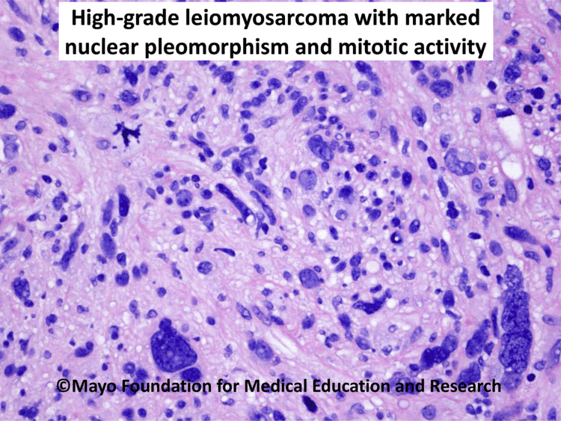
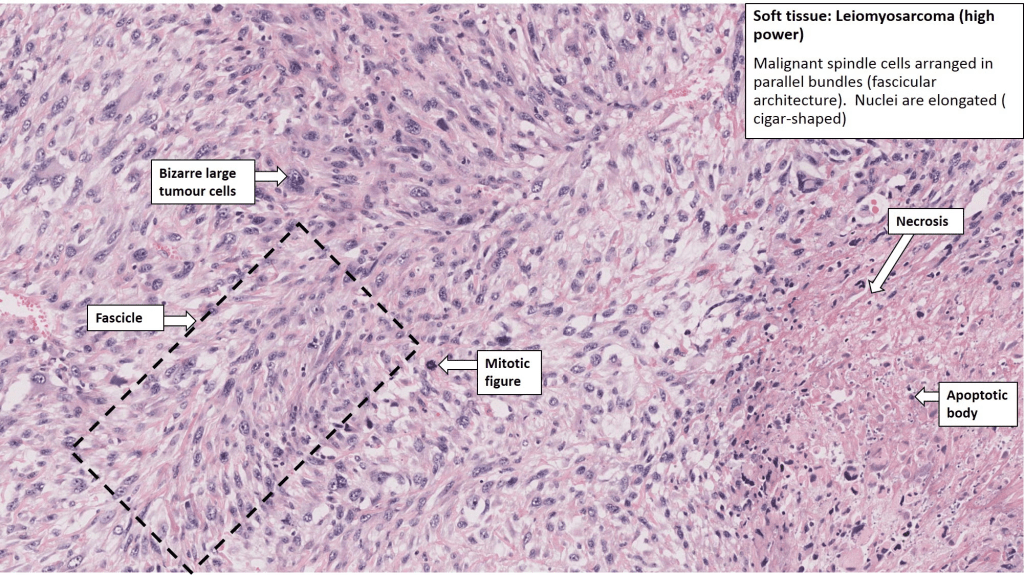
Appearance Under Microscope
Cell Morphology:
References
Alexiev, B. (2023) Smooth muscle malignant leiomyosarcoma. Available at: https://www.pathologyoutlines.com/topic/softtissueleiomyosarcoma.html&lang=en (Accessed: 4th April 2026)
Bădilă, A.E., Rădulescu, D.M., Niculescu, A.-G., Grumezescu, A.M., Rădulescu, M. and Rădulescu, A.R. (2021). Recent Advances in the Treatment of Bone Metastases and Primary Bone Tumors: An Up-to-Date Review. Cancers, [online] 13(16), p.4229. Doi: https://doi.org/10.3390/cancers13164229.
Biermann, J.S., Hirbe, A., Ahlawat, S., Bernthal, N.M., Binitie, O., Boles, S., Brigman, B., Callan, A.K., Cipriano, C., Cranmer, L.D., Davis, J., Donnelly, E., Ferguson, M., Graham, A., Groundland, J., Hess, M., Hiniker, S.M., Hoover-Regan, M.L., Hornick, J.L. and Jonard, B. (2025). Bone Cancer, Version 2.2025, NCCN Clinical Practice Guidelines in Oncology. Journal of the National Comprehensive Cancer Network, [online] 23(4). does: https://doi.org/10.6004/jnccn.2025.0017.
Cancer Research UK (2025a) Types of bone cancer. Available at: https://www.cancerresearchuk.org/about-cancer/bone-cancer/types (Accessed 3rd April 2026)
Cowan, P., Launico, M. and Kahai, P. (2024) Anatomy, Bones. Available at: https://www.ncbi.nlm.nih.gov/books/NBK537199/ (Accessed: 9th April 2026)
Cui, J., Chen, H., Hao, D., Liu, J., Hou, F., & Xu, W. (2017). Imaging features of primary leiomyosarcoma of bone. Available at: https://www.semanticscholar.org/paper/Imaging-features-of-primary-leiomyosarcoma-of-bone-Cui-Chen/e89649ae9a2ae186f094c7928a67893b779ce1fb (Accessed: 23rd July 2026)
Erickson, L.A. (2019). Soft Tissue Leiomyosarcoma. Mayo Clinic Proceedings, 94(11), pp.2366–2367. doi:10.1016/j.mayocp.2019.09.011.
Gerrand, C., Amary, F., Anwar, H.A., Brennan, B., Dileo, P., Kalkat, M.S., McCabe, M.G., McCullough, A.L., Parry, M.C., Patel, A., Seddon, B.M., Sherriff, J.M., Tirabosco, R. and Strauss, S.J. (2024). UK guidelines for the management of bone sarcomas. British Journal of Cancer. doi:https://doi.org/10.1038/s41416-024-02868-4.
Hosseini, H., Heydari, S., Kiavash Hushmandi, Salman Daneshi and Rasoul Raesi (2025). Bone tumors: a systematic review of prevalence, risk determinants, and survival patterns. BMC Cancer, 25(1). doi:https://doi.org/10.1186/s12885-025-13720-0.
National Cancer Institute (n.d.) Leiomyosarcoma. Available at: https://www.cancer.gov/pediatric-adult-rare-tumor/rare-tumors/rare-soft-tissue-tumors/leiomyosarcoma (Accessed: 3rd April 2026)
Pullan, J.E., and Lotfollahzadeh, S. (2024) Primary Bone Cancer Available at: https://www.ncbi.nlm.nih.gov/books/NBK560830/ (Accessed: 9th April 2026)
Sarcoma UK (n.d.) Leiomyosarcoma Available at: https://sarcoma.org.uk/about-sarcoma/what-is-sarcoma/types-of-sarcoma/leiomyosarcoma/ (Accessed: 3rd April 2026)
WHO Editorial Board. WHO classification of bone tumours. In WHO Classification of Tumours Editorial Board. Soft tissue and bone tumours. Bovee J, Flanagan AM, Lazar AJ, Nielsen GP and Yoshida A (eds) pp 338. International Agency for Research on Cancer (2020)
University of Singapore (n.d) Leiomyosarcoma. Available at: https://medicine.nus.edu.sg/pathweb/virtual-pathology-museum/03535-2/ (Accessed: 23rd July 2026)
Winter, A., Yu, S., Khan, F., Mani, K. and Guddati, A.K. (2025). Analysis of trends in race and gender disparities in the incidence of osteosarcoma, leiomyosarcoma, and Ewing sarcoma from 2000 to 2021. Journal of Clinical Oncology, 43(16_suppl). doi:10.1200/jco.2025.43.16_suppl.e23516.
Updated July 2026 Next Review July 2028


Leave a comment