There is unequivocal balance on the research available on the Sudanese Islamic Architecture in comparison to other respected religious places in Sudan. Through the expertise of Dr. Mohammed Al-Fatih Hayaty, Associate Professor in the Department of Archaeology at the Faculty of Arts, University of Khartoum, we have managed to gain an insight into the historical significance of mosques in Sudan. The respected scholar informed that mosques were steadily introduced to Sudan back in the 7th century AD when the Muslim commander Abdullah ibn Abi Al-Sarh besieged Dongola (the capital of the Christian Kingdom of Makuria) under orders from Caliph Uthman ibn Affan (May Allah be pleased with him). This led to the signing of the Baqt Treaty and an agreement and respect between all parties. In 1317 AD, in the palace of King Saif Al-Din Abdullah Barshambo, who was regarded as Sudan’s first Muslim ruler in Old Dongola, a church was converted into a mosque.
The Sudanese had a skilled team that built mosques in Northern Sudan using mud and bricks. Key examples are the Mosque of the Companions south of Dongola and the Mosque of Al-Khandaq in the Islamic City. A subsequent grand mosque was built in the Blue Sultanate era. It was built in the capital of the Funj Sultanate, called Sennar, and was made of mud with a modest architectural design. A religious complex known as “Masid”, “Khalawi” or “Zawaya” was also built using simple materials and was vital in teaching Quranic sciences.
Another historical mud-built mosque is Masjid Al-Sabein in northern Omdurman, but it has large interior columns. Minarets were also simple and were made of mud bricks. Many locals began to speak Arabic in the 16th and 17th centuries. The transition of architecture took place during the Ottoman era, when intricate decorative elements were presented in the mosques. Key examples were the Khartoum Grand Mosque, the Omdurman Grand Mosque, and the King Farouk Mosque. In the early 20th century, the use of red bricks and carefully detailed inscriptions of Quranic verses on minbars/pulpites were introduced, especially in mountainous regions. Additional mosques were further built over time.
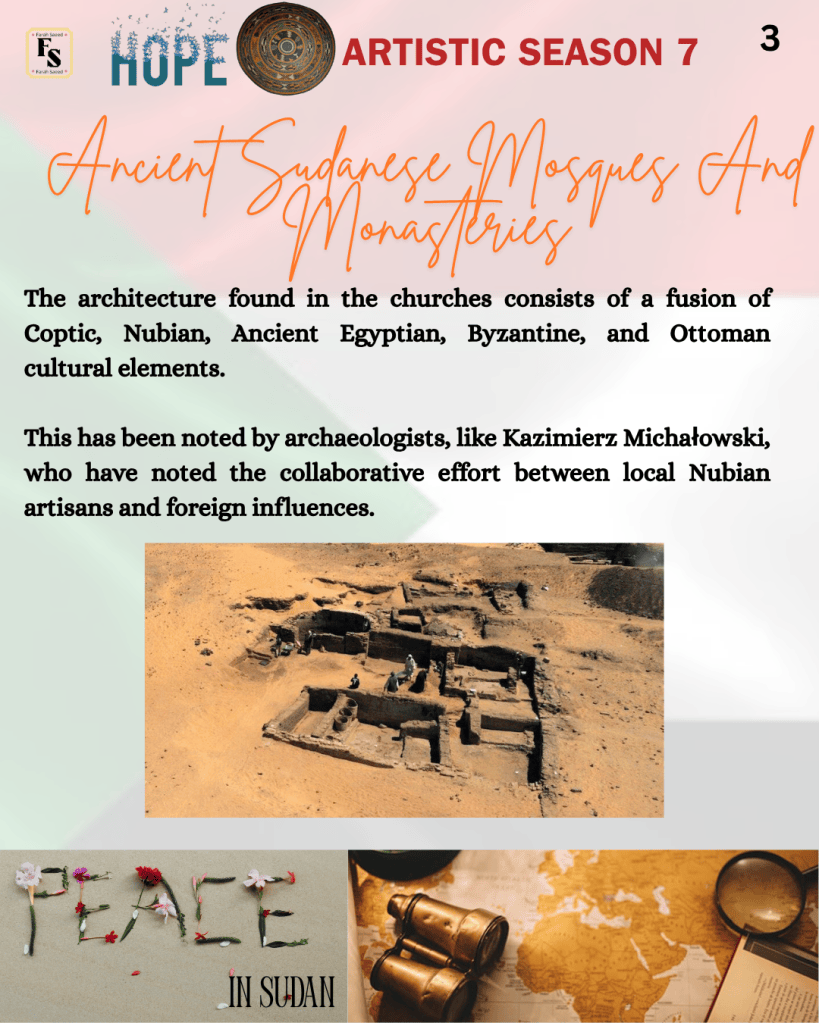
Simultaneously, there is a wealth of Christian history embedded in the sands and earth of Sudan. After the fall of the Kushite Kingdom, three Christian Nubian Kingdoms came to power by the 4th century CE: Nobadia, Makurra, and Alwa. There were missionaries led by the Emperor Justinian I of the Byzantine Empire in Egypt and Constantinople. This was integral and was depicted in the art and architecture present in the churches, where there is a fusion between Coptic, Nubian, Ancient Egyptian, Byzantine, and Ottoman cultural elements. This has been noted by archaeologists, like Kazimierz Michałowski, who have noted the collaborative effort between local Nubian artisans and foreign influences.
The Christian kingdom had Nobadia in the North, whose capital was Faras. In the centre, it was Makuria, with its capital at Old Dongola. In the South, it was Alwa (Alodia) at Soba East. Nobadia later joined Makuria. King Merkuiros of Dongola (r. from 697 CE), who had unified the three Christian kingdoms in Nubia, led to the modern studies on medieval Christian Nubia. The aim of this article is to provide an insight into two mosques and a cathedral: The Tuti Grand Mosque (Al-Atiq), the Al-Nour Complex, and the Cathedral of Faras.
Masjid Al-Atiq
The Tuti Grand Mosque is the oldest in Khartoum, the capital of Sudan. Dr Hayaty estimated that it may have been built using local materials, presenting simplicity and functionality between 1480 and 885 in the Funj Kingdom. The Mahas people of Tuti built a mosque and a Khalawi (a religious complex) in central Sudan, where they studied Fiqh (Islamic jurisprudence) and other Quranic sciences.
Little is known about the origins of the Funj, but it is thought to be from the Shilluk or another southern tribe that moved to the North. They ruled for nearly three centuries, during which their rulers converted to Islam, especially in Gezira between the Blue and White Niles, and extended to Kordofan and the coastal region of Suakin near the Red Sea. The Alwan capital was overthrown in 1504 AD. The capital of the Funj state was Sennar, and were led by Abdallah Gamaa and Omarah Dongus.
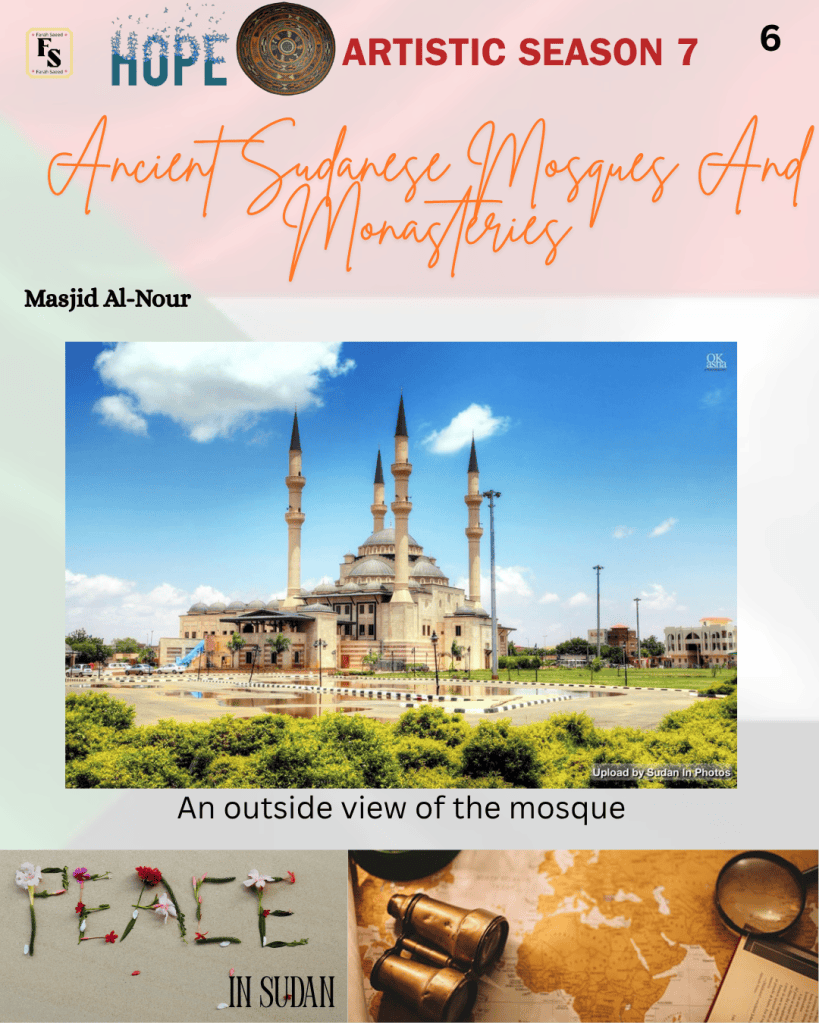
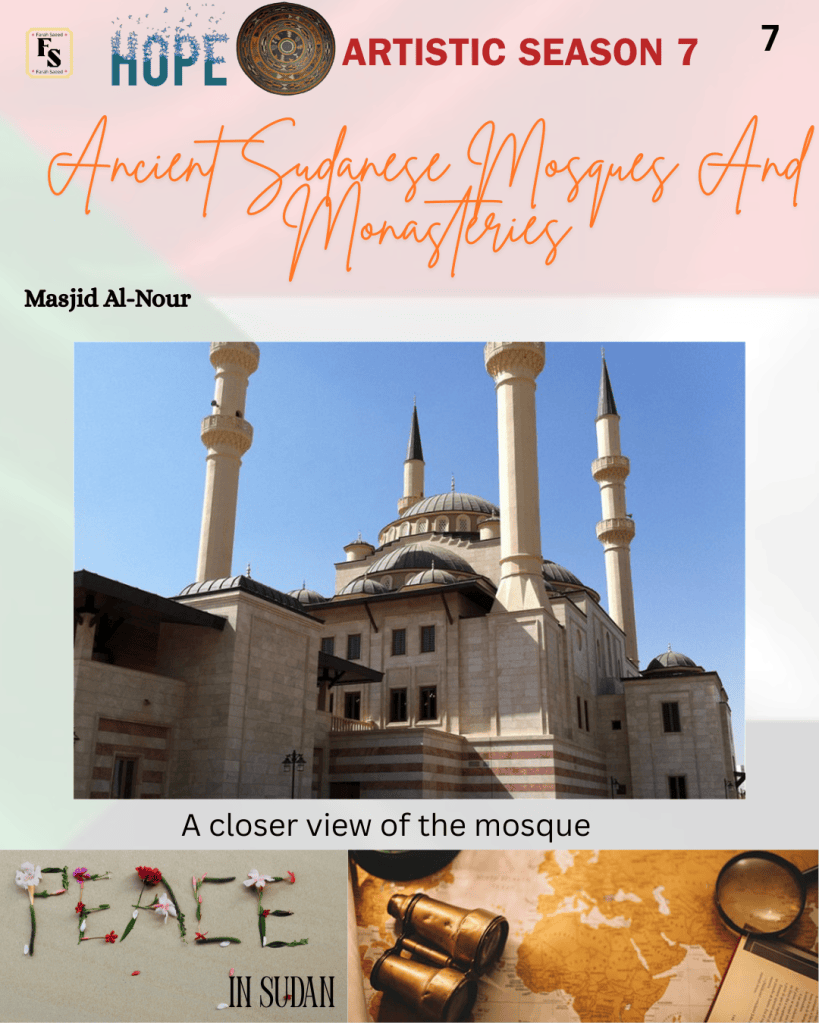
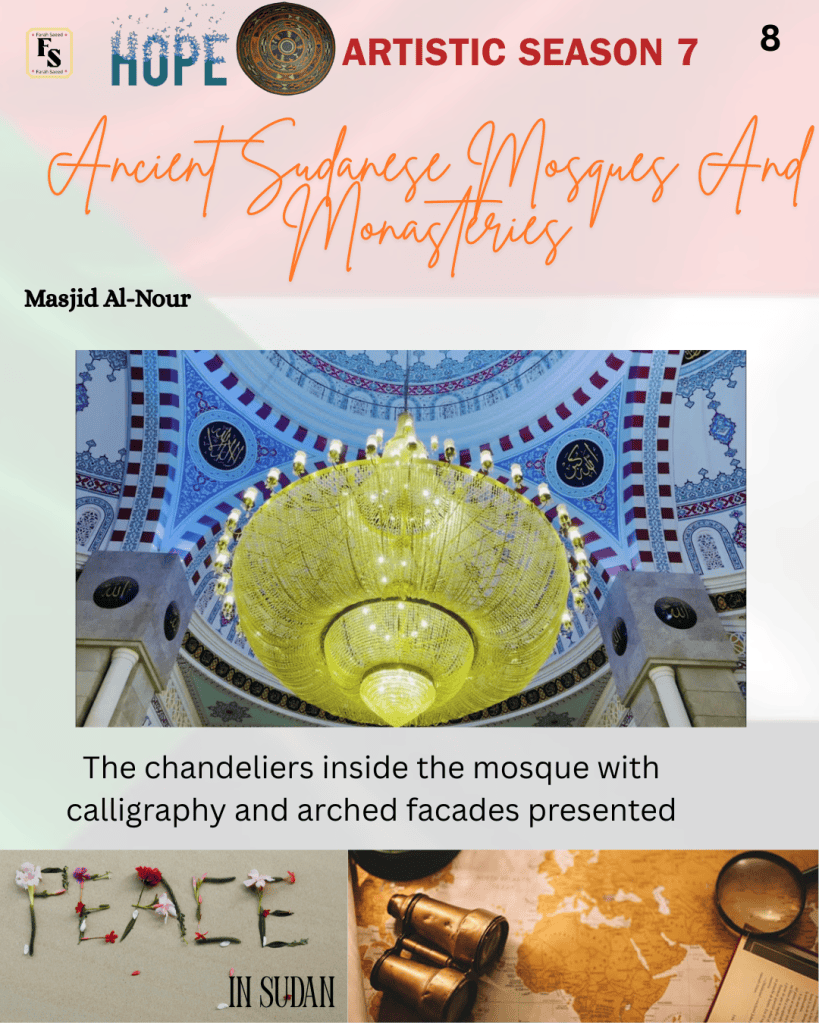
Masjid Al-Nour
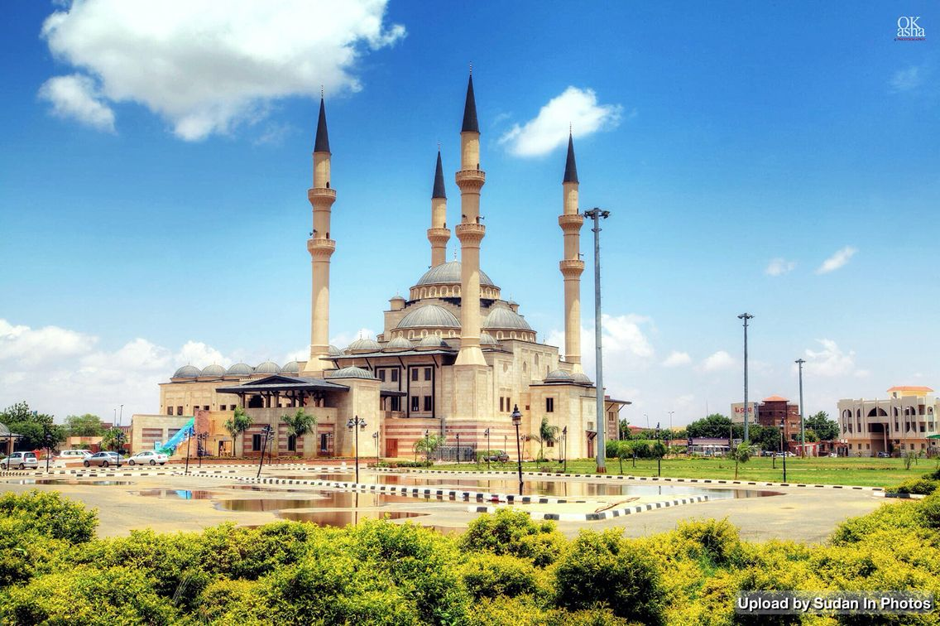
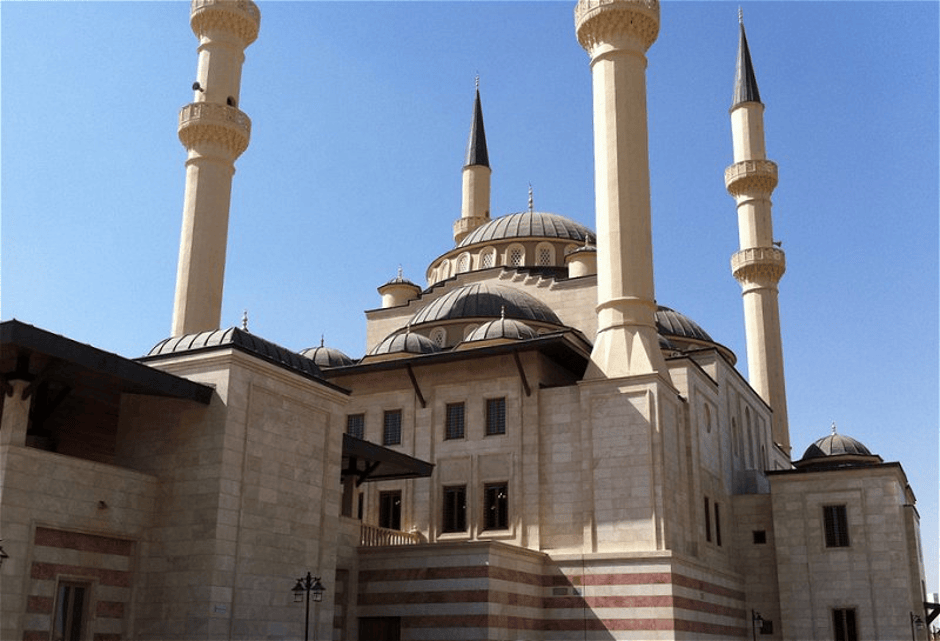
This masjid has an Ottoman-style Islamic Complex and is situated in Kafouri in Khartoum, Sudan. It began in 2008 and was completed in 2010. The total size of the area was 2700 square metres. It has two large domes supported by additional smaller domes surrounding it estimated at 22. The two large domes have a diameter of 11.5m and 10.75 m, respectively. There are also four quarter spheres with a diameter of 11.5m. The dome was extended to accommodate more indoor prayers and is 208 square metres, whereas the terrace is 246 square metres. The mosque is notable for its four cone-headed minarets that are 48.15 metres high.
The masjid holds a Quranic school and mosque with beautiful inscriptions on its walls from architecture, geometry, and botanical patterns in its interiors. There are also chandeliers.
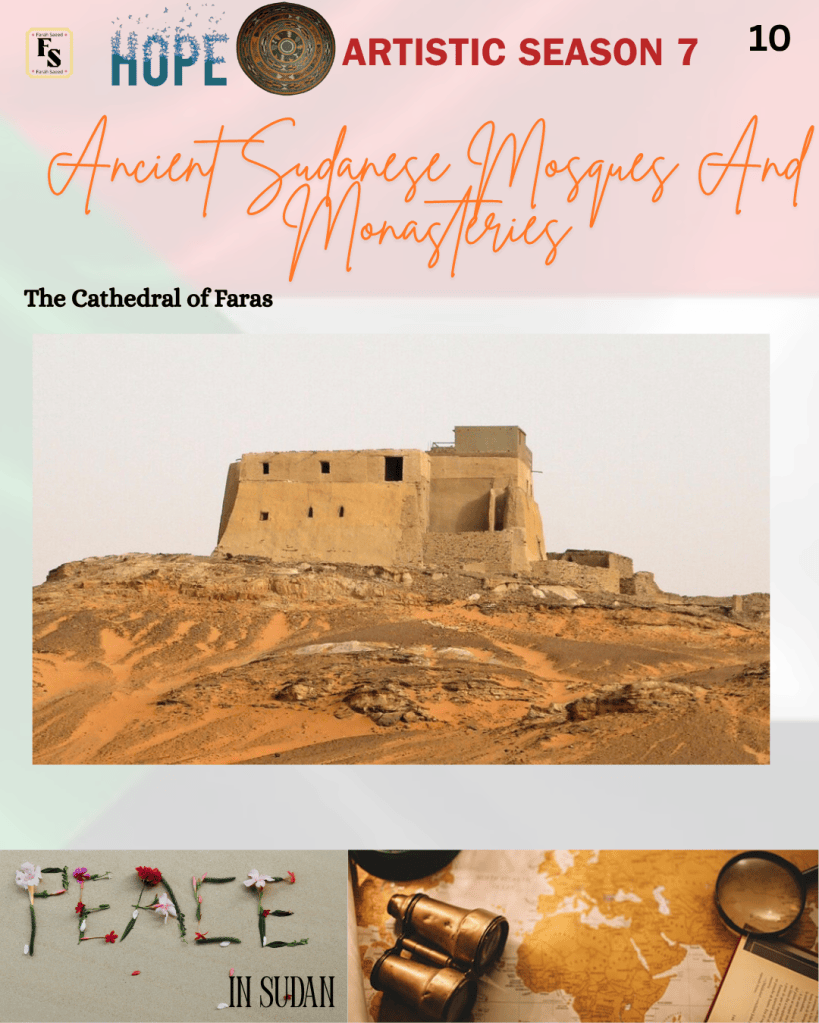
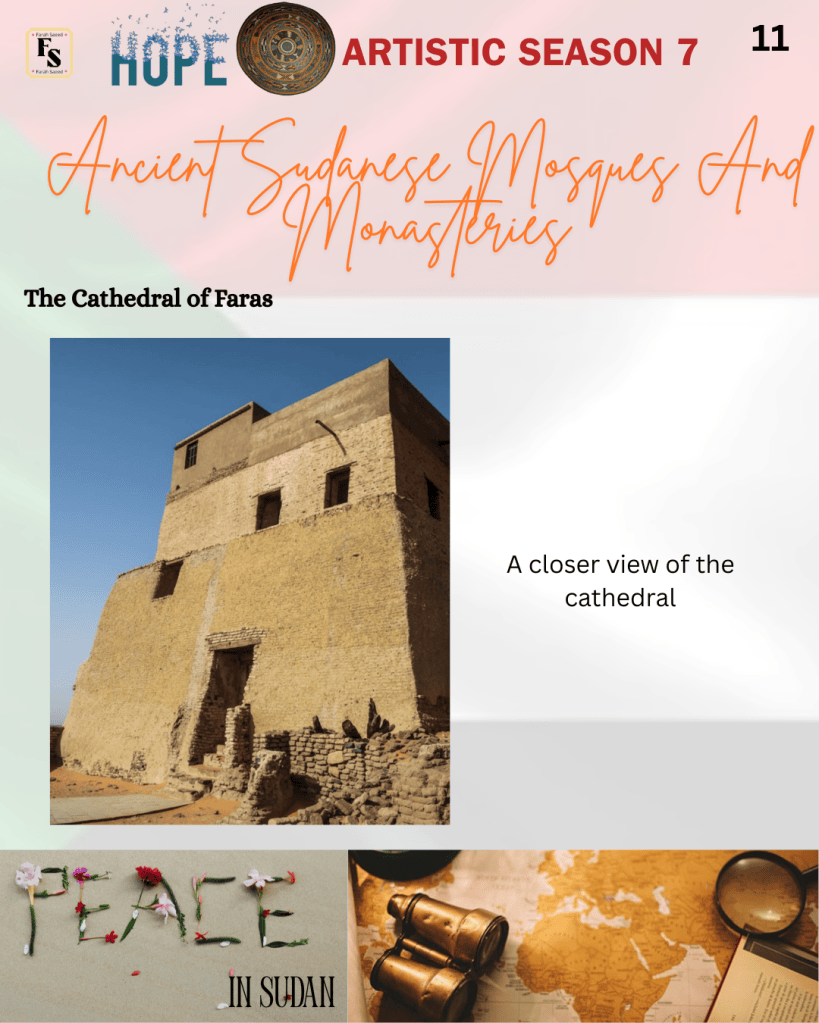
The Cathedral Of Faras
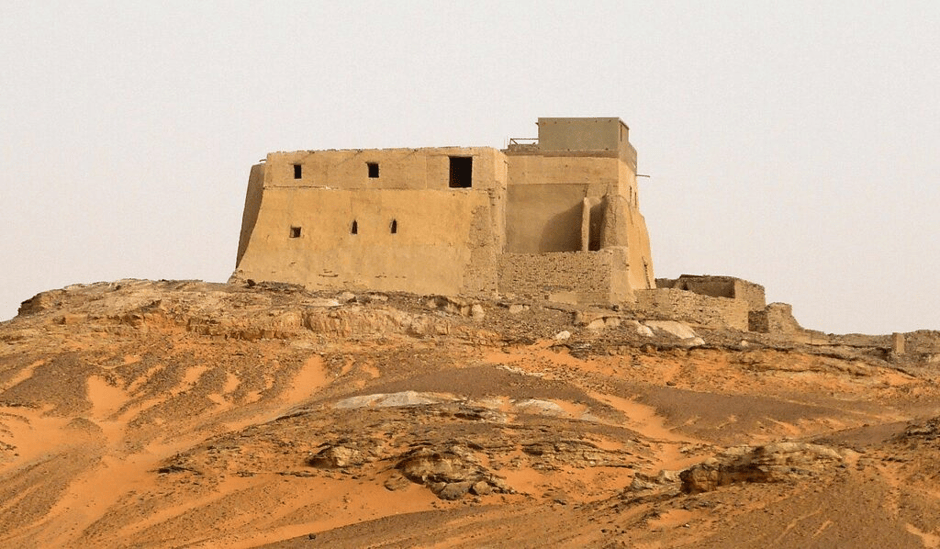
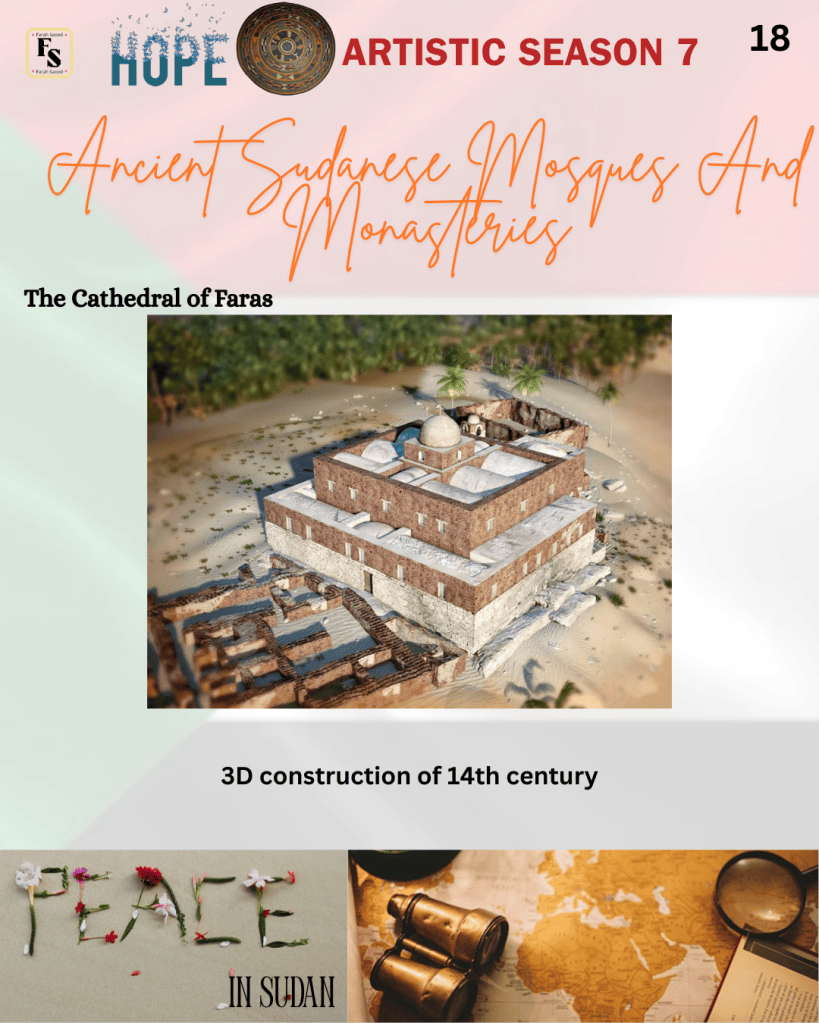
The Cathedral of Faras (Pachoras) is situated on the banks of the Nile River, in Northern Nubia, where the ancient Christian Kingdom of Nobatia lies. The landscape of Faras is marked by wide stretches of golden desert, green vegetation, and fertile soil along its rivers. Faras, the capital city of Nobatia, was founded between 2040 and 1750 BCE and became an important centre of culture and religion.
The first cathedral was built in the 7th century CE using local stone, baked brick, and timber beam supports. It had a wooden flat roof and was built for the fifth bishop, Paulos, and for King Merkuiros of Dongola in 697 CE, who unified the Christian Kingdom in Nubia. The cathedral measured 25 by 23 m.
It was replastered in 900 CE and rebuilt in 1000 CE after a fire destroyed the roof. A material change was used to make it more versatile, such as the addition of more fired mud. The granite columns were replaced by brick piers with a strong, complex roof. This helped with durability and withstanding an arid desert environment. The building continued to be made through the 11th century amid the socio-political challenges in Makuria.
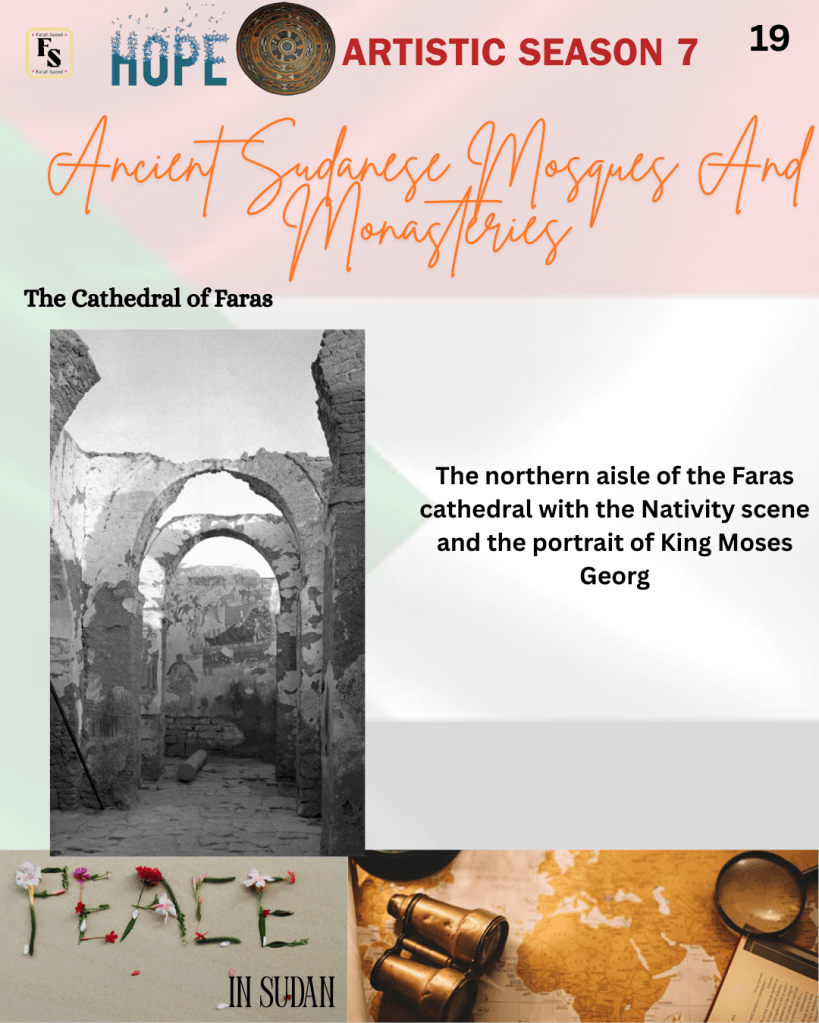
Archaeological excavations have revealed the presence of a subsequent cathedral from the 8th century CE. Historians have also claimed that it was built on a palace, which itself stood on a 4th-century CE Christian Church. This was evidenced by inscriptions found on two foundation stones: Coptic and Greek. The cathedral of Faras was excavated between 1961 and 1964 CE by a Polish archaeological team before the establishment of Lake Nasser, when the whole area was flooded. One of the archaeologists, Kazimierz Michalowski, has noted a blend of Nubian and foreign artisans. This is likely Byzantine.
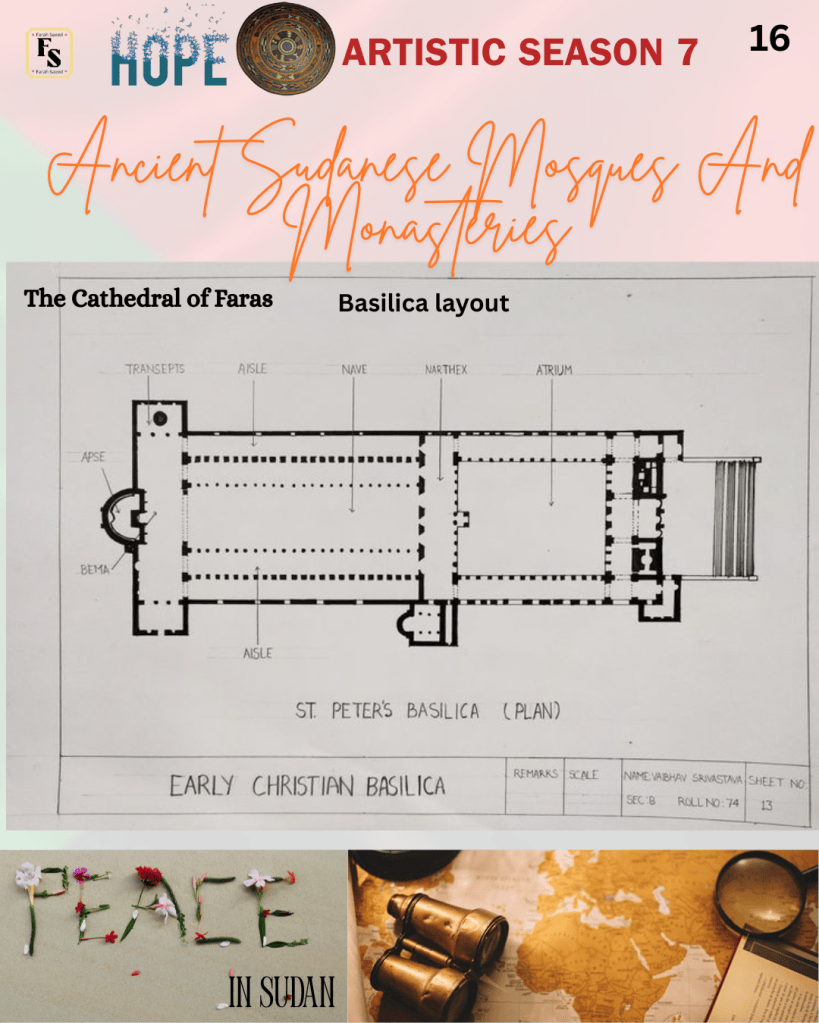
A Byzantine Basilica layout is a longitudinal building with a nave, and the large central cross is within a square on the floor plan. The cathedral is subdivided into the chancel, aisles, and narthex. The chancel has a semicircular or semi-dome called an apse, which helps support Christian worshippers.
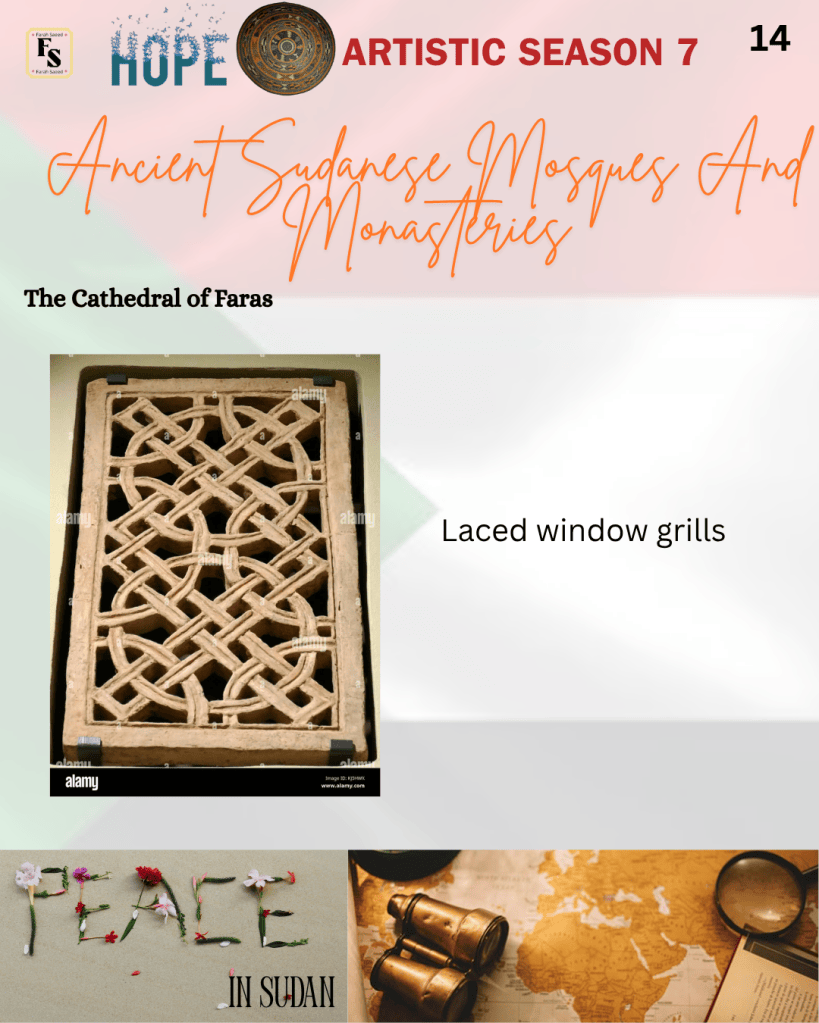
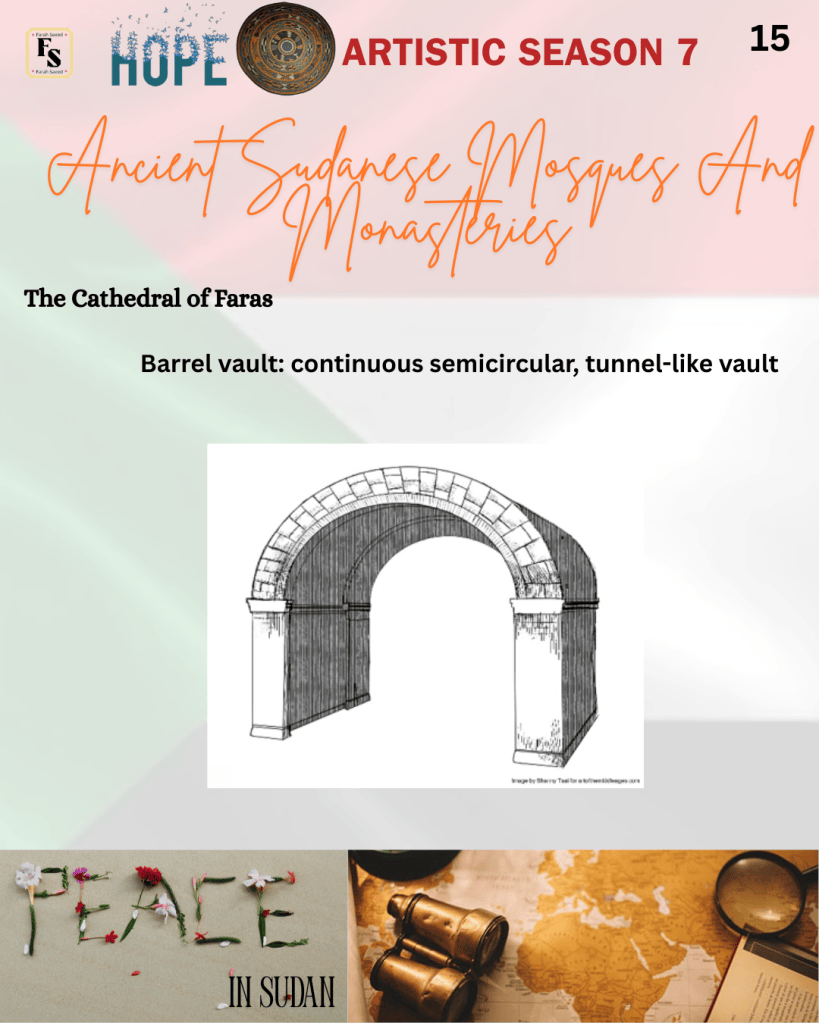
There is a large central dome and smaller domes over the four aisles and vaulted ceilings with barrel vaults, which is symbolic of Byzantine Art. The presence of barrel vaults helped strengthen the structure and create spacious interiors. The façade featured arches and tall windows that allowed natural light to illuminate the interior. The nave is where Christians mainly congregate and pray. It had tall columns and arches but collapsed due to the barrel vaulting in 1169 CE.
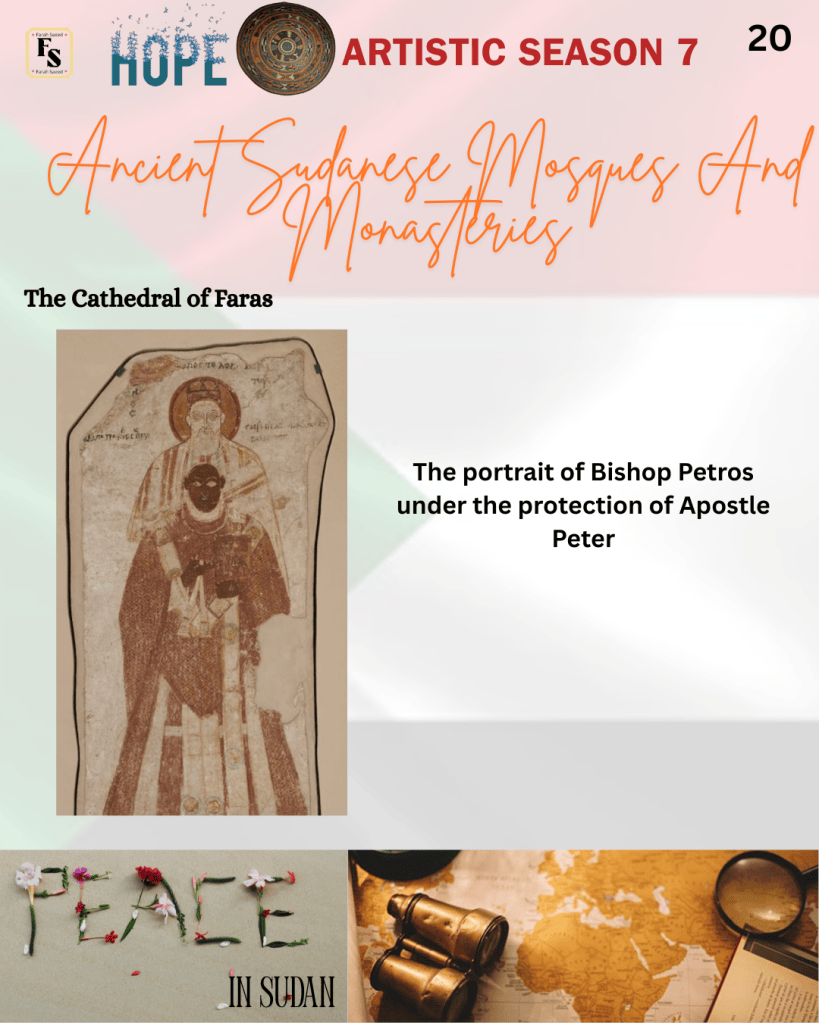
In relation to the artwork present inside the cathedral. There are lots of mural paintings and frescoes. Frescoes are paintings performed quickly in watercolour on wet plaster on a wall or ceiling to allow fixation of the colour on plaster when it dries. These commonly present Biblical history, like the Nativity and the Adoration of the Magi/Visitation of the Wise Men, visit the infant Jesus, offering gold, frankincense, and myrrh, and paying homage to him. There are also portraits of Nubian bishops and rulers.
There was vivid colours were used in the frescoes and paintings of Christian art. Some of the frescoes of the first cathedral of Faras had large eyes, squarish heads, and thick lines. There were also shades of violet in earlier works. However, those from the 9th century were ivory-white in colour, and in the 10th century CE fresco, it was orange-red.
An example of a painting is on the south side of the cathedral, where there is Bishop Petros (r. 972–99), being protected by his namesake, St. Peter; and Bishop Marianos (r. 1005–36), being blessed by the Virgin and Child. The artists focused on garments and skin tone, where there are shades of dark, olive, and ivory-white tones.
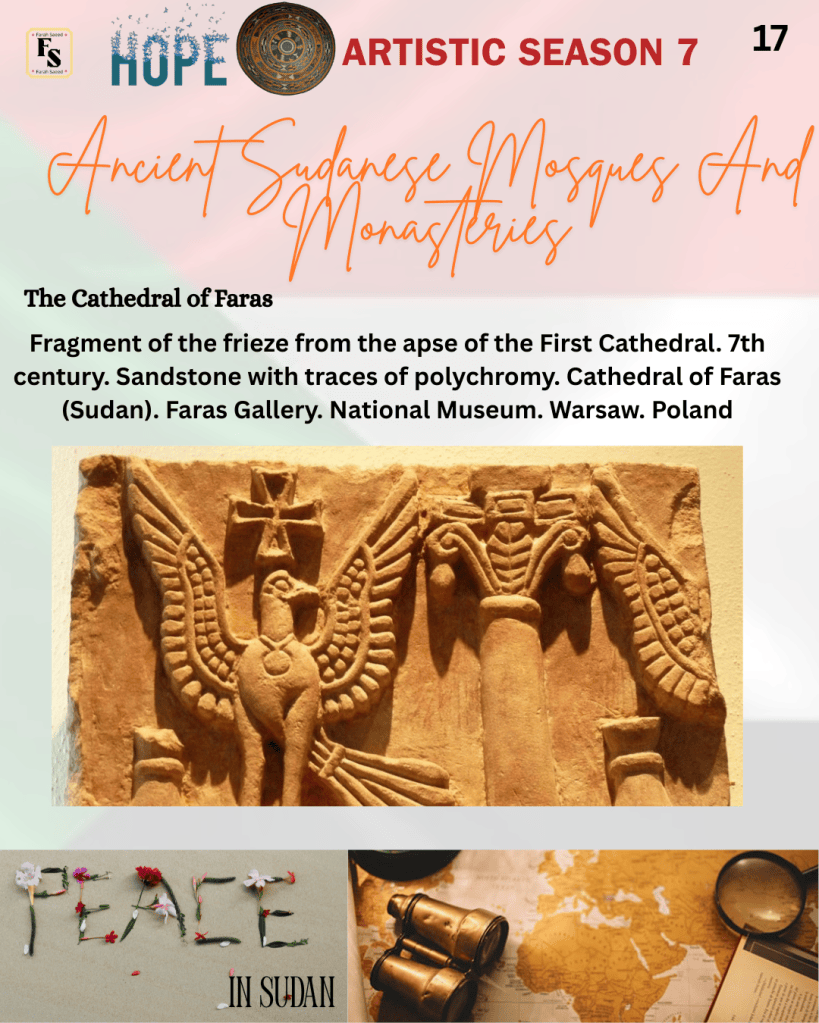
Symbolic of the Christian faith, there are crosses in relief carvings and paintings. Archangels and People were embroidered with beads and jewels, influenced by Byzantine art. There are also epitaphs (inscriptions on tombstones ) of local leaders presenting communal memory to sacred space. Outside the cathedral, bishops of Faras, Nubian kings, and mothers were buried.
Today, many of the wall paintings and inscriptions have been sent to the National Museum of Sudan in Khartoum and the National Museum of Warsaw in Poland after the creation of the Aswan Dam in the 1960s, where all medieval sites were submerged.
Overall, the Ancient Sudanese mosques and monasteries were built using local materials like stone and mudbrick, and their architecture was a blend of local Nubian and Ancient Egypt and was influenced by the Mamluks and Ottomans for mosques and Byzantine and Coptic for monasteries. This indicates a blend of foreign and local influences across the centuries that impacted their material and style. Art and inscriptions reveal cultural and religious diversity in Sudanese history.
References
Archaeolist (n.d.) Faras Cathedral Available at: https://archaeolist.com/sites/sudan/faras-cathedral (Accessed: 19th July 2026)
Cartwright, M. (2019) Faras Cathedral Available at: https://www.worldhistory.org/Faras_Cathedral/ (Accessed: 19th July 2026)
Caskey, J., Cohen, A. and Safran, L. (n.d.) Art and Architecture of the Middle Ages: Exploring a Connected World. Available at: https://artofthemiddleages.com/s/main/item/3494 (Accessed: 19th July 2026)
E-A-A (2026) Faras Cathedral, Faras, Sudan: Architectural Marvel in a Nubian Desert. Available at: https://www.e-a-a.com/faras-cathedral-faras-sudan/ (Accessed: 19th July 2026)
Lovin Khartoum (2023) Check out These Beautiful Mosques Around Khartoum. Available at: https://lovin.co/khartoum/en/community/check-out-these-beautiful-mosques-around-khartoum/ (Accessed: 19th July 2026)
Medieval Studies in Leiden (2021) The cathedral of Faras: Rediscovering the submerged Nubian ‘site of remembrance’ Available at: https://www.leidenmedievalistsblog.nl/articles/the-cathedral-of-faras-rediscovering-the-submerged-nubian-site-of-remembrance (19th July 2026)
Sudanow Magazine (2025) Mosques in Sudan: A Sanctuary on Earth and Palaces in the Hereafter. Available at: https://sudanow-magazine.net/page.php?Id=1628 (Accessed: 19th July 2026)
TRCON Construction Consultancy (2019) Al-Nour Islamic Complex Extension-Khartoum, Sudan. Available at: https://www.trcon.com.tr/projectdetails.asp?id=2 (Accessed: 19th July 2026)
Yosra (n.d) 10 Sudanese Structures That Showcase Africa’s Rich Architectural Heritage Available at: https://www.arch2o.com/buildings-sudanese-diverse-architecture/ (AccessedL 28th June 2026)


Leave a comment