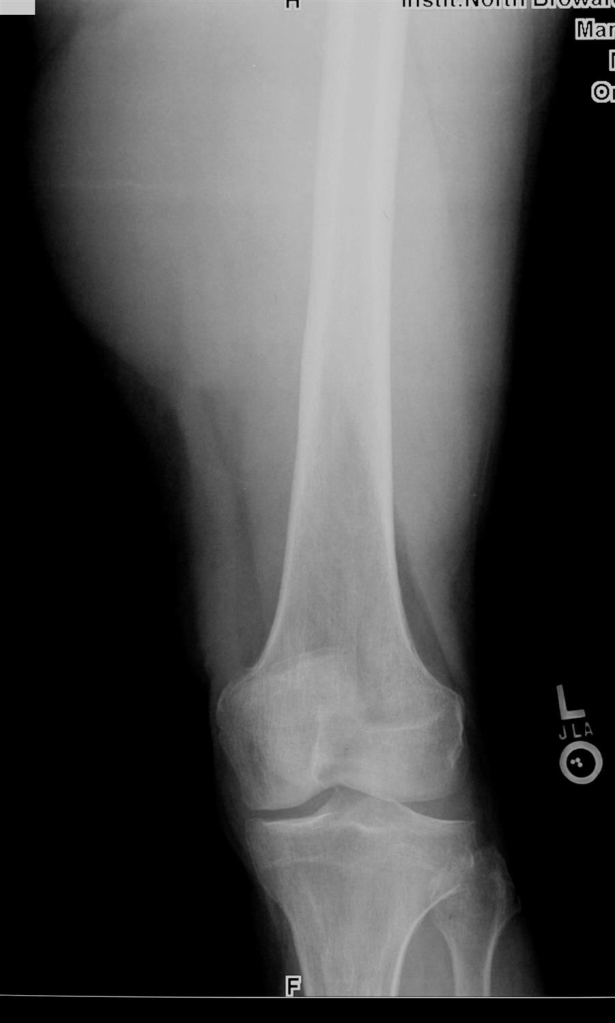
Overview of Undifferentiated pleomorphic sarcoma (UPS) of the bone
Other names: Previously called malignant fibrous histocytoma.
Malignancy: Malignant and fast-growing mesenchymal tumour.
Type of bone tumour: Primary
Grade: High and can metastasize in 50% of cases.
Extremely rare (2 – 6% of all primary malignant bone tumours.
Location:
Long bones: femur (lower limb/thigh bone).
Tibia and humerus are the next most common locations.
Among the bones of the trunk, pelvic bones are most commonly affected.
Undifferentiated pleomorphic sarcoma of the soft tissues can also occur.
Onset: More common in people over the age of 40. This is especially seen in people aged 55 to 80 years who present with a slow-growing, painless mass.
Risk Factors of Undifferentiated pleomorphic sarcoma of the bone
Most cases are de novo (primary), where no previous family member had the condition.
Secondary (nearly 30% of cases) where the cancer occurred in another location before spreading to the bone.
Some cases arise from preexisting bone disease:
Bone infarction
Paget disease: It affects remodelling and the process of bone in the skull, facial bones, pelvis, and spine.
Previous radiation in the area.
Metallic prosthesis/Hardware
A) Genetics:
Changes (mutations) in the genes and chromosomes may arise.
- Aneuploidy is when there is a loss or gain in the normal number of chromosomes, which is 23 pairs (46 chromosomes).
- An extra chromosome in cells is referred to as trisomy.
- There are more common chromosomal gains than losses.
- Chromosomal gains: 4q, 5p, 6p, 7p, 8q, 12p, 14q, 17q, 19p, 20q, 22q and X have been reported.
- Chromosomal losses: 8p, 9p, 10, 13q and 18q.
- Loss of tumour suppressor genes and other genes involved in the cell cycle and regulation may occur increasing risk of cancer: CDKN2A, RB1, TP53 and ING1.
- Chromatin remodelling genes (ATRX, DOT1L and H3F3A) are also common.
- Programmed cell death protein 1 (PD-1) expression in 30%.
Hereditary diaphyseal medullary stenosis (Hardcastle syndrome) – autosomal dominant genetic disorder characterized by bone dysplasia and a high risk of bone malignancy.
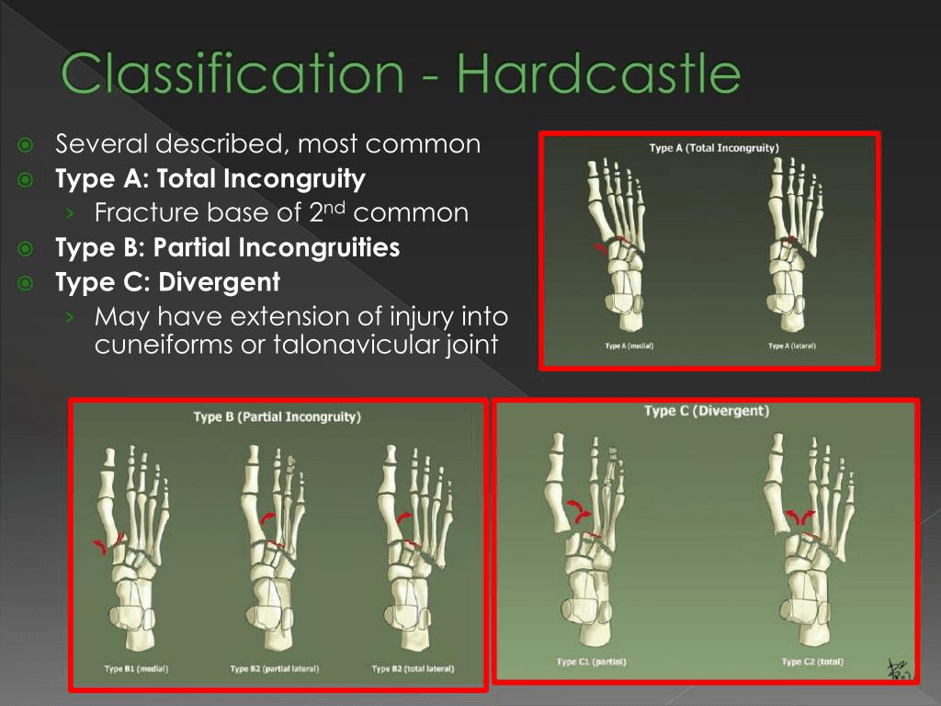
Other risk factors of Undifferentiated pleomorphic sarcoma of the bone.
B) Gender
More common in men.
C) Ethnicity:
Caucasian > African American
Appearance Under Microscope
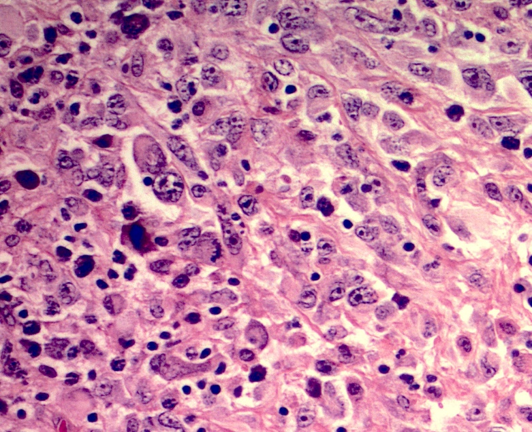
Cell Morphology:
Pleomorphic (different forms) of malignant neoplasm of bone:
- Spindle-shaped cells.
- Epithelioid cells (similar to the flat, brick-like appearance that appears like epithelial cells). They have oval, centrally located or elongated nucleus, abundant cytoplasm and a large, elongated or polygonal shape.
- They are grown in a storiform(cells are arranged in a woven or pinwheel-like formation, resembling a mat) or fascicular (a bundle of muscle fibres) growth pattern.
- No identifiable line of differentiation.
- Poor and ill-defined margins
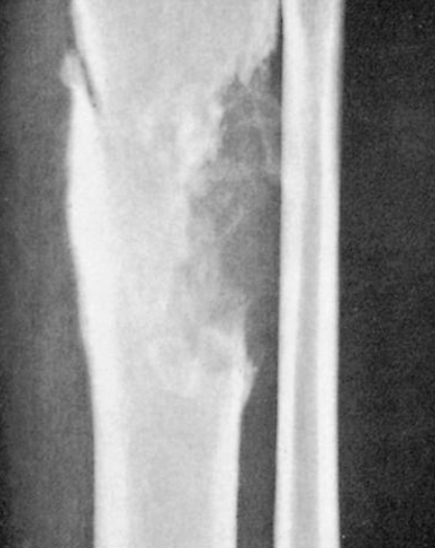
- Destruction of the cortex
- Soft tissue mass
- No cartilage matrix
- No osteoid production
- Atypical mitotic activity
- Necrosis
- Pathological fractures
References
Bădilă, A.E., Rădulescu, D.M., Niculescu, A.-G., Grumezescu, A.M., Rădulescu, M. and Rădulescu, A.R. (2021). Recent Advances in the Treatment of Bone Metastases and Primary Bone Tumors: An Up-to-Date Review. Cancers, [online] 13(16), p.4229. Doi: https://doi.org/10.3390/cancers13164229.
Biermann, J.S., Hirbe, A., Ahlawat, S., Bernthal, N.M., Binitie, O., Boles, S., Brigman, B., Callan, A.K., Cipriano, C., Cranmer, L.D., Davis, J., Donnelly, E., Ferguson, M., Graham, A., Groundland, J., Hess, M., Hiniker, S.M., Hoover-Regan, M.L., Hornick, J.L. and Jonard, B. (2025). Bone Cancer, Version 2.2025, NCCN Clinical Practice Guidelines in Oncology. Journal of the National Comprehensive Cancer Network, [online] 23(4). does: https://doi.org/10.6004/jnccn.2025.0017.
Cancer Research UK (2025a) Types of bone cancer. Available at: https://www.cancerresearchuk.org/about-cancer/bone-cancer/types (Accessed 3rd April 2026)
Cowan, P., Launico, M. and Kahai, P. (2024) Anatomy, Bones. Available at: https://www.ncbi.nlm.nih.gov/books/NBK537199/ (Accessed: 9th April 2026)
Gerrand, C., Amary, F., Anwar, H.A., Brennan, B., Dileo, P., Kalkat, M.S., McCabe, M.G., McCullough, A.L., Parry, M.C., Patel, A., Seddon, B.M., Sherriff, J.M., Tirabosco, R. and Strauss, S.J. (2024). UK guidelines for the management of bone sarcomas. British Journal of Cancer. doi:https://doi.org/10.1038/s41416-024-02868-4.
Hosseini, H., Heydari, S., Kiavash Hushmandi, Salman Daneshi and Rasoul Raesi (2025). Bone tumors: a systematic review of prevalence, risk determinants, and survival patterns. BMC Cancer, 25(1). doi:https://doi.org/10.1186/s12885-025-13720-0.
Orthobullets (2026) Undifferentiated Pleomorphic Sarcoma. Available at: https://www.orthobullets.com/pathology/8064/undifferentiated-pleomorphic-sarcoma (Accessed: 22nd July 2026)
Piazza, Y. and Kaseb, H. (2026) Bone & joints Other tumors of bone Undifferentiated pleomorphic sarcoma. Available at: https://www.pathologyoutlines.com/topic/boneMFH.html (Accessed: 26th April 2026)
Pullan, J.E., and Lotfollahzadeh, S. (2024) Primary Bone Cancer Available at: https://www.ncbi.nlm.nih.gov/books/NBK560830/ (Accessed: 9th April 2026)
WHO Editorial Board. WHO classification of bone tumours. In WHO Classification of Tumours Editorial Board. Soft tissue and bone tumours. Bovee J, Flanagan AM, Lazar AJ, Nielsen GP and Yoshida A (eds) pp 338. International Agency for Research on Cancer (2020)
Updated July 2026 Next Review July 2028


Leave a comment